The Day Our Client Almost Paid Too Much for a Gantry Crane
We remember a specific instance where a client of ours, a mid-sized manufacturing firm, was on the verge of significantly overpaying for a gantry crane. They were initially swayed by a vendor offering a seemingly low price, but closer inspection revealed hidden costs and substandard materials. This situation underscores why understanding the intricacies of gantry crane costs is crucial.
The purpose of this article is to arm you with the knowledge needed to navigate the complex world of gantry crane purchases. We want to help you avoid costly mistakes, ensuring your projects are not only successful but also economically sound. We’ll explore everything from base prices to hidden fees, empowering you to make informed decisions.
What Exactly Is a Gantry Crane, and Why Does It Matter?
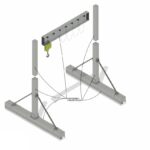
A gantry crane is a type of overhead crane distinguished by its supporting legs. These legs travel on wheels or rails, allowing the entire structure to move, providing lifting capabilities across a defined area. They are specifically designed for lifting and moving heavy materials, playing a crucial role in streamlining operations across a variety of industries.
Gantry cranes find applications in numerous sectors. In manufacturing, they’re used to move heavy components and finished products. Construction sites utilize them for lifting and positioning materials. Ports rely on gantry cranes to load and unload cargo from ships.
Gantry cranes differ from overhead cranes primarily in their support structure. Overhead cranes are typically suspended from a building’s structure, while gantry cranes are self-supporting. This self-supporting nature makes gantry cranes particularly useful in spaces where an existing overhead support structure is absent or inadequate. A key benefit of gantry cranes is their portability, especially with models designed for easy relocation. There are various types, including portable gantry cranes, adjustable gantry crane price variations, and full gantry cranes tailored to specific operational needs.
Understanding gantry cranes is essential because they drastically improve efficiency, safety, and overall productivity. They enable the swift and secure movement of heavy loads, reducing manual labor and minimizing the risk of accidents. By implementing gantry crane solutions, businesses can optimize workflows and boost their bottom line.
The Base Price: More Than Just Steel and Motors
The base price of a gantry crane represents the foundational cost elements. It’s more than just the cost of steel and motors; it encompasses a complex interplay of factors. These include the raw materials required, the manufacturing processes involved, and the engineering and design expertise that goes into creating a safe and reliable lifting solution.
Raw materials, particularly steel, constitute a significant portion of the base price. Steel prices fluctuate based on market conditions, impacting the overall overhead crane costs. The manufacturing processes, such as welding, fabrication, and assembly, contribute substantially to the initial cost. Each step requires skilled labor and specialized equipment. Finally, the engineering and design costs reflect the intellectual effort involved in creating a crane that meets specific load requirements and safety standards.
These factors collectively determine the initial price tag. Ignoring any of them can lead to inaccurate budgeting and unexpected expenses down the line. We’ve seen clients underestimate the impact of fluctuating steel prices, resulting in budget overruns.
Understanding material quality is essential for assessing long-term value. Investing in higher-grade steel and robust components may increase the upfront cost but can significantly extend the crane’s lifespan and reduce maintenance requirements. We believe that prioritizing quality over initial cost savings ultimately translates to a better return on investment.
Capacity Counts: How Lifting Power Impacts Your Wallet
The lifting capacity of a gantry crane is a crucial determinant of its price. Higher capacity cranes require stronger materials and more robust engineering, which naturally translates to increased overhead crane costs. The capacity dictates the size and strength of the structural components, motors, and lifting mechanisms.
A direct relationship exists between capacity and crane size. A crane designed to lift 10 tons will necessarily be smaller and less expensive than one engineered to lift 50 tons. The increased material and manufacturing costs associated with higher capacity cranes are substantial.
“Over-specifying” capacity can lead to unnecessary expenses. Purchasing a crane with a lifting capacity far exceeding your actual needs results in paying for capabilities you will never use. It’s essential to accurately assess your lifting requirements to optimize cost-efficiency.
To accurately assess your lifting needs, start by analyzing the heaviest loads you’ll be lifting regularly. Consider potential future needs, but avoid overestimating. A slightly larger crane is better than one that’s too small, but excessive capacity simply wastes money. By carefully evaluating your needs, you can ensure you’re getting the right crane at the right price. We often advise our clients to conduct a thorough assessment of their lifting requirements before soliciting quotes.
Span and Height: Size Does Matter (to Your Budget)
The crane’s span (the distance between its legs) and height significantly impact its overall cost. Longer spans require more structural support and specialized designs to maintain stability and prevent deflection. Higher cranes necessitate more powerful lifting mechanisms and robust support structures to ensure safe and efficient operation.
Longer spans directly increase material costs. More steel is required to construct the supporting beams, and the engineering becomes more complex. Specialized designs may be needed to mitigate the effects of wind and other environmental factors.
Similarly, taller cranes demand more powerful lifting mechanisms and stronger support structures. The increased height also necessitates more sophisticated safety features, such as anti-sway systems, to prevent loads from swinging uncontrollably. All of these factors contribute to higher adjustable gantry crane price points.
Site-specific dimensions play a crucial role in determining the overall cost. If a crane needs to fit within a confined space or operate around existing infrastructure, customization may be required, adding to the expense. We’ve encountered situations where clients had to modify their facilities to accommodate a standard-sized crane, incurring significant additional costs.
Consider a case where a client needed a gantry crane to operate inside a building with low ceilings. A standard crane would have been too tall, so we worked with them to design a low-headroom crane that met their lifting needs without requiring costly modifications to the building’s structure. This demonstrates how adapting the crane design to fit existing infrastructure can result in significant cost savings.
Automation: The Smart Choice… If It Fits
Automation in gantry cranes refers to the integration of technology to streamline operations and reduce manual labor. Different levels of automation are available, ranging from simple remote control operation to fully automated positioning and lifting systems integrated with warehouse management systems. The level of automation significantly impacts the overall crane price factors.
Remote control operation is a basic level of automation that allows operators to control the crane from a safe distance. Automated positioning and lifting systems use sensors and software to precisely position and lift loads, reducing the need for manual adjustments. Integration with warehouse management systems enables seamless coordination between the crane and other warehouse operations, such as inventory management and order fulfillment.
A cost-benefit analysis is essential when considering automation. While automation can increase efficiency and reduce labor costs, it also requires a higher upfront investment. The key is to determine whether the long-term benefits of automation outweigh the initial expenses. For some operations, the increased throughput and reduced error rates justify the investment. For others, the cost may be prohibitive.
Automated gantry cranes are particularly well-suited for high-volume operations and repetitive lifting tasks. Warehouses, manufacturing plants, and ports that handle a large number of similar items can benefit significantly from automation. The ability to automatically position and lift loads reduces cycle times and minimizes the risk of errors. However, for operations with low volumes or highly variable lifting tasks, the benefits of automation may be less pronounced.
Installation Costs: Don’t Forget the Fine Print!
Installation costs are often overlooked when budgeting for a gantry crane. These costs can be substantial, and failing to account for them can lead to significant budget overruns. Crane installation cost factors include site preparation, crane assembly and erection, and electrical work and safety inspections.
Site preparation may involve clearing the area, leveling the ground, and installing foundations or rails for the crane to travel on. Crane assembly and erection require specialized equipment and skilled labor. Electrical work is necessary to connect the crane to the power supply and ensure proper operation of the controls. Safety inspections are essential to verify that the crane has been installed correctly and meets all relevant safety standards.
Professional installation is crucial to ensure safety and performance. Improper installation can lead to accidents, equipment damage, and costly repairs. Hiring experienced and qualified technicians is essential to avoid these risks. We’ve seen instances where clients attempted to install cranes themselves, resulting in significant damage and delays.
Hidden costs to watch out for include permits, inspections, and potential site modifications. Obtaining the necessary permits can be a time-consuming and expensive process. Inspections are required to ensure compliance with safety regulations. Site modifications may be necessary to accommodate the crane’s size and weight. These costs can quickly add up, so it’s important to factor them into your budget.
Location, Location, Location: How Geography Affects the Bottom Line
Geographic location significantly impacts gantry crane costs. Shipping and transportation expenses, regional labor rates, and import duties and taxes all contribute to variations in price. Understanding how location affects the bottom line is crucial for accurate budgeting and cost control.
Shipping and transportation expenses depend on the distance between the manufacturing facility and the installation site. The farther the distance, the higher the transportation costs. Regional labor rates for installation and maintenance vary depending on the local market. Areas with higher labor costs will naturally result in higher overhead crane costs. Import duties and taxes can add significantly to the cost of cranes sourced from overseas.
Our global presence helps mitigate location-related cost fluctuations. For example, our team in Dubai can often source specific components more efficiently due to established relationships with regional suppliers, ultimately benefiting the client. We leverage our international network to optimize sourcing and logistics, reducing costs for our customers.
Local regulations and compliance requirements also play a role. Different regions have different safety standards and permitting processes. Compliance with these regulations can add to the overall cost, but it’s essential to ensure safety and avoid legal issues. We have extensive experience navigating local regulations in various regions, helping our clients ensure compliance and avoid costly penalties.
The “Extras”: Customization and Add-ons
Customization options enhance functionality but also increase costs. Adding specialized lifting attachments, custom paint colors, and weatherproofing can tailor a crane to specific needs. It’s important to carefully consider the balance between enhanced functionality and the additional expense.
Specialized lifting attachments, such as grapples, magnets, and slings, can significantly improve the crane’s ability to handle specific types of loads. Custom paint colors and finishes can enhance the crane’s appearance and protect it from corrosion. Weatherproofing is essential for outdoor use, protecting the crane from the elements and extending its lifespan.
These add-ons can substantially increase costs. Each customization requires additional materials, labor, and engineering. The more complex the customization, the higher the cost. Prioritizing essential customizations based on specific operational needs is essential for cost control.
To prioritize essential customizations, carefully analyze your lifting tasks and identify the features that will provide the most significant benefit. Avoid adding features simply because they are available. Focus on the customizations that will improve efficiency, safety, and productivity. By prioritizing essential customizations, you can maximize the value of your investment.
Common Misconceptions: Debunking the Myths About Crane Costs
Several misconceptions surround gantry crane costs, leading to poor decision-making. Let’s debunk some common myths:
Myth 1: “All gantry cranes are the same price for the same capacity.” This is incorrect because brand reputation, manufacturing quality, and included features all play a role. A crane from a reputable manufacturer with high-quality components and advanced features will generally cost more than a generic crane with basic features.
Myth 2: “Installation is easy; I can do it myself.” Attempting to install a gantry crane without proper training and equipment is extremely dangerous. Improper installation can lead to accidents, equipment damage, and costly repairs. It’s always best to hire a qualified professional for installation.
Myth 3: “The cheapest crane is always the best option.” Opting for the cheapest crane may seem like a good way to save money upfront, but it can lead to higher long-term costs. Cheaper cranes often have lower-quality components, requiring more frequent maintenance and repairs. They may also be less reliable, leading to downtime and lost productivity.
Real-World ROI: Why Investing in Quality Pays Off
Investing in a high-quality gantry crane offers a substantial return on investment (ROI). Data consistently demonstrates that quality cranes lead to reduced downtime, increased efficiency, improved safety, and reduced accident rates. These benefits translate to significant cost savings and improved profitability over the crane’s lifespan.
Reduced downtime is a major benefit of investing in quality. High-quality cranes are built to withstand the rigors of daily use, minimizing the risk of breakdowns and repairs. Increased efficiency and productivity result from the crane’s ability to operate smoothly and reliably. Improved safety and reduced accident rates protect workers and reduce the risk of liability claims.
Long-term cost savings are associated with durable and reliable equipment. While the initial cost of a high-quality crane may be higher, the long-term savings in maintenance, repairs, and downtime more than offset the initial investment. A client once asked us about this, questioning whether a higher initial investment was truly worth it. We showed them how applying a higher-quality, more robust crane led to a measurable lift in their KPIs, exceeding their expectations and proving the long-term value.
“The bitterness of poor quality remains long after the sweetness of low price is forgotten.” – Benjamin Franklin
Making the Right Choice: A Checklist for Smart Buyers
To guide you through the gantry crane purchasing process, here’s a checklist for smart buyers:
- ✅ Define your lifting needs and capacity requirements.
- ✅ Obtain quotes from multiple reputable suppliers to understand crane price factors.
- ✅ Carefully review all specifications and included features.
- ✅ Factor in installation, crane maintenance cost, and operating costs.
- ✅ Prioritize safety and compliance with relevant regulations.
Conclusion: Secure Your Future with the Right Gantry Crane
Understanding the factors that influence gantry crane costs is vital for making informed decisions and maximizing your return on investment. We’ve explored the base price, capacity, span, height, automation, installation, location, customization, and common misconceptions surrounding crane costs.
Making informed decisions about gantry crane purchases is essential for improving safety, efficiency, and profitability. We, at Safe and Secure Trading Company, are committed to providing high-quality gantry crane solutions tailored to your specific needs.
By understanding these cost factors, you can secure your future with the right gantry crane, leading to improved operations and a stronger bottom line.
FAQ Section
Q: What is the typical lifespan of a gantry crane?
A: The lifespan of a gantry crane can vary depending on several factors, including the quality of construction, the frequency of use, and the level of maintenance. Generally, a well-maintained gantry crane can last for 20 to 30 years or even longer. Regular inspections, lubrication, and timely repairs are essential to extending the crane’s lifespan.
Q: How often should a gantry crane be inspected?
A: The frequency of gantry crane inspections depends on the intensity of use and the operating environment. At a minimum, gantry cranes should be inspected annually by a qualified professional. However, cranes that are used frequently or operate in harsh environments may require more frequent inspections. Daily pre-shift inspections by the operator are also recommended to identify any obvious issues.
Q: What are the common maintenance tasks for gantry cranes?
A: Common maintenance tasks for gantry cranes include:
- Lubrication of moving parts
- Inspection of cables, chains, and hooks
- Tightening of bolts and fasteners
- Inspection of electrical components
- Checking for signs of wear or damage
- Testing of safety devices
Regular maintenance is essential to ensure the safe and reliable operation of the crane.
Q: Can I modify a gantry crane after it has been installed?
A: Modifying a gantry crane after installation is possible, but it’s crucial to consult with a qualified engineer to ensure that the modifications are safe and compliant with relevant regulations. Modifications can affect the crane’s structural integrity and lifting capacity, so it’s important to proceed with caution.
Q: What safety features should a gantry crane have?
A: Gantry cranes should have several safety features, including:
- Overload protection: Prevents the crane from lifting loads exceeding its capacity.
- Limit switches: Prevent the hoist from traveling too far in either direction.
- Emergency stop buttons: Allow operators to quickly stop the crane in case of an emergency.
- Warning devices: Alert workers to the crane’s presence and movements.
- Anti-collision systems: Prevent collisions between cranes operating in the same area.
Prioritizing safety is essential to prevent accidents and injuries.
Q: How does crane automation affect safety?
A: Crane automation can enhance safety by reducing the need for manual operation and minimizing the risk of human error. Automated systems can precisely control crane movements, preventing collisions and ensuring that loads are lifted and positioned safely. However, it’s important to implement proper safety protocols and training to ensure that automated cranes are operated safely.
Q: What is the typical crane installation cost as a percentage of the crane price?
A: Crane installation cost can vary widely depending on the complexity of the installation, the site conditions, and the location. As a general guideline, installation costs can range from 10% to 50% of the crane’s purchase price. However, more complex installations may exceed this range.
Q: How do I estimate the total cost of owning a gantry crane over its lifespan?
A: Estimating the total cost of owning a gantry crane requires considering several factors, including:
- Purchase price
- Installation costs
- Maintenance costs
- Operating costs (electricity, fuel)
- Repair costs
- Downtime costs
- Depreciation
By factoring in all of these costs, you can get a more accurate picture of the total cost of ownership and make informed decisions about your investment.
Q: What is the impact of crane span on stability?
A: The crane span significantly impacts stability. Longer spans require more robust structural designs to prevent bending or twisting under load. Engineers must carefully calculate the required material thickness and support structures to ensure the crane remains stable and safe. Wider spans may also increase the risk of swaying or instability, requiring additional stabilization features.
Q: How does Safe and Secure Trading Company (SSTC) ensure the quality of its gantry cranes?
A: We, at Safe and Secure Trading Company, ensure the quality of our gantry cranes through a rigorous quality control process that begins with the selection of high-quality materials and continues through every stage of manufacturing. We adhere to strict industry standards and regulations. Each crane undergoes thorough testing and inspection before it leaves our facility to ensure that it meets our high standards for safety and performance. We also provide comprehensive training and support to our customers to ensure that they can operate and maintain their cranes safely and effectively.