Gantry vs Overhead: An Industrial Showdown
I remember visiting a client’s facility in Riyadh a few 2026 ago. They were in the middle of expanding their operations and were completely stuck on which crane to choose: a gantry or an overhead crane. The initial confusion they faced is common. Many businesses struggle to understand the nuances between these two crucial pieces of material handling equipment.
Which crane truly reigns supreme in the world of industrial lifting? It’s a question we at Safe and Secure Trading Company (SSTC) are often asked. We specialize in providing expert advice and comprehensive material handling solutions to businesses across the region, and this decision requires careful consideration of various factors.
Understanding the Contenders: Gantry Cranes Defined
So, what exactly is a gantry crane? A gantry crane is a freestanding crane characterized by its A-frame or similar support structures. Unlike overhead cranes, gantry cranes don’t rely on a building’s support system. They stand on their own, offering remarkable flexibility.
The defining feature of a gantry crane is its mobility. These cranes can move along a fixed path or even be portable, allowing for lifting operations in diverse locations. This makes them ideal for environments where flexibility is paramount.
Types of Gantry Cranes
There are several types of gantry cranes, each designed for specific applications.
- Full Gantry Cranes: These cranes are supported on wheels or rails at ground level, spanning an entire area. They offer complete mobility within their designated path.
- Semi-Gantry Cranes: A semi-gantry crane has one side supported on the ground via wheels or rails, while the other side is supported by the building structure. This provides a balance between mobility and structural support.
- Portable Gantry Cranes: These lightweight gantry cranes are designed for easy movement and temporary use. They are ideal for maintenance tasks or short-term lifting needs in various locations.
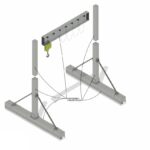
[IMAGE: A detailed illustration of a full gantry crane in operation]
Understanding the Contenders: Overhead Cranes Defined
What about overhead cranes, sometimes called bridge cranes? An overhead crane, also known as a bridge crane, is a fixed structure mounted to a building’s support system. Instead of standing independently, it relies on the building’s framework for stability.
Overhead cranes are well-suited for heavy-duty, repetitive tasks. They are a permanent fixture in a facility and provide consistent lifting power within their designated area. This makes them ideal for manufacturing plants and warehouses.
Types of Overhead Cranes
Just like gantry cranes, overhead cranes come in different types to suit various needs.
- Single Girder Overhead Cranes: These cranes feature a simpler design and are typically used for lighter loads. They are a cost-effective solution for many lifting applications.
- Double Girder Overhead Cranes: Double girder overhead cranes are more robust and offer a higher load capacity. They are designed for heavy-duty lifting and continuous operation.
- Underhung Overhead Cranes: Underhung overhead cranes are suspended from the roof structure of a building. This configuration maximizes floor space and is often used in facilities with limited headroom.
[IMAGE: A clear diagram showing a double girder overhead crane system]
The Core Differences: A Head-to-Head Comparison
The gantry vs overhead crane decision hinges on several key differences. Let’s dive into a detailed comparison.
Structure and Support
Gantry cranes are freestanding structures, whereas overhead cranes rely on the building’s support. This is a fundamental difference.
This structural difference significantly impacts installation and cost. Gantry cranes often have lower installation costs because they don’t require modifications to the building structure. Overhead cranes, however, need a structurally sound building to support their weight and operation, which can add to the overall expense.
Mobility
Gantry cranes offer mobility, while overhead cranes are fixed in place. This is another critical distinction between the two crane types.
The advantage of mobility in dynamic environments cannot be overstated. Gantry cranes can be moved to different locations within a facility or even outdoors, providing flexibility for various lifting needs. Overhead cranes, being fixed, are limited to their designated area.
Load Capacity
Overhead cranes generally handle heavier loads compared to gantry cranes. This is due to their robust design and support structure.
While gantry cranes can handle significant loads, overhead cranes are often designed for the most demanding lifting tasks. This makes overhead cranes the preferred choice for industries dealing with extremely heavy materials. A typical gantry crane might have a crane capacity of 5-10 tons, while an overhead crane can easily exceed 20 tons or more.
Cost
The initial investment, installation, and maintenance costs differ between gantry and overhead cranes. Gantry cranes often have a lower initial cost because they don’t require building modifications.
However, the long-term costs can vary depending on the specific application. Overhead cranes may have higher maintenance costs due to their complex structure and heavy-duty operation. We have seen instances where clients initially chose gantry cranes to save on upfront costs but then invested significantly more in maintenance due to the increased usage.
Space Requirements
Overhead cranes utilize vertical space more efficiently, while gantry cranes require more floor space. This is an important consideration for facilities with limited space.
Gantry cranes take up valuable floor space due to their support structures. Overhead cranes, on the other hand, are suspended from the ceiling, freeing up floor space for other operations.
When to Choose a Gantry Crane: The Ideal Scenarios
Gantry cranes are ideal for specific scenarios where their unique features provide a distinct advantage.
Temporary Lifting Needs
Portable gantry cranes are perfect for temporary jobs. Their ease of assembly and disassembly makes them ideal for short-term projects or maintenance tasks in various locations. This is a significant advantage for businesses that don’t require permanent lifting solutions.
Outdoor Operations
Gantry cranes are well-suited for shipyards, construction sites, and other outdoor locations. Their ability to operate independently of a building structure makes them ideal for environments where overhead crane installation is impractical. In these settings, the mobility of gantry cranes allows for efficient material handling across large areas.
Limited Building Support
Gantry cranes are a great choice when building structures can’t support an overhead crane. Their freestanding design eliminates the need for structural modifications, saving time and money.
For one client in Jubail, we found that a portable gantry crane was the perfect solution for their temporary pipeline project. The building they were using couldn’t support a permanent overhead crane, and the gantry crane allowed them to efficiently move and position pipe sections.
When to Choose an Overhead Crane: The Ideal Scenarios
Overhead cranes excel in scenarios that demand high performance, heavy lifting, and efficient space utilization.
High-Frequency Lifting
Overhead cranes excel in repetitive lifting tasks. Their robust design and smooth operation make them ideal for continuous production environments. The efficiency of overhead cranes in these scenarios can significantly increase productivity.
Heavy Load Requirements
Overhead cranes handle significantly heavier loads. Their strong support structure allows them to lift and move massive objects with ease. This is essential in industries like steel manufacturing and heavy machinery production.
Optimized Vertical Space
Overhead cranes efficiently utilize vertical space within a facility. By suspending loads from the ceiling, they free up valuable floor space for other operations. This is particularly beneficial in warehouses and manufacturing plants where space is at a premium.
We’ve seen many of our clients here in Dammam benefit from the efficiency of overhead cranes in their steel fabrication plants. The overhead cranes allow them to move heavy steel beams and plates quickly and safely, optimizing their production workflow.
Expert Insight: Weighing the Pros and Cons
Let’s break down the advantages and disadvantages of each crane type.
Gantry Crane Pros and Cons
✅ Mobility: Can be moved to different locations as needed.
✅ Lower initial cost: Typically cheaper to install than overhead cranes.
✅ No building support needed: Can be used in buildings that can’t support an overhead crane.
❌ Lower load capacity: Generally can’t handle as heavy loads as overhead cranes.
❌ Takes up floor space: The support structure occupies valuable floor space.
Overhead Crane Pros and Cons
✅ High load capacity: Can handle extremely heavy loads.
✅ Efficient use of vertical space: Frees up floor space.
✅ Durable: Designed for continuous, heavy-duty operation.
❌ Higher initial cost: More expensive to install due to building modifications.
❌ Requires building support: Needs a structurally sound building.
❌ Fixed location: Can’t be moved easily.
“Choosing between a gantry and overhead crane isn’t just about capacity; it’s about workflow, space, and long-term operational costs. A thorough site assessment is crucial.” – Ahmed Khan, Senior Engineer at Safe and Secure Trading Company*
Real-World Applications: Case Studies
Let’s look at some real-world examples of how gantry and overhead cranes are used.
Gantry Crane Example
A shipyard utilizes a gantry crane to move massive ship sections. The mobility of the gantry crane allows it to operate across the entire shipyard, moving sections from fabrication areas to the dry dock. This outdoor operation is a perfect example of the gantry crane’s versatility.
The benefits of mobility and outdoor operation are clear in this case. The shipyard can efficiently move large ship sections without the need for a permanent, building-supported structure.
Overhead Crane Example
A steel mill uses an overhead crane for continuous production. The crane lifts and moves heavy steel coils and beams throughout the mill, facilitating the manufacturing process. The high load capacity and frequency of operation make the overhead crane an indispensable part of the steel mill.
The advantages of high load capacity and frequency are crucial in this scenario. The overhead crane ensures a smooth and efficient production process, handling the heavy materials with ease.
[IMAGE: A side-by-side comparison image showing both cranes in typical work environments]
Installation and Safety Considerations
Proper installation and adherence to safety regulations are crucial for both gantry and overhead cranes.
Gantry Crane Installation
Proper leveling and ground support are essential for gantry crane installation. The crane must be placed on a stable, level surface to ensure safe operation. Regular inspections of the support structure are also necessary to prevent accidents.
Overhead Crane Installation
Professional structural engineering assessments are needed for overhead crane installation. The building’s support structure must be capable of handling the crane’s weight and the loads it will be lifting. Any modifications to the building structure should be performed by qualified professionals.
Safety Regulations
Compliance with OSHA regulations is mandatory for both crane types. Regular inspections, maintenance, and operator training are crucial for ensuring a safe working environment. Crane safety is paramount.
Training
Proper training is essential for crane operators. Operators must be trained on the safe operation of the crane, including load handling, signaling, and emergency procedures. This training helps prevent accidents and ensures the efficient operation of the crane.
Making the Right Choice for Your Needs
Choosing the right crane requires a careful assessment of your specific needs and requirements.
Assess Your Lifting Requirements
Determine your load capacity, frequency, and space constraints. Consider the weight of the materials you will be lifting, how often you will be lifting them, and the amount of space you have available.
Evaluate Your Budget
Consider the initial cost, installation, and maintenance expenses. Factor in the cost of building modifications, operator training, and ongoing maintenance.
Consult with Experts
Seek advice from experienced material handling professionals. They can help you assess your needs and recommend the best crane for your specific application.
At SSTC, we always recommend a thorough on-site assessment to help our clients make informed decisions. Our team of experts can evaluate your facility, assess your lifting needs, and recommend the most suitable crane solution.
Final Verdict: Which Crane Wins?
The gantry vs overhead crane debate doesn’t have a single winner. The best choice depends entirely on your specific needs.
- For Temporary or Outdoor Needs: The gantry crane is the clear winner due to its mobility and ease of installation.
- For Heavy-Duty, High-Frequency Lifting: The overhead crane provides superior performance and efficiency.
- The Ultimate Choice: Depends on your specific operational needs and constraints.
We’ve provided insight and advice on crane selection for many clients and are confident we can guide you to the right decision, too.
FAQ Section
Q: What is the main difference between a gantry crane and an overhead crane?
A: The main difference lies in their support structure. Gantry cranes are freestanding and mobile, while overhead cranes are fixed and supported by the building structure.
Q: Which crane is cheaper to install, a gantry or an overhead crane?
A: Gantry cranes are typically cheaper to install because they don’t require building modifications.
Q: Which crane can handle heavier loads, a gantry or an overhead crane?
A: Overhead cranes generally handle heavier loads due to their robust design and support structure.
Q: What are some common crane applications for gantry cranes?
A: Common crane applications include shipyards, construction sites, and temporary lifting tasks.
Q: What are some common crane applications for overhead cranes?
A: Common crane applications include manufacturing plants, steel mills, and warehouses with high-frequency lifting needs.
Q: How important is crane safety?
A: Crane safety is extremely important. Proper training, regular inspections, and adherence to safety regulations are crucial for preventing accidents.