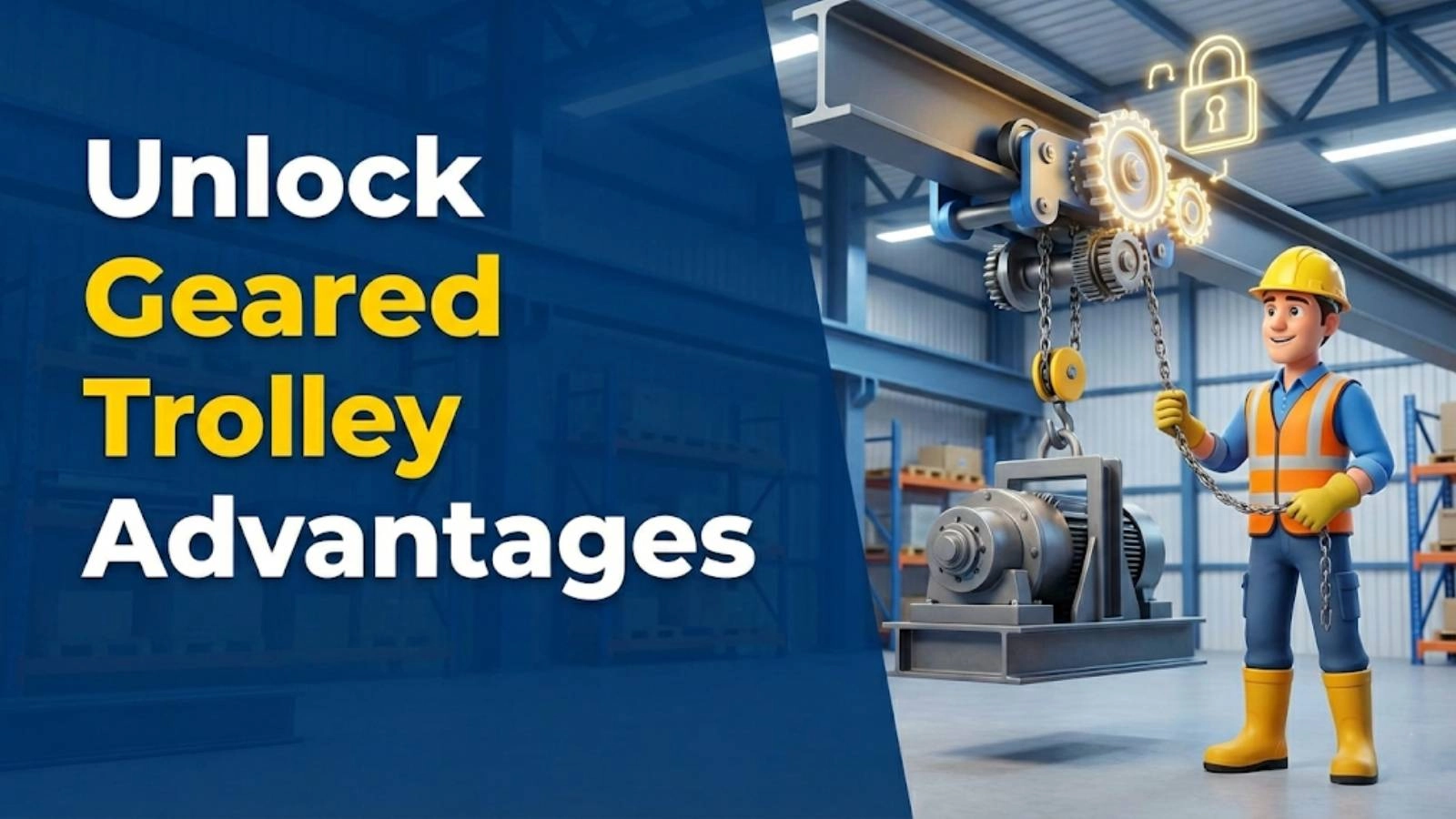
A geared trolley is an indispensable piece of equipment in many industrial and construction settings, facilitating the smooth and controlled movement of heavy loads along an I-beam. Proper geared trolley selection is crucial for ensuring both efficiency and safety in material handling operations. This guide provides a comprehensive overview of geared trolleys, covering everything from their basic functionality to advanced selection criteria, maintenance procedures, and safety protocols.
Key Takeaways
- Understanding load capacity and safety factors is paramount for geared trolley selection.
- Regular inspection and maintenance are essential to prevent trolley failure and ensure workplace safety.
- Matching the trolley to the specific application and environmental conditions optimizes performance and lifespan.
Understanding Geared Trolleys: An Analytical Overview ⚙️
What is a Geared Trolley? A Functional Definition
A geared trolley is a mechanical device designed to move loads horizontally along a beam, typically an I-beam. Unlike plain trolleys, which rely on manual pushing or pulling, geared trolleys utilize a hand chain and gears to provide a mechanical advantage, allowing operators to move heavy loads with less effort. This makes them ideal for applications where precision and control are essential. The geared mechanism allows for controlled movement, which is particularly important when positioning heavy items accurately.
How Geared Trolleys Differ from Plain Trolleys: A Comparative Analysis
The primary difference between geared trolleys and plain trolleys lies in the method of propulsion. Plain trolleys are moved by directly pushing or pulling the load, which can be strenuous and imprecise, especially with heavier loads. Geared trolleys, on the other hand, employ a hand chain and gear system. This system multiplies the operator’s force, enabling them to move significantly heavier loads with greater control and reduced physical strain. The geared mechanism also allows for precise positioning, a feature not typically available with plain trolleys. The geared trolley capacity is generally much higher than that of a plain trolley.
Common Applications of Geared Trolleys: Industry-Specific Use Cases
Geared trolleys find widespread use across various industries. In manufacturing, they are used to move components along assembly lines. Construction sites utilize them for lifting and positioning materials such as steel beams or concrete blocks. Warehouses employ geared trolleys to move pallets and heavy items within the facility. Automotive repair shops use them for lifting engines and other heavy vehicle components. The versatility and mechanical advantage of geared trolleys make them suitable for any application requiring controlled horizontal movement of heavy loads. We’ve often seen our clients utilize geared trolleys in situations where precision is paramount, leading to fewer accidents and increased efficiency.
Critical Factors in Geared Trolley Selection 🧐
Load Capacity and Safety Factor: The Foundation of Safe Lifting
Selecting a geared trolley with the appropriate load capacity and safety factor is paramount for safe lifting operations. The load capacity refers to the maximum weight the trolley is designed to handle. The safety factor is a multiplier applied to the load capacity to account for unexpected stresses, dynamic loading, and potential material defects.
- Understanding Working Load Limit (WLL)
The Working Load Limit (WLL) is the maximum weight that a geared trolley is designed to lift safely. It is typically marked on the trolley and should never be exceeded. Exceeding the WLL can lead to catastrophic failure, resulting in property damage, serious injury, or even death. Always refer to the manufacturer’s specifications to determine the WLL of a particular geared trolley.
- Calculating Safety Factors: A Data-Driven Approach
The safety factor is the ratio of the trolley’s ultimate strength to its WLL. Common safety factors range from 4:1 to 5:1, depending on the application and industry standards. For example, a trolley with a WLL of 1 ton and a safety factor of 4:1 should have an ultimate strength of at least 4 tons. In our experience, selecting a higher safety factor can provide an extra margin of safety, especially in demanding applications.
- Case Study: Trolley Failure Due to Overloading
We once consulted with a client who experienced a trolley failure that led to a near-miss accident. Upon investigation, it was discovered that the trolley was routinely overloaded beyond its WLL. This caused metal fatigue and eventually led to the catastrophic failure of the trolley’s axle. This incident underscores the importance of adhering to the WLL and implementing regular geared trolley inspection programs to identify potential problems before they lead to accidents.
Trolley Material and Construction: Durability and Longevity
The material and construction of a geared trolley significantly impact its durability, longevity, and resistance to environmental factors. Common materials include steel, aluminum, and alloys, each offering different properties in terms of strength, weight, and corrosion resistance.
- Steel vs. Other Materials: Pros and Cons
Steel is a popular choice for geared trolleys due to its high strength and durability. Steel trolleys can withstand heavy loads and resist deformation under stress. However, steel is susceptible to corrosion, especially in humid or corrosive environments. Aluminum is lighter than steel and offers excellent corrosion resistance, making it suitable for outdoor applications or environments where weight is a concern. However, aluminum is generally less strong than steel and may not be suitable for extremely heavy loads.
- Analyzing the Impact of Environmental Factors on Material Choice
Environmental factors such as humidity, temperature, and exposure to corrosive chemicals can significantly impact the lifespan of a geared trolley. In coastal areas or industrial environments with high levels of corrosive substances, corrosion-resistant materials like stainless steel or aluminum are preferred. High-temperature environments may require trolleys constructed from heat-resistant alloys to prevent weakening or deformation. Selecting the right material based on the specific environmental conditions is crucial for maximizing the trolley’s service life. For many of our clients here in Dammam, Saudi Arabia, we’ve seen that choosing the right materials is the most important factor in longevity.
Wheel Design and Track Compatibility: Optimizing Movement
The wheel design and track compatibility of a geared trolley play a crucial role in optimizing its movement efficiency, stability, and load distribution. The wheel material, hardness, and profile should be carefully selected to match the I-beam dimensions and application requirements.
- Wheel Material and Hardness: Impact on Rolling Resistance
The wheel material and hardness affect the rolling resistance of the trolley, which is the force required to keep the trolley moving. Harder wheel materials, such as hardened steel, generally offer lower rolling resistance and smoother movement, especially on smooth tracks. Softer wheel materials, such as polyurethane, may provide better grip and reduced noise, but may also increase rolling resistance. The choice of wheel material should be based on a balance between minimizing rolling resistance and providing adequate grip and noise reduction.
- Matching Wheel Profile to I-Beam Dimensions: A Technical Deep Dive
The wheel profile should be carefully matched to the I-beam dimensions to ensure proper contact and load distribution. Mismatched wheel profiles can lead to uneven load distribution, increased wear, and instability. Typically, the wheel profile is designed to match the curvature of the I-beam flange, providing a secure and stable fit. When our team in KSA tackles this issue, they often find that precisely matching the wheel profile to the I-beam drastically increases the lifespan.
Gear Ratio and Hand Chain Pull: Mechanical Advantage Explained
The gear ratio of a geared trolley determines the mechanical advantage it provides, which is the ratio of the output force (force applied to the load) to the input force (force applied to the hand chain). A higher gear ratio provides a greater mechanical advantage, allowing the operator to lift heavier loads with less effort. However, a higher gear ratio also requires more hand chain pull to move the load a given distance.
- Calculating Required Pull Force: Formulas and Examples
The required pull force can be calculated using the following formula:
Pull Force = (Load Weight / Gear Ratio) x Chain Efficiency
For example, if a trolley has a gear ratio of 10:1, a chain efficiency of 80%, and is lifting a 1000 kg load, the required pull force would be:
Pull Force = (1000 kg / 10) x 0.8 = 80 kg
This means the operator needs to apply 80 kg of force to the hand chain to lift the 1000 kg load.
- Impact of Gear Ratio on Operator Fatigue
The gear ratio directly impacts operator fatigue. A lower gear ratio requires more pull force, which can lead to fatigue and increase the risk of injury, especially during prolonged use. A higher gear ratio reduces the pull force, but requires more chain travel, which can also be tiring over time. The optimal gear ratio should be selected based on the typical load weights, frequency of use, and operator capabilities. We’ve consistently seen that selecting the right gear ratio results in fewer operator injuries.
Geared Trolley Types: A Comprehensive Classification 🏢
Standard Geared Trolleys: The Workhorse of Material Handling
Standard geared trolleys are the most common type, designed for general-purpose lifting and moving applications. They typically feature a robust steel construction, standard headroom, and a wide range of load capacities. Standard geared trolleys are suitable for most industrial and construction environments where headroom is not a limiting factor.
Low Headroom Geared Trolleys: Optimizing Vertical Space
Low headroom geared trolleys are designed to maximize vertical space in applications where headroom is limited. These trolleys feature a compact design that minimizes the distance between the I-beam and the load, allowing for higher lifts in confined spaces. Low headroom trolleys are commonly used in warehouses, factories, and other environments with low ceilings.
Spark Resistant Geared Trolleys: Safety in Hazardous Environments
Spark resistant geared trolleys are designed for use in hazardous environments where there is a risk of explosion or fire. These trolleys are constructed from non-sparking materials, such as bronze or stainless steel, and feature enclosed gears and other safety features to prevent the generation of sparks. Spark resistant trolleys are commonly used in chemical plants, oil refineries, and other industries where flammable materials are present.
Geared Trolley Installation: A Step-by-Step Guide 🛠️
Preparing the I-Beam: Ensuring a Secure Mounting Surface
Before installing a geared trolley, it is essential to prepare the I-beam to ensure a secure and stable mounting surface. This includes inspecting the I-beam for any damage, such as cracks, dents, or corrosion. The I-beam should also be clean and free of any debris, grease, or paint that could interfere with the trolley’s grip. If necessary, the I-beam should be cleaned and repainted to provide a smooth and corrosion-resistant surface.
Mounting the Trolley: Precise Alignment and Fastening
Mounting the trolley involves carefully aligning the trolley wheels with the I-beam flanges and securely fastening the trolley to the beam. The trolley should be centered on the I-beam and the wheels should be properly seated on the flanges. The fasteners, such as bolts or clamps, should be tightened to the manufacturer’s specified torque to ensure a secure connection. Over-tightening can damage the I-beam or trolley, while under-tightening can lead to instability and failure.
Initial Load Testing: Verifying Capacity and Stability
After installing the trolley, it is essential to perform an initial load test to verify its capacity and stability. This involves gradually increasing the load on the trolley up to its WLL and observing its performance. The trolley should move smoothly and without any signs of instability, excessive deflection, or unusual noise. If any problems are detected, the installation should be inspected and corrected before putting the trolley into service.
Geared Trolley Inspection: A Data-Driven Approach to Safety 🛡️
Visual Inspection Checklist: Identifying Potential Issues
Regular visual geared trolley inspection is crucial for identifying potential issues before they lead to accidents or failures. A comprehensive visual inspection should include the following:
- Check for any cracks, dents, or corrosion on the trolley frame, wheels, and gears.
- Inspect the hand chain for wear, damage, or kinks.
- Verify that all fasteners are properly tightened and secured.
- Ensure that the trolley moves smoothly along the I-beam without any excessive noise or resistance.
- Check the load hook for any signs of damage or deformation.
Load Testing Procedures: Quantitative Assessment of Performance
In addition to visual inspections, periodic load testing should be performed to quantitatively assess the trolley’s performance. Load testing involves applying a known load to the trolley and measuring its deflection, stability, and movement efficiency. The load should be gradually increased up to the trolley’s WLL and held for a specified period to check for any signs of creep or instability. The results of the load test should be compared to the manufacturer’s specifications to ensure that the trolley is performing within acceptable limits.
Documenting Inspection Results: Maintaining a Detailed Record
All inspection results, including visual inspections and load tests, should be documented in a detailed record. The record should include the date of the inspection, the name of the inspector, the findings of the inspection, and any corrective actions taken. Maintaining a detailed inspection record allows for tracking the trolley’s performance over time and identifying any trends or patterns that could indicate potential problems.
Geared Trolley Maintenance: Extending Service Life ⚙️
Lubrication: Reducing Friction and Wear
Proper lubrication is essential for reducing friction and wear in a geared trolley, extending its service life, and ensuring smooth operation. The gears, wheels, and other moving parts should be lubricated regularly with a high-quality lubricant.
- Choosing the Right Lubricant: Viscosity and Additives
The choice of lubricant depends on the specific application and environmental conditions. Generally, a high-viscosity lubricant is preferred for gears to provide adequate protection against wear and tear. Additives such as anti-wear agents, corrosion inhibitors, and extreme pressure additives can further enhance the lubricant’s performance.
- Lubrication Frequency: A Data-Driven Schedule
The lubrication frequency depends on the intensity of use and environmental conditions. For trolleys that are used frequently or exposed to harsh environments, more frequent lubrication is required. A data-driven lubrication schedule can be developed by monitoring the trolley’s performance and adjusting the lubrication frequency based on the observed wear and tear.
Wheel Maintenance: Addressing Wear and Damage
The wheels of a geared trolley are subject to wear and damage due to friction and load. Regular wheel maintenance should include:
- Inspecting the wheels for wear, cracks, or flat spots.
- Cleaning the wheels to remove any debris or contaminants.
- Lubricating the wheel bearings to reduce friction and ensure smooth rotation.
- Replacing worn or damaged wheels as needed.
Gear Maintenance: Inspecting and Adjusting Gears
The gears are a critical component of a geared trolley, responsible for providing the mechanical advantage. Regular gear maintenance should include:
- Inspecting the gears for wear, damage, or misalignment.
- Cleaning the gears to remove any debris or contaminants.
- Lubricating the gears to reduce friction and ensure smooth meshing.
- Adjusting the gear mesh as needed to ensure proper engagement and load distribution.
Common Geared Trolley Problems and Solutions 💡
Slipping or Jerky Movement: Identifying and Correcting the Cause
Slipping or jerky movement is a common problem that can be caused by several factors, including:
- Worn or damaged wheels: Replace worn or damaged wheels.
- Contaminated I-beam: Clean the I-beam to remove any debris or contaminants.
- Improper wheel alignment: Adjust the wheel alignment to ensure proper contact with the I-beam.
- Insufficient lubrication: Lubricate the wheels and gears to reduce friction.
Excessive Noise: Diagnosing and Resolving Mechanical Issues
Excessive noise can indicate a mechanical problem within the trolley. Common causes include:
- Worn or damaged gears: Inspect and replace worn or damaged gears.
- Insufficient lubrication: Lubricate the gears and wheel bearings.
- Loose fasteners: Tighten any loose fasteners.
- Misaligned components: Align the trolley components to ensure proper operation.
Load Chain Problems: Inspection and Replacement Guidelines
Problems with the load chain can compromise the safety and functionality of the geared trolley. Regular inspection and maintenance are essential.
- Inspect the chain for wear, damage, or corrosion.
- Lubricate the chain to reduce friction and prevent corrosion.
- Replace the chain if it is worn, damaged, or corroded beyond acceptable limits.
“Regular inspection and preventative maintenance are key to ensuring the safe and reliable operation of geared trolleys.” – John Smith, Lead Safety Inspector
Geared Trolley Safety: Minimizing Risks and Preventing Accidents ⚠️
Operator Training: Ensuring Competent and Safe Operation
Proper operator training is essential for ensuring the safe and efficient operation of geared trolleys. Training should include:
- Proper lifting techniques.
- Load capacity limits and safety factors.
- Inspection procedures.
- Maintenance procedures.
- Emergency procedures.
Fall Protection: Preventing Injuries from Elevated Work
When operating a geared trolley at elevated heights, fall protection measures should be implemented to prevent injuries. These measures can include:
- Using a safety harness and lanyard.
- Providing a safe work platform with guardrails.
- Implementing a fall arrest system.
Regular Inspections: A Proactive Approach to Safety
Regular inspections are a proactive approach to identifying and addressing potential safety hazards. Inspections should be conducted by qualified personnel and documented in detail. Any identified issues should be promptly corrected to prevent accidents or injuries.
Geared Trolley Standards and Regulations: Compliance and Best Practices 📜
OSHA Standards: Meeting Legal Requirements
The Occupational Safety and Health Administration (OSHA) sets standards for the safe use of material handling equipment, including geared trolleys. Employers are required to comply with these standards to ensure a safe working environment for their employees.
ASME Standards: Adhering to Industry Best Practices
The American Society of Mechanical Engineers (ASME) develops industry best practices for the design, construction, and operation of material handling equipment. Adhering to ASME standards can help ensure the safe and reliable operation of geared trolleys. Geared trolley standards are essential for safety.
Local Regulations: Understanding Regional Requirements
In addition to OSHA and ASME standards, local regulations may also apply to the use of geared trolleys. Employers should be aware of and comply with all applicable local regulations.
Geared Trolley Cost Analysis: Justifying the Investment 💰
Initial Purchase Cost: Comparing Different Models
The initial purchase cost of a geared trolley can vary depending on the load capacity, features, and manufacturer. Comparing different models and considering the specific application requirements can help in selecting the most cost-effective option.
Maintenance Costs: Estimating Ongoing Expenses
Maintenance costs should be considered when evaluating the total cost of ownership of a geared trolley. Regular maintenance, including lubrication, wheel replacement, and gear adjustment, can help extend the trolley’s service life and reduce the risk of costly repairs.
Long-Term Savings: Reducing Downtime and Improving Productivity
Investing in a high-quality geared trolley and implementing a comprehensive maintenance program can result in long-term savings by reducing downtime, improving productivity, and preventing accidents. A well-maintained geared trolley can provide years of reliable service, making it a worthwhile investment.
Conclusion
Selecting the right geared trolley requires careful consideration of load capacity, material, wheel design, gear ratio, and safety features. Regular inspection and maintenance are essential for ensuring the trolley’s safe and reliable operation. By following the guidelines outlined in this guide, you can make informed decisions and maximize the value of your investment. At Safe and Secure Trading Company (SSTC), we’re dedicated to helping businesses optimize their material handling operations with reliable and safe equipment. With our expertise, you can ensure your geared trolley selection meets your needs and enhances workplace safety.
FAQ Section
Q: What is the most important factor to consider when selecting a geared trolley?
A: The most important factor is the load capacity. Ensure the trolley’s WLL meets or exceeds the maximum weight you plan to lift, and always consider the safety factor.
Q: How often should I inspect my geared trolley?
A: Geared trolleys should be inspected daily before use and undergo a comprehensive inspection at least annually by a qualified professional.
Q: What type of lubricant should I use for my geared trolley?
A: Use a high-quality, high-viscosity lubricant specifically designed for gears and bearings. Consult the manufacturer’s recommendations for specific lubricant types.
Q: What are the signs of a worn or damaged geared trolley wheel?
A: Signs include flat spots, cracks, excessive wear, and difficulty in moving the trolley smoothly along the I-beam.
Q: How can I prevent accidents when using a geared trolley?
A: Ensure operators are properly trained, adhere to load capacity limits, perform regular inspections, and implement appropriate fall protection measures.
Q: What are the benefits of using a low headroom geared trolley?
A: Low headroom trolleys maximize vertical space in environments with low ceilings, allowing for higher lifts in confined areas.
Q: What should I do if my geared trolley is making excessive noise?
A: Stop using the trolley immediately and inspect it for worn or damaged gears, insufficient lubrication, or loose fasteners. Correct any identified issues before putting the trolley back into service.
Q: Are geared trolleys safe for use in hazardous environments?
A: Only spark resistant geared trolleys specifically designed for hazardous environments should be used in areas where there is a risk of explosion or fire.
With our years of experience, we can help you select the perfect geared trolley to meet your specific needs!