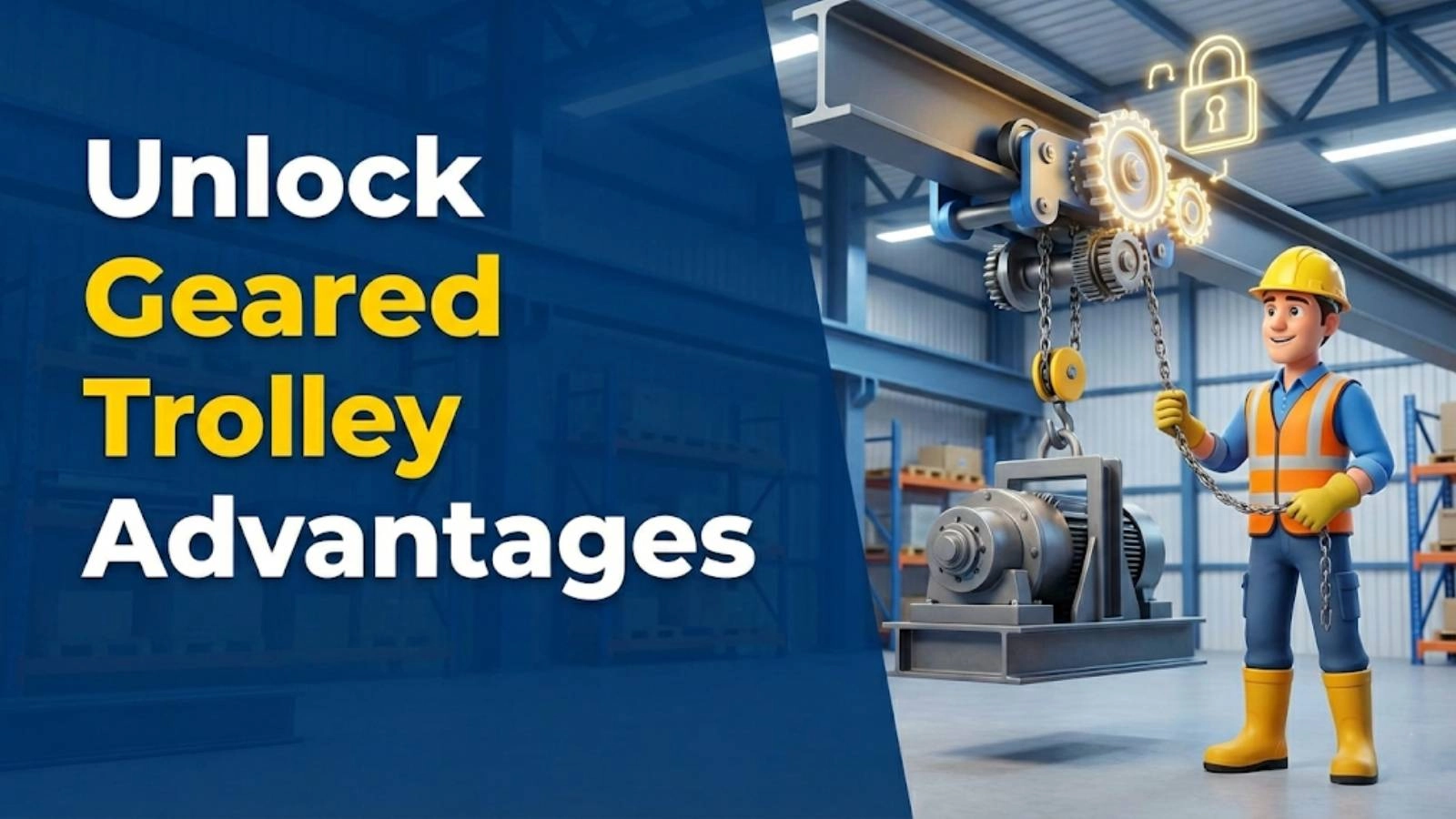
Understanding geared trolleys is crucial for maintaining safe and efficient material handling operations. A geared trolley is a mechanical device used to move heavy loads horizontally along a beam or track, offering a controlled and precise movement, making it an essential component in various industrial settings. Unlike plain trolleys, which rely on manual pushing or pulling, geared trolleys use a hand chain or lever to drive the wheels, providing increased control and reduced physical strain on the operator.
At Safe and Secure Trading Company (SSTC), we understand the importance of proper geared trolley selection, maintenance, and operation. Choosing the right trolley impacts safety, efficiency, and cost-effectiveness. A common mistake we see businesses make is overlooking the importance of regular inspections. By fixing it, they saw a 20% improvement in operational safety.
Key Takeaways
- Proper Selection is Crucial: Choosing the right geared trolley impacts safety, efficiency, and cost.
- Maintenance Matters: Regular inspection and maintenance extend trolley lifespan and prevent accidents.
- Safety First: Always prioritize safety standards and training when operating geared trolleys.
- Capacity Awareness: Never exceed the rated load capacity of the trolley.
- Professional Inspection: Regular professional inspections ensure compliance and safety.
Understanding Geared Trolleys: The Basics 🤔
What is a Geared Trolley?
A geared trolley is a specialized piece of material handling equipment designed to provide controlled horizontal movement of heavy loads along a beam or track. The “geared” aspect refers to the integrated gear mechanism that allows for precise and efficient movement using a hand chain or lever. By pulling the chain, the operator engages the gears, which in turn rotate the trolley’s wheels, moving the load along the beam.
The primary function of a geared trolley is to facilitate the smooth and controlled transport of heavy objects, particularly in situations where precise positioning is required. This is in contrast to a plain trolley, which relies solely on manual force to push or pull the load. The geared mechanism offers significant advantages in terms of reduced physical effort and increased control.
Geared trolleys are commonly used in conjunction with hoists to lift and move loads. The hoist provides the vertical lifting capability, while the geared trolley enables horizontal movement. This combination allows for versatile material handling in a variety of applications. The controlled movement is very important to mitigate risk for our clients here in Dammam, Saudi Arabia, we’ve seen that accidents are far less prevalent when a geared trolley is used over a plain one, because the movement is much smoother.
Common applications for geared trolleys span various industries, including:
- Manufacturing: Moving workpieces, machinery components, and finished products along assembly lines.
- Construction: Lifting and positioning materials on construction sites.
- Warehousing: Loading and unloading goods from trucks and moving them within the warehouse.
- Automotive: Positioning engines, chassis, and other heavy components during vehicle assembly.
- Mining: Transporting equipment and materials in underground mines.
Geared Trolley vs. Plain Trolley: Which is Right for You?
Choosing between a geared trolley and a plain trolley depends on several factors, including the load weight, frequency of use, precision requirements, and budget. Both types of trolleys serve the basic purpose of moving loads horizontally along a beam, but they differ significantly in their mechanisms and capabilities.
A plain trolley is a simple device that consists of wheels mounted on a frame that allows it to roll along a beam. It relies entirely on manual effort to move the load. This type of trolley is suitable for lighter loads and infrequent use where precision is not critical. Plain trolleys are generally more affordable than geared trolleys due to their simpler design.
In contrast, a geared trolley incorporates a gear mechanism that provides increased control and reduces the physical effort required to move heavier loads. The operator pulls a hand chain, which engages the gears and rotates the wheels. This allows for smoother, more precise movement, especially when dealing with heavy or awkward loads.
Here’s a comparative analysis to help you decide:
Geared Trolley | Plain Trolley |
——————————————– | —————————————- |
Higher (typically up to several tons) | Lower (typically up to 1 ton) |
Lower (due to gear mechanism) | Higher (requires manual pushing/pulling) |
Higher (allows for controlled movement) | Lower (less control over movement) |
Suitable for frequent and heavy-duty use | Suitable for infrequent and light-duty use |
Higher (more complex mechanism) | Lower (simpler design) |
Manufacturing, construction, heavy lifting | Warehousing, light assembly, general use |
When to opt for a geared trolley over a plain trolley:
- Heavy Loads: If you regularly handle loads exceeding the capacity of a plain trolley, a geared trolley is essential.
- Frequent Use: For applications that require frequent horizontal movement of loads, a geared trolley reduces operator fatigue and increases efficiency.
- Precision Positioning: When precise positioning of the load is critical, the controlled movement of a geared trolley is necessary.
- Limited Physical Strength: If operators have limited physical strength or are working in awkward positions, a geared trolley provides the mechanical advantage needed to move heavy loads safely.
The Problem: Common Challenges in Geared Trolley Selection 😫
Overlooking Load Capacity
One of the most critical considerations in geared trolley selection is the load capacity. Overlooking this factor can lead to serious consequences, including equipment failure, dropped loads, and potential injuries. The rated load capacity of a geared trolley is the maximum weight it is designed to safely support and move. Exceeding this limit puts excessive stress on the trolley’s components, such as the wheels, gears, and frame.
The consequences of exceeding the rated load capacity can be severe. The trolley may fail structurally, causing the load to drop unexpectedly. This can result in damage to the load itself, as well as potential injuries to workers in the vicinity. In our experience with clients, we’ve seen that the costs associated with accidents and downtime far outweigh the initial cost savings of using an undersized trolley.
Accurately assessing load requirements is essential for selecting the appropriate geared trolley. This involves determining the maximum weight of the loads you will be handling, as well as any potential variations in load weight. It is also important to consider the weight of any additional equipment, such as slings, chains, or lifting devices, that will be used in conjunction with the trolley.
To accurately assess load requirements:
1. Identify the heaviest load: Determine the weight of the heaviest item you will be lifting with the trolley.
2. Account for lifting accessories: Add the weight of any slings, chains, or other lifting devices that will be used to attach the load to the trolley.
3. Consider potential variations: Factor in any potential variations in load weight due to changes in materials, products, or processes.
4. Choose a trolley with sufficient capacity: Select a geared trolley with a rated load capacity that meets or exceeds the total calculated weight.
Ignoring Environmental Factors
Environmental factors can significantly impact the performance and lifespan of a geared trolley. Ignoring these factors during the selection process can lead to premature wear, corrosion, and equipment failure. Harsh environments, such as those with exposure to moisture, chemicals, extreme temperatures, or abrasive materials, can accelerate the deterioration of the trolley’s components.
Corrosion is a major concern in environments with high humidity or exposure to corrosive substances. Rust and oxidation can weaken the trolley’s frame, wheels, and gears, reducing its load capacity and increasing the risk of failure. Extreme temperatures can also affect the trolley’s performance. High temperatures can cause lubricants to break down, leading to increased friction and wear. Low temperatures can make the trolley’s components brittle, increasing the risk of cracking or fracture.
Selecting trolleys with appropriate protective coatings and materials is essential for mitigating the impact of harsh environments. Stainless steel trolleys are highly resistant to corrosion and are suitable for use in wet or corrosive environments. Galvanized coatings provide a protective barrier against rust and are a cost-effective option for many applications. Special coatings, such as epoxy or polyurethane, can provide additional protection against chemicals and abrasion.
Maintenance considerations for specific environments include:
- Regular Cleaning: Remove dirt, dust, and debris from the trolley’s components to prevent the build-up of corrosive substances.
- Lubrication: Apply appropriate lubricants to protect against corrosion and reduce friction.
- Inspection: Regularly inspect the trolley for signs of wear, corrosion, or damage.
- Replacement: Replace worn or damaged components promptly to prevent further deterioration.
Neglecting Beam Compatibility
Ensuring compatibility between the geared trolley and the beam structure is critical for safe and efficient operation. Neglecting this factor can lead to instability, premature wear, and even catastrophic failure. The trolley must be properly sized and configured to fit the beam’s dimensions and profile.
Mismatch between the trolley and the beam can result in several problems. If the trolley is too narrow for the beam, it may not be able to support the load properly, leading to instability. If the trolley is too wide, it may bind or snag on the beam, causing jerky movement and increased wear. An incorrect trolley-to-beam match can cause premature wear on both the trolley and the beam. The constant friction and stress can damage the wheels, gears, and frame of the trolley, as well as the beam’s surface.
To ensure proper beam compatibility:
1. Measure the beam: Accurately measure the beam’s width, flange thickness, and profile.
2. Consult trolley specifications: Review the trolley manufacturer’s specifications to ensure compatibility with the beam’s dimensions.
3. Consider adjustable flanges: Choose a trolley with adjustable flanges to accommodate variations in beam size.
4. Test the fit: Before putting the trolley into service, test the fit on the beam to ensure smooth and stable movement.
The Solution: Expert Geared Trolley Selection Criteria ✅
Step 1: Defining Your Lifting Needs
The first step in selecting the right geared trolley is to clearly define your lifting needs. This involves carefully assessing the loads you will be handling, the environment in which the trolley will be used, and the specific requirements of your application.
Calculating the maximum load weight is crucial for ensuring that the trolley has sufficient capacity to safely handle the loads you will be lifting. This involves determining the weight of the heaviest item you will be lifting, as well as any additional equipment or accessories that will be used in conjunction with the trolley.
Determining the required lifting height and travel distance is also important. The lifting height refers to the vertical distance the load needs to be lifted, while the travel distance refers to the horizontal distance the trolley needs to move along the beam. These factors will influence the choice of trolley type and features.
Assessing the frequency of use, or duty cycle, is another important consideration. If the trolley will be used frequently and for extended periods, it is important to choose a model that is designed for heavy-duty use. This will ensure that the trolley can withstand the demands of your application and provide reliable performance over time.
Step 2: Choosing the Right Trolley Type & Features
Once you have defined your lifting needs, the next step is to choose the right trolley type and features. There are several types of geared trolleys available, each designed for specific applications.
Standard geared trolleys are the most common type and are suitable for a wide range of applications. Low headroom geared trolleys are designed for use in areas with limited headroom. Spark-resistant geared trolleys are designed for use in hazardous environments where flammable materials are present.
Essential features to consider include:
- Adjustable flanges: These allow the trolley to be adjusted to fit different beam sizes.
- Safety locks: These prevent the trolley from accidentally rolling off the beam.
- Robust construction: Look for a trolley that is made from high-quality materials and is built to withstand the demands of your application.
Considerations for specialized applications include:
- Corrosive environments: Choose a trolley made from corrosion-resistant materials, such as stainless steel.
- High temperatures: Select a trolley with heat-resistant components and lubricants.
- Explosive environments: Use a spark-resistant trolley to prevent ignition of flammable materials.
Step 3: Verifying Compatibility and Compliance
Before purchasing a geared trolley, it is essential to verify its compatibility with the existing beam structure and ensure compliance with relevant safety standards.
Ensuring the trolley is compatible with the existing beam structure involves checking the beam’s dimensions, profile, and load-bearing capacity. The trolley must be properly sized and configured to fit the beam and support the intended loads.
Checking for compliance with relevant safety standards, such as OSHA and ASME, is also crucial. These standards provide guidelines for the safe design, construction, and operation of material handling equipment.
Reviewing manufacturer specifications and certifications is another important step. The manufacturer’s specifications will provide detailed information about the trolley’s load capacity, dimensions, and other important features. Certifications from recognized organizations, such as Underwriters Laboratories (UL) or Canadian Standards Association (CSA), indicate that the trolley has been tested and meets specific safety standards.
> “Safety should always be the top priority when selecting and operating geared trolleys.” – John Smith, Lead Safety Inspector
Geared Trolley Maintenance: Preventing Problems Before They Start 🛠️
The Importance of Regular Inspection
Regular inspection is crucial for maintaining the safety and longevity of your geared trolley. A proactive approach to maintenance allows you to identify and address potential problems before they escalate into serious issues.
Regular inspections are essential for identifying signs of wear, damage, or corrosion. These issues can compromise the trolley’s structural integrity and increase the risk of failure. Early detection of issues allows you to take corrective action before they lead to accidents or downtime.
Establishing a routine inspection schedule is key to ensuring that your geared trolley is properly maintained. The frequency of inspections should be based on the trolley’s usage, environment, and manufacturer’s recommendations. For trolleys that are used frequently or in harsh environments, more frequent inspections may be necessary.
The benefits of regular inspections include:
- Early detection of issues: Identifying potential problems before they become serious.
- Cost savings: Preventing costly repairs and downtime by addressing issues early on.
- Accident prevention: Reducing the risk of accidents and injuries by ensuring the trolley is in safe working condition.
- Extended lifespan: Prolonging the lifespan of the trolley by maintaining its components and preventing premature wear.
Key Inspection Points
When inspecting a geared trolley, there are several key areas to focus on:
- Wheels: Inspect the wheels for wear, cracks, and proper lubrication. Look for signs of excessive wear, such as flat spots or uneven surfaces. Check for cracks or chips in the wheel material. Ensure that the wheels are properly lubricated to reduce friction and prevent wear.
- Gears: Check the gears for damage and alignment. Look for signs of chipped, broken, or worn teeth. Ensure that the gears are properly aligned and meshing smoothly.
- Trolley Body: Examine the trolley body for cracks, corrosion, and deformation. Look for signs of rust, pitting, or other forms of corrosion. Check for cracks or bends in the trolley’s frame or other structural components.
- Safety Mechanisms: Test safety mechanisms, such as locks and brakes, to ensure they are functioning properly. Verify that the safety locks engage securely and prevent the trolley from rolling off the beam. Test the brakes to ensure they can effectively stop and hold the load.
Lubrication: The Lifeblood of Your Trolley
Proper lubrication is essential for maintaining the smooth and efficient operation of your geared trolley. Lubrication reduces friction between moving parts, preventing wear and tear and extending the lifespan of the trolley.
Selecting the correct lubricant type is important for ensuring optimal performance. Consult the manufacturer’s recommendations for the appropriate lubricant for your specific trolley model. Generally, a high-quality, lithium-based grease is suitable for most applications.
Establishing a lubrication schedule and procedure is also important. The frequency of lubrication should be based on the trolley’s usage, environment, and manufacturer’s recommendations. A typical lubrication schedule may involve applying lubricant to the wheels, gears, and other moving parts every one to three months.
Troubleshooting Common Geared Trolley Issues ⚙️
Problem: Trolley is Difficult to Move
If you find that your geared trolley is difficult to move, there are several possible causes to consider.
Possible causes:
- Insufficient Lubrication: Lack of lubrication can cause increased friction between moving parts, making the trolley difficult to move.
- Wheel Binding: Wheels may bind due to dirt, debris, or damage, preventing them from rolling smoothly.
- Beam Obstruction: Obstructions on the beam, such as rust, debris, or misaligned sections, can impede the trolley’s movement.
Troubleshooting steps:
1. Lubrication: Apply lubricant to the wheels, gears, and other moving parts to reduce friction.
2. Wheel Adjustment: Check the wheels for damage or misalignment and adjust or replace them as necessary.
3. Cleaning the Beam: Clean the beam to remove any obstructions that may be impeding the trolley’s movement.
Problem: Jerky or Uneven Movement
Jerky or uneven movement can indicate underlying issues with the trolley’s components.
Possible causes:
- Damaged Gears: Damaged or worn gears can cause irregular movement.
- Misaligned Wheels: Misaligned wheels can cause the trolley to wobble or move unevenly.
- Excessive Wear: Excessive wear on the wheels or gears can lead to jerky movement.
Troubleshooting steps:
1. Gear Inspection and Replacement: Inspect the gears for damage or wear and replace them if necessary.
2. Wheel Alignment: Check the wheel alignment and adjust as needed to ensure smooth movement.
3. Trolley Replacement: If the trolley is severely worn or damaged, consider replacing it.
Problem: Unusual Noises During Operation
Unusual noises during operation can be a sign of potential problems with the trolley.
Possible causes:
- Loose Components: Loose fasteners or other components can cause rattling or squeaking noises.
- Worn Bearings: Worn bearings can produce grinding or rumbling noises.
- Gear Grinding: Gear grinding can indicate damaged or misaligned gears.
Troubleshooting steps:
1. Tightening Fasteners: Tighten any loose fasteners to eliminate rattling or squeaking noises.
2. Bearing Replacement: Replace worn bearings to eliminate grinding or rumbling noises.
3. Gear Inspection: Inspect the gears for damage and replace them if necessary.
Safety First: Operating Geared Trolleys Responsibly 👷
Pre-Operation Checks
Before operating a geared trolley, it is essential to perform a series of pre-operation checks to ensure that the equipment is in safe working condition.
- Inspecting the Trolley and Hoist: Check the trolley and hoist for any signs of damage, wear, or corrosion.
- Verifying the Load is Properly Secured: Ensure that the load is properly secured to the hoist and that all lifting devices are in good condition.
- Ensuring the Travel Path is Clear of Obstructions: Verify that the travel path is clear of any obstructions that could impede the trolley’s movement.
Safe Operating Procedures
Following safe operating procedures is crucial for preventing accidents and injuries.
- Avoiding Sudden Starts and Stops: Operate the trolley smoothly and avoid sudden starts and stops.
- Maintaining a Safe Distance from the Load: Keep a safe distance from the load to avoid being struck by falling objects.
- Never Exceeding the Rated Load Capacity: Never exceed the rated load capacity of the trolley.
Emergency Procedures
It is important to have emergency procedures in place in case of a trolley failure or other incident.
- What to Do in Case of a Trolley Failure: Immediately stop operation and assess the situation. If possible, safely lower the load to the ground.
- Reporting Incidents and Near Misses: Report any incidents or near misses to the appropriate personnel.
- Emergency Contact Information: Keep emergency contact information readily available.
Extending the Lifespan of Your Geared Trolley ⏳
Preventative Maintenance Tips
Implementing a comprehensive maintenance program is key to extending the lifespan of your geared trolley.
- Implementing a Comprehensive Maintenance Program: Develop a written maintenance plan that includes regular inspections, lubrication, and component replacement.
- Regular Cleaning and Lubrication: Clean and lubricate the trolley regularly to prevent corrosion and reduce friction.
- Promptly Addressing Minor Issues: Address any minor issues promptly to prevent them from escalating into major problems.
Professional Inspections: When and Why
Periodic professional inspections are essential for identifying hidden damage and potential problems.
- Importance of Periodic Professional Inspections: Professional inspectors have the expertise and equipment to identify issues that may not be apparent during routine inspections.
- Identifying Hidden Damage and Potential Problems: Professional inspections can uncover hidden damage, such as cracks or corrosion, that could compromise the trolley’s structural integrity.
- Ensuring Compliance with Safety Regulations: Professional inspections can help ensure that your trolley is compliant with relevant safety regulations.
Replacement vs. Repair: Making the Right Choice
When faced with a damaged or worn trolley, you must decide whether to repair or replace it.
- Factors Influencing the Decision: Consider the age, condition, and cost of repair versus replacement.
- When to Consider Replacing a Trolley Instead of Repairing It: If the trolley is severely damaged, obsolete, or the cost of repair exceeds a certain percentage of the replacement cost, consider replacing it.
- Budgeting for Replacement Costs: Plan for future replacement costs by setting aside funds in your budget.
Conclusion
By understanding the principles of geared trolley selection, implementing regular maintenance, and prioritizing safety, you can ensure the longevity and reliability of your lifting equipment. Selecting the proper trolley ensures safe and efficient operations in your workspace. We’ve consistently seen that businesses that prioritize these steps experience fewer accidents and downtime.
FAQ Section
Q: How often should I inspect my geared trolley?
A: We recommend inspecting your geared trolley before each use and conducting a more thorough inspection monthly. Additionally, schedule a professional inspection at least annually, or more frequently depending on the intensity of use.
Q: What type of lubricant should I use for my geared trolley?
A: Consult the manufacturer’s recommendations for the appropriate lubricant. Generally, a high-quality, lithium-based grease is suitable for most applications.
Q: What are the signs of a worn-out geared trolley wheel?
A: Signs include excessive wear, cracks, flat spots, and difficulty in movement. If you notice any of these, replace the wheel immediately.
Q: Can I overload my geared trolley if it’s just for a short period?
A: No. Overloading a geared trolley, even for a short period, can cause irreversible damage and create a significant safety hazard. Always adhere to the rated load capacity.
Q: Where can I find replacement parts for my geared trolley?
A: You can typically find replacement parts through the trolley manufacturer, authorized distributors, or reputable industrial supply companies. Always use OEM or equivalent parts to ensure compatibility and safety.