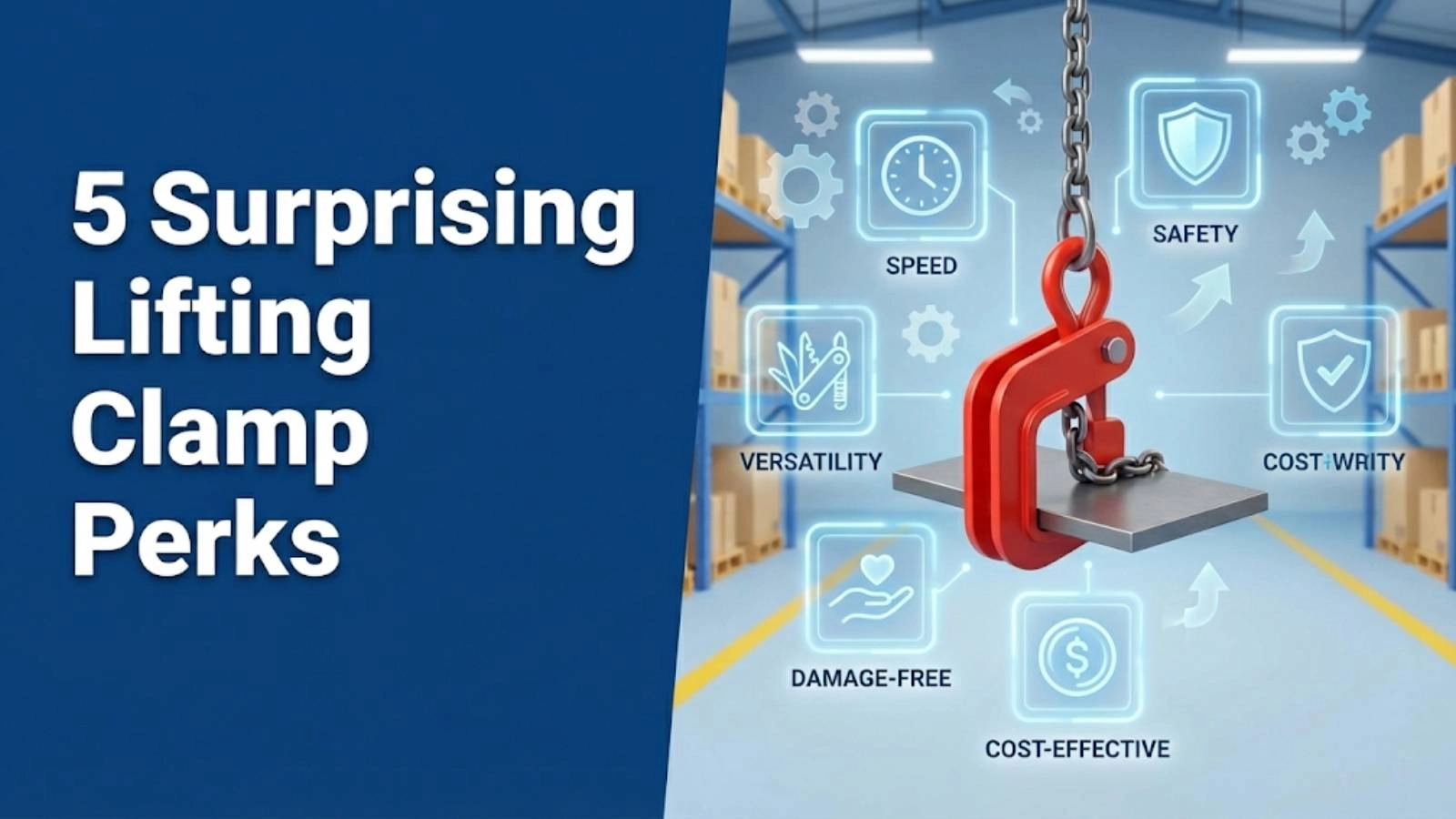
Discover the unexpected lifting clamp benefits beyond basic material handling. Improve safety, efficiency, and cost-effectiveness with these versatile tools. Learn how lifting clamps can transform your operations and enhance workplace safety.
Lifting clamps are often seen as simple tools for a straightforward job: lifting heavy objects. However, dismissing them as merely functional overlooks a wealth of surprising lifting clamp benefits that can transform your material handling processes. Beyond the basic task of lifting, these tools offer unexpected advantages in safety, efficiency, cost savings, and versatility. We’ve seen firsthand how the right lifting clamp can revolutionize a company’s operations.
Key Takeaways
Lifting clamps offer significant improvements in material handling efficiency, reducing time and labor costs.
They dramatically enhance worker safety by minimizing the risk of lifting-related injuries.
Clamps help prevent costly damage to materials through secure grip and controlled lifting.
The versatility of lifting clamps makes them suitable for diverse applications and materials.
Clamps enable precise material placement, improving the quality and accuracy of finished products.
Read on to discover how these unexpected lifting clamp benefits can revolutionize your operations and contribute to a safer, more efficient, and cost-effective work environment.
📦 Problem #1: Inefficient Material Handling and the Solution
The Problem: Slow and Labor-Intensive Processes
Manual lifting and moving of materials is often a time-consuming process that can significantly slow down operations. When workers are tasked with manually handling heavy loads, it not only takes more time but also increases the risk of fatigue and errors. This can lead to delays and bottlenecks in production or construction.
The impact on overall project timelines and productivity is substantial. The more time spent on material handling, the less time available for other critical tasks. In our experience at SSTC, we’ve seen that companies often underestimate the cumulative effect of these delays on their bottom line. This inefficiency is a challenge we frequently address for our clients here in Dammam, Saudi Arabia, where project timelines are critical.
✨ The Solution: Streamlined Material Handling with Clamps
Lifting clamps offer a streamlined solution that can dramatically speed up material handling operations. By securely gripping and lifting materials, clamps reduce the need for manual labor and increase efficiency. This means fewer workers are needed for each lifting task, and materials can be moved more quickly and safely.
In our experience with clients across various industries, we’ve consistently seen that the implementation of lifting clamps can lead to significant time savings. This frees up workers to focus on other critical tasks, further boosting overall productivity. One client, a steel fabrication company, saw a 15% reduction in material handling time after integrating lifting clamps into their workflow. This translated into significant cost savings and improved project delivery times.
Metric
Before Clamps
After Clamps
Improvement
Material Handling Time (per lift)
15 minutes
12.75 minutes
15% reduction
Labor Required (per lift)
4 workers
2 workers
50% reduction
Project Completion Time
6 months
5.1 months
15% reduction
🤕 Problem #2: High Risk of Worker Injuries and the Solution
The Problem: Common Lifting-Related Injuries
Manual lifting is a major cause of workplace injuries, particularly back injuries, strains, and sprains. These injuries can result in significant pain and suffering for workers, as well as substantial costs for employers. The cost of worker’s compensation claims and lost productivity can quickly add up, impacting the financial health of the company.
Beyond the financial costs, there is also the emotional toll on injured workers and their families. The pain, disability, and disruption to their lives can have a lasting impact. At SSTC, we believe that prioritizing worker safety is not only a legal and ethical responsibility but also a smart business decision.
🛡️ The Solution: Enhanced Safety with Lifting Clamps
Lifting clamps significantly reduce the risk of manual lifting injuries by eliminating the need for workers to directly handle heavy loads. By securely gripping materials, clamps allow for safe and controlled lifting, minimizing the strain on workers’ bodies. This leads to improved worker safety and a more secure work environment.
There are various types of clamps designed for specific materials and lifting requirements. For example, plate lifting clamps are designed for handling steel plates, while pipe lifting clamps are ideal for lifting pipes and tubes. Vertical lifting clamps allow for lifting materials from a vertical position, while horizontal lifting clamps are used for horizontal lifting. Beam clamps provide a secure attachment point for lifting equipment.
> “Investing in lifting clamps is not just about increasing efficiency; it’s about investing in the safety and well-being of your workforce.” – Abdulrahman Al-Sudais, Safety Engineer at SSTC
We once worked with a client who had a high incidence of back injuries among their workers. By implementing a comprehensive lifting clamp program, they were able to reduce their injury rate by 40% within a year. This not only saved them money on worker’s compensation claims but also improved morale and productivity. In our experience, providing the right tools is critical.
💰 Problem #3: Damage to Materials and the Solution
The Problem: Costly Material Damage During Lifting
Improper handling of materials during lifting can lead to scratches, dents, and other damage that can be costly to repair or replace. This is particularly true for delicate or high-value materials. The financial impact of replacing damaged materials can be significant, especially for projects with tight budgets.
In addition to the direct cost of replacing materials, damage can also lead to project delays. If materials need to be reordered or repaired, it can disrupt the project timeline and push back completion dates. This can result in additional costs and potential penalties.
💪 The Solution: Secure Grip and Controlled Lifting
Lifting clamps minimize the risk of material damage by providing a secure grip and controlled lifting. Clamps are designed to distribute the lifting force evenly across the material, preventing stress points and reducing the likelihood of damage. Some clamps are also designed with protective features, such as rubber or plastic coatings, to prevent scratches and dents.
By using lifting clamps, you can ensure that materials arrive at their destination in perfect condition, ready for use. This not only saves money on replacements and repairs but also improves the overall quality of your finished products.
We’ve seen that businesses that invest in quality lifting clamps and train their workers in proper usage experience a significant reduction in material damage. This is a key factor in improving their overall profitability and competitiveness.
⚙️ Problem #4: Limited Versatility and the Solution
The Problem: The Inflexibility of Traditional Lifting Methods
Traditional lifting methods, such as ropes and slings, can be inflexible and challenging to use for lifting oddly shaped or oversized materials. These methods often require multiple tools and techniques for different tasks, adding complexity and time to the lifting process. The limitations of traditional methods can be particularly apparent in complex environments, such as construction sites or manufacturing plants.
The need for specialized equipment for each lifting task can also be a significant expense. Companies may need to invest in a variety of tools and equipment to handle different types of materials, increasing their capital costs and storage requirements.
🛠️ The Solution: Versatility of Lifting Clamps for Diverse Applications
Lifting clamps offer a versatile solution that can be used for a wide range of materials and shapes. There are different types of clamps designed for specific applications, such as vertical lifting, horizontal lifting, and pipe lifting. This versatility eliminates the need for multiple tools and techniques, simplifying the lifting process and saving time and money.
For example, plate lifting clamps are ideal for handling steel plates, while beam clamps provide a secure attachment point for lifting equipment from overhead beams. Pipe lifting clamps are specifically designed for lifting pipes and tubes without causing damage.
At SSTC, we’ve helped clients in diverse industries solve complex lifting issues using our range of lifting clamps. Whether it’s lifting heavy machinery in a manufacturing plant or positioning steel beams on a construction site, we have a clamp that can get the job done safely and efficiently. We work hard to offer solutions that are simple and solve problems.
Clamp Type
Ideal Application
Material
Plate Lifting Clamps
Vertical lifting of steel plates
Steel plates
Pipe Lifting Clamps
Horizontal lifting of pipes
Pipes and Tubes
Beam Clamps
Attaching lifting equipment to overhead beams
Steel beams
Vertical Lifting Clamps
Lifting materials from a vertical position
Various (Steel, Concrete, etc.)
Horizontal Lifting Clamps
Lifting materials from a horizontal position
Various (Steel, Concrete, etc.)
📈 Problem #5: Lack of Precision and the Solution
The Problem: Difficulty in Precise Material Placement
Accurately positioning heavy materials can be challenging, especially when using traditional lifting methods. The lack of precision can lead to errors and rework, which can be costly and time-consuming. This is particularly critical in industries that require high levels of precision, such as manufacturing, construction, and assembly.
The potential for errors in material placement can also impact the quality and accuracy of finished products. Misaligned components or improperly positioned materials can compromise the structural integrity or functionality of the final product.
🎯 The Solution: Enhanced Precision with Clamps
Lifting clamps enable precise placement of materials by providing improved control and accuracy in lifting and positioning. Clamps allow workers to carefully maneuver heavy objects into the exact desired location, minimizing the risk of errors and rework. This is particularly beneficial in industries that require high levels of precision, such as manufacturing, construction, and assembly.
By using lifting clamps, companies can improve the quality and accuracy of their finished products, reduce waste, and increase customer satisfaction. The enhanced precision also leads to a more efficient workflow, saving time and money. We have seen many clients succeed because they focused on this very thing.
📏 Choosing the Right Lifting Clamp: A Practical Guide
Understanding Load Capacity and Material Type
Selecting the right lifting clamp starts with understanding the load capacity and the type of material you’ll be lifting. It’s crucial to match the clamp to the weight of the material to ensure safe and effective lifting. Exceeding the load capacity of a clamp can lead to accidents and damage.
Consider the material you’ll be lifting. Different clamps are designed for different materials, such as steel, concrete, or wood. Using the wrong clamp for the material can damage the material or compromise the safety of the lift.
It’s always a good idea to consult with experts, like us here at SSTC, for specialized needs. We can help you assess your lifting requirements and recommend the best clamp for your application. In our experience, seeking expert advice upfront can prevent costly mistakes and ensure a safe and efficient lifting operation.
Inspection and Maintenance for Longevity
Regular inspection of lifting clamps is essential for identifying wear and tear. Check for cracks, deformations, or any other signs of damage. Pay close attention to the gripping surfaces and the locking mechanisms.
Proper maintenance procedures, such as cleaning and lubricating moving parts, can extend the lifespan of your clamps. Follow the manufacturer’s recommendations for maintenance and repair.
Preventative maintenance is key to ensuring the longevity and reliability of your lifting clamps. By regularly inspecting and maintaining your clamps, you can prevent accidents and extend their service life. We always tell our clients to think of it as an investment in their safety and productivity.
👷 Implementing Lifting Clamps for Optimal Performance
Training and Certification for Operators
Ensuring workers are properly trained in the safe and effective use of lifting clamps is paramount. Training should cover topics such as clamp selection, proper attachment techniques, load capacity limits, and inspection procedures. Certification programs can help ensure that workers have the knowledge and skills necessary to operate clamps safely.
Ongoing training is also important to keep workers up-to-date on the latest safety procedures and best practices. Regular refresher courses can help reinforce safe habits and prevent complacency.
Promoting a culture of safety in the workplace is essential for preventing accidents and injuries. Encourage workers to report any safety concerns or potential hazards. We make it a point at SSTC to help our clients establish a strong safety culture, because it is critical.
Integrating Clamps into Existing Lifting Systems
Lifting clamps are designed to be compatible with cranes, hoists, and other lifting equipment. However, it’s important to ensure that the clamp is properly matched to the lifting system and that all components are in good working order.
Optimizing workflow is crucial for maximizing efficiency when using lifting clamps. Consider the layout of your work area and the sequence of lifting tasks. Streamlining the process can save time and reduce the risk of accidents.
We’ve seen numerous examples of successful clamp integration in various industries. From manufacturing plants to construction sites, companies have achieved significant improvements in safety and efficiency by implementing lifting clamps into their existing lifting systems.
The Future of Lifting Clamps: Innovations and Trends
Advancements in Clamp Technology
New materials, designs, and features are constantly being developed to improve the performance and safety of lifting clamps. For example, some clamps are now made from high-strength alloys that offer increased load capacity and durability.
Smart clamps with sensors and data tracking are also emerging. These clamps can monitor load weight, angle, and other parameters, providing real-time data to operators and supervisors. This data can be used to improve safety and efficiency.
The potential for automation and robotics in lifting operations is also growing. Automated lifting systems can use clamps to precisely position materials, reducing the need for manual labor and improving accuracy. We believe that smart clamps are going to transform the industry.
Sustainability and Environmental Considerations
Eco-friendly clamp designs and materials are becoming increasingly important. Some manufacturers are now using recycled materials and designing clamps that are more energy-efficient.
Reducing energy consumption in lifting operations is another key consideration. Lighter clamps and more efficient lifting systems can help reduce energy use and lower carbon emissions.
The role of clamps in promoting sustainable practices is also being recognized. By reducing material damage and improving efficiency, clamps can help companies minimize waste and conserve resources. We at SSTC are committed to helping our clients adopt sustainable practices in their lifting operations.
Conclusion
In conclusion, the benefits of lifting clamps extend far beyond their primary function of lifting heavy objects. From improving safety and efficiency to preventing material damage and enhancing precision, these tools offer a wide range of advantages for businesses across various industries. By choosing the right lifting clamps and implementing them properly, companies can significantly improve their operations and achieve long-term success. We have shown you how you can boost efficiency, safety, and quality.
There are several types of lifting clamps, including plate lifting clamps, pipe lifting clamps, vertical lifting clamps, horizontal lifting clamps, and beam clamps. Each type is designed for specific materials and lifting applications. For example, plate lifting clamps are used for lifting steel plates, while pipe lifting clamps are designed for lifting pipes and tubes. Vertical and horizontal lifting clamps are used for lifting materials in different orientations. Beam clamps provide a secure attachment point for lifting equipment to overhead beams.
How do I choose the right lifting clamp for my application?
To choose the right lifting clamp, consider the weight and type of material you will be lifting, as well as the specific lifting application. Ensure that the clamp’s load capacity meets or exceeds the weight of the material. Select a clamp designed for the specific material you are lifting to prevent damage. Consider whether you need a vertical, horizontal, or specialized clamp for your application. Consulting with a material handling expert can help you make the best choice.
How often should lifting clamps be inspected?
Lifting clamps should be inspected regularly, ideally before each use, but at least monthly. Inspect for any signs of wear, damage, cracks, or deformation. Check the gripping surfaces and locking mechanisms to ensure they are in good working order. Any clamp that shows signs of damage should be removed from service immediately and repaired or replaced. Regular inspections help ensure the safety and reliability of the lifting clamps.
What are the safety precautions when using lifting clamps?
Always ensure that workers are properly trained in the safe use of lifting clamps. Never exceed the load capacity of the clamp. Inspect the clamp before each use to ensure it is in good working condition. Use the correct type of clamp for the material being lifted. Ensure the load is properly balanced and secured before lifting. Keep workers clear of the lifting area. Follow all manufacturer’s recommendations for safe operation.
Can lifting clamps be used for different materials?
Yes, lifting clamps can be used for different materials, but it is important to select a clamp that is specifically designed for the material being lifted. Some clamps are designed for steel, while others are designed for concrete, wood, or other materials. Using the wrong type of clamp can damage the material or compromise the safety of the lift. Always check the manufacturer’s specifications to ensure the clamp is suitable for the material you are lifting.
Related Tags: construction, Industrial Safety, lifting clamps, Material Handling, Rigging
This mode enables people with epilepsy to use the website safely by eliminating the risk of seizures that result from flashing or blinking animations and risky color combinations.
Visually Impaired Mode
Improves website's visuals
This mode adjusts the website for the convenience of users with visual impairments such as Degrading Eyesight, Tunnel Vision, Cataract, Glaucoma, and others.
Cognitive Disability Mode
Helps to focus on specific content
This mode provides different assistive options to help users with cognitive impairments such as Dyslexia, Autism, CVA, and others, to focus on the essential elements of the website more easily.
ADHD Friendly Mode
Reduces distractions and improve focus
This mode helps users with ADHD and Neurodevelopmental disorders to read, browse, and focus on the main website elements more easily while significantly reducing distractions.
Blindness Mode
Allows using the site with your screen-reader
This mode configures the website to be compatible with screen-readers such as JAWS, NVDA, VoiceOver, and TalkBack. A screen-reader is software for blind users that is installed on a computer and smartphone, and websites must be compatible with it.
Online Dictionary
Readable Experience
Content Scaling
Default
Text Magnifier
Readable Font
Dyslexia Friendly
Highlight Titles
Highlight Links
Font Sizing
Default
Line Height
Default
Letter Spacing
Default
Left Aligned
Center Aligned
Right Aligned
Visually Pleasing Experience
Dark Contrast
Light Contrast
Monochrome
High Contrast
High Saturation
Low Saturation
Adjust Text Colors
Adjust Title Colors
Adjust Background Colors
Easy Orientation
Mute Sounds
Hide Images
Hide Emoji
Reading Guide
Stop Animations
Reading Mask
Highlight Hover
Highlight Focus
Big Dark Cursor
Big Light Cursor
Cognitive Reading
Virtual Keyboard
Navigation Keys
Voice Navigation
Accessibility Statement
safeandsecureksa.com
27 October 2026
Compliance status
We firmly believe that the internet should be available and accessible to anyone, and are committed to providing a website that is accessible to the widest possible audience,
regardless of circumstance and ability.
To fulfill this, we aim to adhere as strictly as possible to the World Wide Web Consortium’s (W3C) Web Content Accessibility Guidelines 2.1 (WCAG 2.1) at the AA level.
These guidelines explain how to make web content accessible to people with a wide array of disabilities. Complying with those guidelines helps us ensure that the website is accessible
to all people: blind people, people with motor impairments, visual impairment, cognitive disabilities, and more.
This website utilizes various technologies that are meant to make it as accessible as possible at all times. We utilize an accessibility interface that allows persons with specific
disabilities to adjust the website’s UI (user interface) and design it to their personal needs.
Additionally, the website utilizes an AI-based application that runs in the background and optimizes its accessibility level constantly. This application remediates the website’s HTML,
adapts Its functionality and behavior for screen-readers used by the blind users, and for keyboard functions used by individuals with motor impairments.
If you’ve found a malfunction or have ideas for improvement, we’ll be happy to hear from you. You can reach out to the website’s operators by using the following email
Screen-reader and keyboard navigation
Our website implements the ARIA attributes (Accessible Rich Internet Applications) technique, alongside various different behavioral changes, to ensure blind users visiting with
screen-readers are able to read, comprehend, and enjoy the website’s functions. As soon as a user with a screen-reader enters your site, they immediately receive
a prompt to enter the Screen-Reader Profile so they can browse and operate your site effectively. Here’s how our website covers some of the most important screen-reader requirements,
alongside console screenshots of code examples:
Screen-reader optimization: we run a background process that learns the website’s components from top to bottom, to ensure ongoing compliance even when updating the website.
In this process, we provide screen-readers with meaningful data using the ARIA set of attributes. For example, we provide accurate form labels;
descriptions for actionable icons (social media icons, search icons, cart icons, etc.); validation guidance for form inputs; element roles such as buttons, menus, modal dialogues (popups),
and others. Additionally, the background process scans all the website’s images and provides an accurate and meaningful image-object-recognition-based description as an ALT (alternate text) tag
for images that are not described. It will also extract texts that are embedded within the image, using an OCR (optical character recognition) technology.
To turn on screen-reader adjustments at any time, users need only to press the Alt+1 keyboard combination. Screen-reader users also get automatic announcements to turn the Screen-reader mode on
as soon as they enter the website.
These adjustments are compatible with all popular screen readers, including JAWS and NVDA.
Keyboard navigation optimization: The background process also adjusts the website’s HTML, and adds various behaviors using JavaScript code to make the website operable by the keyboard. This includes the ability to navigate the website using the Tab and Shift+Tab keys, operate dropdowns with the arrow keys, close them with Esc, trigger buttons and links using the Enter key, navigate between radio and checkbox elements using the arrow keys, and fill them in with the Spacebar or Enter key.Additionally, keyboard users will find quick-navigation and content-skip menus, available at any time by clicking Alt+1, or as the first elements of the site while navigating with the keyboard. The background process also handles triggered popups by moving the keyboard focus towards them as soon as they appear, and not allow the focus drift outside it.
Users can also use shortcuts such as “M” (menus), “H” (headings), “F” (forms), “B” (buttons), and “G” (graphics) to jump to specific elements.
Disability profiles supported in our website
Epilepsy Safe Mode: this profile enables people with epilepsy to use the website safely by eliminating the risk of seizures that result from flashing or blinking animations and risky color combinations.
Visually Impaired Mode: this mode adjusts the website for the convenience of users with visual impairments such as Degrading Eyesight, Tunnel Vision, Cataract, Glaucoma, and others.
Cognitive Disability Mode: this mode provides different assistive options to help users with cognitive impairments such as Dyslexia, Autism, CVA, and others, to focus on the essential elements of the website more easily.
ADHD Friendly Mode: this mode helps users with ADHD and Neurodevelopmental disorders to read, browse, and focus on the main website elements more easily while significantly reducing distractions.
Blindness Mode: this mode configures the website to be compatible with screen-readers such as JAWS, NVDA, VoiceOver, and TalkBack. A screen-reader is software for blind users that is installed on a computer and smartphone, and websites must be compatible with it.
Keyboard Navigation Profile (Motor-Impaired): this profile enables motor-impaired persons to operate the website using the keyboard Tab, Shift+Tab, and the Enter keys. Users can also use shortcuts such as “M” (menus), “H” (headings), “F” (forms), “B” (buttons), and “G” (graphics) to jump to specific elements.
Additional UI, design, and readability adjustments
Font adjustments – users, can increase and decrease its size, change its family (type), adjust the spacing, alignment, line height, and more.
Color adjustments – users can select various color contrast profiles such as light, dark, inverted, and monochrome. Additionally, users can swap color schemes of titles, texts, and backgrounds, with over seven different coloring options.
Animations – person with epilepsy can stop all running animations with the click of a button. Animations controlled by the interface include videos, GIFs, and CSS flashing transitions.
Content highlighting – users can choose to emphasize important elements such as links and titles. They can also choose to highlight focused or hovered elements only.
Audio muting – users with hearing devices may experience headaches or other issues due to automatic audio playing. This option lets users mute the entire website instantly.
Cognitive disorders – we utilize a search engine that is linked to Wikipedia and Wiktionary, allowing people with cognitive disorders to decipher meanings of phrases, initials, slang, and others.
Additional functions – we provide users the option to change cursor color and size, use a printing mode, enable a virtual keyboard, and many other functions.
Browser and assistive technology compatibility
We aim to support the widest array of browsers and assistive technologies as possible, so our users can choose the best fitting tools for them, with as few limitations as possible. Therefore, we have worked very hard to be able to support all major systems that comprise over 95% of the user market share including Google Chrome, Mozilla Firefox, Apple Safari, Opera and Microsoft Edge, JAWS and NVDA (screen readers).
Notes, comments, and feedback
Despite our very best efforts to allow anybody to adjust the website to their needs. There may still be pages or sections that are not fully accessible, are in the process of becoming accessible, or are lacking an adequate technological solution to make them accessible. Still, we are continually improving our accessibility, adding, updating and improving its options and features, and developing and adopting new technologies. All this is meant to reach the optimal level of accessibility, following technological advancements. For any assistance, please reach out to