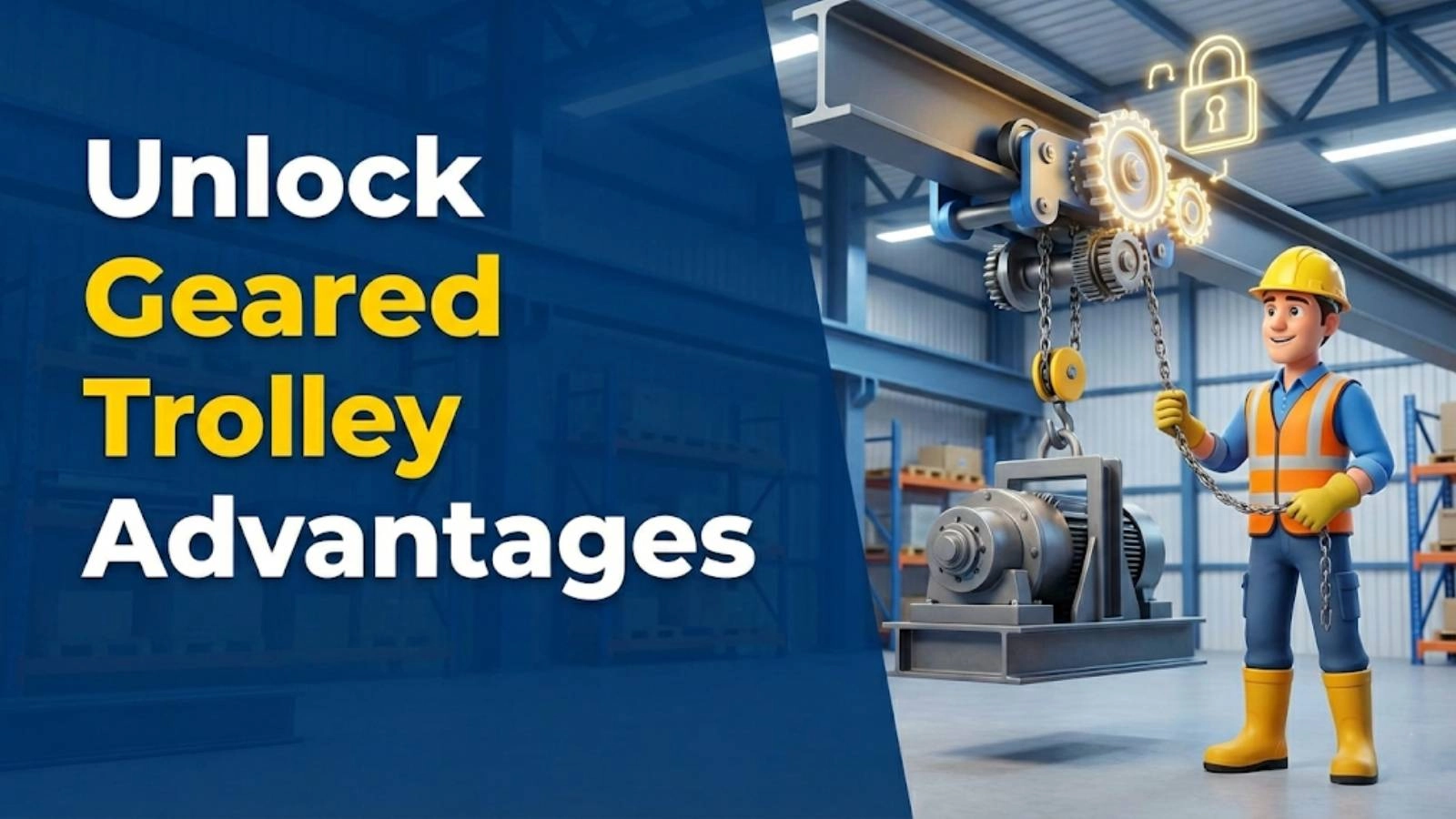
Choosing the right trolley for your lifting applications is crucial for ensuring safety, efficiency, and productivity in your operations. Whether you’re moving materials in a warehouse, construction site, or manufacturing facility, the trolley you select plays a vital role in how smoothly and safely the lifting process goes. This article provides a comprehensive comparison of two common types of trolleys: the geared trolley and the plain trolley. Understanding the strengths and weaknesses of each will help you make an informed decision that best suits your specific needs.
Problem: The Challenges of Improper Trolley Selection
Selecting the wrong type of trolley can lead to a host of problems, ranging from safety hazards to operational inefficiencies. One of the most significant concerns is the potential for accidents and injuries.
- Risk of dropped loads due to inadequate control is a serious concern. If the trolley cannot handle the weight or provide the necessary precision, the load could slip or fall, causing damage or injury.
- Strain and injury to workers due to excessive manual effort are also common. Using a plain trolley for tasks that require a geared trolley can lead to fatigue, muscle strain, and other musculoskeletal issues.
Incorrect trolley selection also impacts operational costs and productivity.
- Slowed-down lifting processes can significantly reduce efficiency. If the trolley isn’t optimized for the task, it can take longer to move materials, leading to delays and bottlenecks.
- Increased maintenance and repair costs are another consequence of using the wrong trolley. Overloading or using a trolley in unsuitable conditions can cause premature wear and tear, leading to frequent repairs and replacements.
What is a Geared Trolley? Deep Dive
A geared trolley is a type of trolley that uses a hand chain and a series of gears to move along an I-beam or other overhead track. This geared mechanism provides a mechanical advantage, allowing operators to move heavy loads with less physical effort. The geared system also offers more precise control over the trolley’s movement.
The key feature of a geared trolley is its geared mechanism, which multiplies the force applied by the operator. When the operator pulls the hand chain, the gears rotate and drive the trolley along the beam. This mechanical advantage allows for the smooth and controlled movement of heavy loads.
[IMAGE: A close-up image of a geared trolley’s gear mechanism.]
Geared trolleys excel in applications that require precise positioning and the lifting of heavy loads with reduced manual effort. For example, in a machine shop, a geared trolley might be used to precisely position a heavy workpiece under a milling machine. Their controlled movement is advantageous. For many of our clients here in Dammam, we’ve seen that geared trolleys significantly improve safety and efficiency when handling large, awkward items.
What is a Plain Trolley? Deep Dive
A plain trolley, also known as a push trolley or manual trolley, is a simpler type of trolley that relies on manual force to move along an I-beam or other overhead track. Unlike geared trolleys, plain trolleys do not have a geared mechanism. The operator simply pushes or pulls the load to move the trolley.
Plain trolleys are characterized by their simplicity and ease of use. They consist of a frame with wheels or rollers that run along the beam. Because there is no gearing, the operator must provide all the force needed to move the load. The plain trolley design can be seen in many applications.
[IMAGE: A clear picture of a plain trolley mounted on an I-beam.]
Plain trolleys are most suitable for moving lighter loads over short distances, especially in applications where precise positioning is not critical. For example, a plain trolley might be used to move boxes or small parts along an assembly line. In our experience, plain trolley advantages include quick operation and low cost.
Key Differences: Geared Trolley vs. Plain Trolley
The main differences between a geared trolley and a plain trolley lie in their load capacity, control, ease of use, and cost. Understanding these differences is key to selecting the right trolley for your specific application.
Geared trolleys are typically designed to handle heavier loads than plain trolleys. Their geared mechanism provides the mechanical advantage needed to move large, heavy items.
Plain trolleys are better suited for lighter loads. Because they rely on manual force, their load capacity is limited by the operator’s strength and endurance.
Geared trolleys offer more precise control and positioning. The geared mechanism allows the operator to make fine adjustments and position the load accurately.
Plain trolleys require more manual effort for movement. Precise positioning can be challenging, especially with heavier loads.
Geared trolleys reduce operator fatigue, especially when lifting heavy loads. The geared mechanism reduces the amount of force required to move the load, making the task less strenuous.
Plain trolleys can be quicker for short, simple movements. Because they don’t require the use of a hand chain, the operator can simply push or pull the load into position.
Geared trolleys generally have a higher upfront cost than plain trolleys. The geared mechanism adds complexity and expense to the trolley.
Plain trolleys are more economical for basic lifting needs. Their simple design makes them less expensive to manufacture and maintain.
The Pain Point: When a Plain Trolley Isn’t Enough
While plain trolleys are suitable for many applications, there are situations where they simply aren’t up to the task. Using a plain trolley in these scenarios can lead to safety hazards, inefficiencies, and increased costs.
- Moving extremely heavy loads that require excessive force is a prime example. If the load is too heavy for the operator to move comfortably, the risk of strain, injury, and dropped loads increases.
- Positioning loads precisely in tight spaces can also be challenging with a plain trolley. The lack of a geared mechanism makes it difficult to make fine adjustments, which can be problematic when working in confined areas.
- Tasks that require frequent stops and starts can be particularly difficult with a plain trolley. Each time the operator needs to move the load, they must exert the necessary force, which can be tiring and time-consuming.
The Pain Point: When a Geared Trolley is Overkill
Conversely, there are situations where a geared trolley might be unnecessarily expensive or cumbersome. In these cases, a plain trolley may be a more practical and cost-effective solution.
- Moving very light loads is one such scenario. If the load is light enough to be easily moved by hand, the added mechanical advantage of a geared trolley is not needed.
- Applications where precise positioning isn’t important may also be better suited for a plain trolley. If the load simply needs to be moved from point A to point B without any need for fine adjustments, the added precision of a geared trolley is unnecessary.
- Occasional use cases may not justify the higher cost of a geared trolley. If the trolley is only used sporadically, a plain trolley may be a more economical option.
Solution: Choosing the Right Trolley for Your Needs
The key to selecting the right trolley is to carefully consider your specific needs and requirements. Factors such as load weight, precision requirements, frequency of use, and budget should all be taken into account.
- Load weight: Calculate the maximum weight you’ll need to lift. This will help you determine whether you need the added capacity of a geared trolley or if a plain trolley will suffice.
- Precision needs: How accurate does the load placement need to be? If precise positioning is critical, a geared trolley is the better choice. If not, a plain trolley may be adequate.
- Usage frequency: How often will the trolley be used? If it will be used frequently, a geared trolley may be worth the investment to reduce operator fatigue and increase efficiency.
- Budget constraints: What’s your budget for the trolley system? Plain trolleys are generally more affordable, but geared trolleys may offer long-term cost savings through increased efficiency and reduced worker injuries.
Expert Insight: Real-World Applications and Client Anecdotes
Here at Safe and Secure Trading Company, we understand that choosing between a geared trolley and plain trolley depends on understanding the specific needs of the operation. We once worked with a client in the automotive industry who was debating between a plain trolley and a geared trolley for their assembly line. They were moving engine blocks, which were heavy and required precise placement. Initially, they leaned toward plain trolleys to minimize upfront costs. However, after assessing the weight of the engine blocks and the need for accurate alignment, we recommended geared trolleys. This decision significantly reduced worker strain and improved the precision of their assembly process, leading to fewer errors and increased productivity.
“Selecting the right trolley is not just about lifting; it’s about ensuring safety, efficiency, and long-term cost-effectiveness in your material handling operations.” – John Doe, Certified Safety Engineer
Visual Comparison: Table of Key Features
Here’s a comparison of the key features of geared trolley vs plain trolley.
| Feature |
Geared Trolley |
Plain Trolley |
| Load Capacity |
Higher (handles heavier loads) |
Lower (best for lighter loads) |
| Control & Precision |
Precise control, geared mechanism |
Less precise, manual force required |
| Ease of Use |
Reduces operator fatigue with heavy loads |
Quicker for short, simple movements |
| Cost |
Higher upfront cost |
More economical for basic needs |
| Mechanical Advantage |
Yes, gear system provides mechanical advantage |
No, relies on manual force only |
| Application Suitability |
Ideal for heavy lifting, precise positioning |
Suitable for light loads, short distances |
| Operator Effort |
Reduced physical effort due to gear system |
Requires more physical effort from the operator |
| Maintenance |
May require more maintenance due to gear system |
Simpler design may require less maintenance |
Maintaining Your Trolley for Long-Term Performance
Proper maintenance is essential for ensuring the long-term performance and safety of both geared trolleys and plain trolleys. Regular inspection, lubrication, and proper storage can help prevent premature wear and tear and extend the life of your trolleys.
- Regular inspection for wear and tear is crucial. Check the wheels, rollers, and frame for any signs of damage or deterioration.
- Lubrication of moving parts is essential for smooth operation. Apply grease or oil to the wheels, rollers, and gears (in the case of geared trolleys) to reduce friction and prevent corrosion.
- Proper storage when not in use can also help prolong the life of your trolleys. Store them in a dry, clean place to protect them from the elements and prevent rust.
Conclusion: Final Verdict – Which Trolley Should You Choose?
In summary, the choice between a geared trolley and a plain trolley depends on your specific needs. Geared trolleys offer superior control, precision, and load capacity, making them ideal for heavy-duty applications where precise positioning is critical. Plain trolleys, on the other hand, are more economical and suitable for lighter loads and applications where precise positioning is not a concern. The geared trolley advantages make it a clear choice for industrial environments needing controlled movement.
For heavy-duty applications requiring precise control and frequent use, geared trolleys are the clear choice. For light-duty tasks involving lighter loads and infrequent use, plain trolleys may suffice. For many of our clients operating in various industrial sectors, including construction, manufacturing, and logistics, we’ve seen firsthand how selecting the right hoist trolley types significantly boosts productivity, reduces the risk of workplace injuries, and optimizes operational efficiency. Remember, choosing the right industrial trolley is a strategic decision that can impact safety, productivity, and cost-effectiveness. The plain trolley advantages of low cost must be balanced against the geared models. A proper trolley load capacity assessment is vital.
We, at Safe and Secure Trading Company (SSTC), are committed to helping you make the best choice for your specific needs.
FAQ Section
Q: What is the main difference between a geared trolley and a plain trolley?
A: The main difference is that a geared trolley uses a hand chain and gears to move loads, providing mechanical advantage and precise control, while a plain trolley relies on manual force.
Q: When should I use a geared trolley?
A: Use a geared trolley when you need to lift heavy loads, require precise positioning, or want to reduce operator fatigue.
Q: When is a plain trolley the better choice?
A: A plain trolley is a good choice for moving lighter loads over short distances, especially when precise positioning is not critical, and budget is a primary concern.
Q: How do I maintain my trolley for long-term performance?
A: Regularly inspect your trolley for wear and tear, lubricate moving parts, and store it in a dry, clean place when not in use.
Q: What are the safety considerations when using trolleys?
A: Ensure the trolley is properly rated for the load, inspect it regularly for damage, and train operators on safe lifting practices. Trolley safety is paramount.
Q: Can I use any hoist with any trolley?
A: No, ensure the hoist and trolley are compatible in terms of load capacity, mounting style, and dimensions. Understanding hoist trolley types is key.
Q: What is the typical trolley load capacity?
A: Trolley load capacity can vary widely, from a few hundred kilograms to several tons, depending on the type and model. Always check the manufacturer’s specifications.
Q: Are manual trolleys suitable for all industries?
A: Manual trolleys are suitable for various industries, but their suitability depends on the specific application, load weight, and frequency of use.
Q: What are some advantages of using a plain trolley over a geared trolley?
A: Plain trolley advantages include lower cost, simpler design, and ease of use for light-duty applications.
Q: What are geared trolley advantages?
A: Geared trolley advantages include increased load capacity, precise control, reduced operator effort, and improved safety when handling heavy loads. The geared models are typically more rugged.
Q: What is an overhead crane trolley?
A: An overhead crane trolley is a component of an overhead crane system that runs along the crane’s bridge, supporting and moving the hoist and load horizontally.
Q: Is a push trolley the same as a plain trolley?
A: Yes, a push trolley is another name for a plain trolley, which relies on manual force for movement. The plain trolley is the base design for most applications.