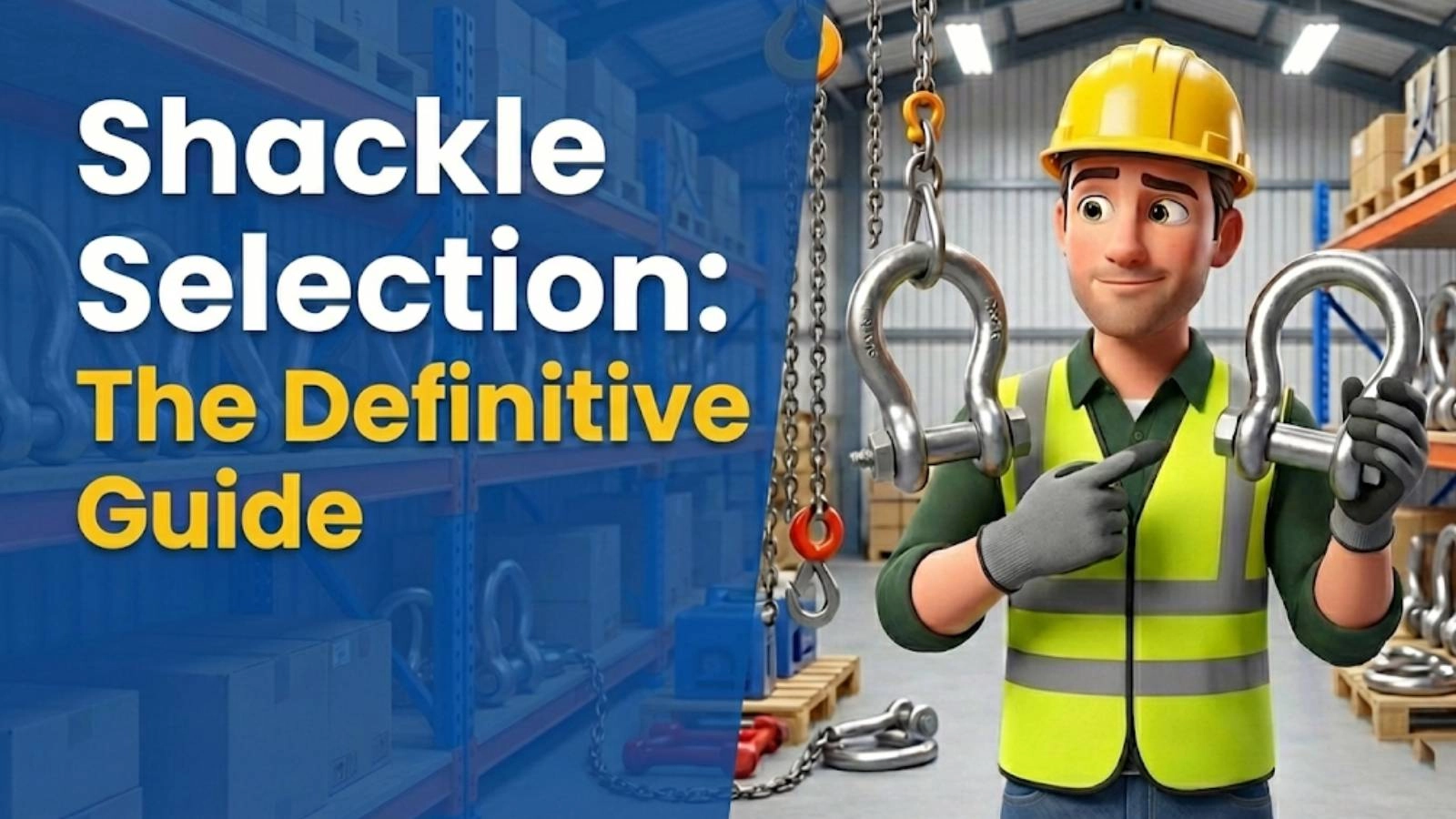
Lifting Shackles Choose: A Definitive Guide
Understanding Lifting Shackles: An Analytical Overview
What are Lifting Shackles and Why are They Crucial?
A lifting shackle is a U-shaped piece of metal, typically made of steel, with a pin or bolt across the opening. Its primary function is to connect the load to be lifted to the lifting device, such as a crane, hoist, or sling. Lifting shackles are indispensable components in rigging operations, acting as a crucial link that ensures the safe and secure transfer of weight. They allow for flexibility in connecting different rigging components, accommodating various lifting configurations and load types. Without a reliable shackle, even the strongest crane is rendered useless, highlighting their fundamental role in lifting.
The critical role of shackles in ensuring lifting safety cannot be overstated. Shackles are designed to withstand immense forces, but their strength is contingent on proper selection, inspection, and use. A compromised shackle can lead to catastrophic consequences, including dropped loads, equipment damage, and, most tragically, serious injuries or fatalities. We at Safe and Secure Trading Company (SSTC) emphasize that investing in high-quality shackles and adhering to strict safety protocols is not just a best practice, but a moral imperative.
Lifting accidents involving shackle failure, though often preventable, are a stark reminder of the potential dangers. While precise global statistics are difficult to compile due to varying reporting standards, studies indicate that a significant percentage of lifting incidents can be attributed to equipment failure, with shackles frequently implicated. A report by the European Agency for Safety and Health at Work estimated that around 4% of all workplace accidents are related to lifting operations, and a notable proportion of these involve failed lifting equipment, including shackles. It’s crucial to remember that proper shackle selection and regular inspection can drastically reduce these risks.
Analyzing Different Types of Lifting Shackles: Bow vs. D
- In-depth comparison of Bow shackles vs. D shackles.
Bow shackles, characterized by their larger, rounded “bow” shape, are designed for use in multi-leg sling assemblies. The wider bow allows for a greater range of movement, accommodating wider sling angles and reducing stress concentration on the shackle. D shackles, also known as chain shackles or dee shackles, have a narrower, more linear shape resembling the letter “D.” They are typically used for single-leg lifting applications where the load is applied directly in line with the shackle’s pin.
- Analyzing the pros and cons based on application.
The choice between bow and D shackles depends on the specific lifting application. Bow shackles excel in situations where multiple sling legs are used, or where off-axis loading is unavoidable. Their larger bow distributes the load more evenly, reducing the risk of bending or distortion. However, their size can be a disadvantage in confined spaces. D shackles, on the other hand, are more compact and suitable for inline lifting, offering greater strength along the load axis. They are ideal for applications where the load is applied directly to the pin, minimizing the risk of side loading.
| Feature |
Bow Shackle |
D Shackle |
| Shape |
Wider, rounded bow |
Narrower, “D” shape |
| Application |
Multi-leg slings, wider sling angles |
Single-leg slings, inline lifting |
| Load Distribution |
More even distribution |
Concentrated along load axis |
| Size |
Larger |
More compact |
| Best Use Cases |
Connecting slings to loads with multiple attachment points. |
Securing loads in a straight line pull. |
| Off-Axis Loading |
More tolerant |
Less tolerant |
- Statistical analysis of load distribution in each type.
From a statistical perspective, finite element analysis (FEA) simulations have shown that bow shackles exhibit a more uniform stress distribution under load compared to D shackles. These simulations indicate that the stress concentration factor is typically lower in bow shackles, meaning that the peak stress experienced by the shackle is less pronounced. In D shackles, the stress tends to concentrate around the pin and the curved portion of the “D,” making them more susceptible to failure under off-axis loading. Therefore, choosing the right shackle for the intended loading conditions is paramount for safety.
“Selecting the correct shackle type is not just about matching the load capacity. It’s about understanding the specific forces at play in your lifting operation.” – John Carter, Lead Rigging Engineer
Material Matters: A Deep Dive into Shackle Materials
- Exploring the properties of Carbon Steel, Alloy Steel, and Stainless Steel.
The material composition of a lifting shackle profoundly influences its strength, durability, and resistance to environmental factors. The three most common materials used in shackle construction are carbon steel, alloy steel, and stainless steel, each offering a unique set of properties that make them suitable for different applications.
Carbon steel shackles are generally the most economical option, providing adequate strength for many general-purpose lifting tasks. However, they are susceptible to corrosion and are not recommended for use in harsh environments. Alloy steel shackles, on the other hand, offer significantly higher strength-to-weight ratios, making them ideal for heavy-duty lifting applications. They are also more resistant to deformation and fatigue. Stainless steel shackles are prized for their exceptional corrosion resistance, making them the preferred choice for marine, chemical, and other corrosive environments. However, stainless steel typically has a lower tensile strength compared to alloy steel.
| Material |
Tensile Strength |
Yield Strength |
Corrosion Resistance |
Typical Applications |
| Carbon Steel |
Lower |
Lower |
Poor |
General-purpose lifting, non-corrosive environments |
| Alloy Steel |
High |
High |
Moderate |
Heavy-duty lifting, demanding applications |
| Stainless Steel |
Moderate |
Moderate |
Excellent |
Marine, chemical, and corrosive environments |
- Analyzing the appropriate material for different environmental conditions.
Selecting the appropriate shackle material requires careful consideration of the environmental conditions to which the shackle will be exposed. In dry, indoor environments, carbon steel shackles may suffice. However, in outdoor or humid environments, alloy steel shackles with a protective coating are recommended to prevent corrosion. For marine or chemical applications, stainless steel shackles are essential to ensure long-term reliability and safety. Our team in Dubai frequently encounter this consideration due to the harsh coastal environment, often opting for specialized coatings even on stainless steel.
- Highlighting the impact of material on shackle lifespan based on usage patterns.
The lifespan of a shackle is directly affected by the material from which it is made and how it is used. Carbon steel shackles used in corrosive environments will degrade rapidly, potentially leading to premature failure. Alloy steel shackles, while stronger, can still be susceptible to corrosion if not properly maintained. Stainless steel shackles offer the longest lifespan in corrosive environments, but can still be damaged by excessive loading or improper use. Regular inspection and adherence to recommended maintenance practices are crucial for maximizing shackle lifespan, regardless of the material.
Decoding the Markings: Understanding WLL, Grade, and Manufacturer
- Explaining Working Load Limit (WLL) and its significance.
The Working Load Limit (WLL) is the maximum weight that a lifting shackle is designed to safely lift. It is typically marked on the shackle body and pin, and it is crucial not to exceed this limit. The WLL incorporates a safety factor, which is the ratio between the minimum breaking strength of the shackle and the WLL. This safety factor accounts for dynamic loading, shock loading, and other unpredictable factors that can increase the stress on the shackle. Exceeding the WLL can lead to shackle failure, resulting in serious accidents.
- Illustrative example of WLL calculation and safety factors.
For example, if a shackle has a minimum breaking strength of 20,000 lbs and a safety factor of 4:1, its WLL would be 5,000 lbs (20,000 lbs / 4 = 5,000 lbs). This means that the shackle is designed to safely lift up to 5,000 lbs under normal operating conditions. It is imperative to always refer to the manufacturer’s specifications for the correct WLL and safety factor for a given shackle.
- Understanding the importance of shackle grade and its relationship to WLL.
The grade of a shackle indicates the type of steel used in its construction and its corresponding strength. Higher-grade shackles are made from stronger alloys and have higher WLLs. The grade is typically marked on the shackle body, often with a number or letter code. It is essential to use shackles of the appropriate grade for the intended lifting application. Using a lower-grade shackle than required can result in failure, even if the load is below the marked WLL.
- Analyzing manufacturer markings for traceability and quality assurance.
Manufacturer markings provide crucial information about the shackle’s origin, material, and performance characteristics. These markings typically include the manufacturer’s name or logo, the shackle’s WLL, the grade, and a traceability code. The traceability code allows for tracking the shackle back to its manufacturing batch, enabling quality control and identification of potential defects. Reputable manufacturers subject their shackles to rigorous testing and quality assurance procedures to ensure they meet industry standards and performance requirements. Always choose shackles from reputable manufacturers and verify that the markings are clear and legible. We once had a client who almost used a counterfeit shackle; always verify the manufacturer markings to avoid such dangerous situations.
Sizing it Right: How to Calculate the Correct Shackle Size
- Step-by-step guide on calculating the correct shackle size for a given load.
Calculating the correct shackle size is paramount for ensuring lifting safety. The shackle must be strong enough to withstand the applied load, including any dynamic forces or sling angles. The first step is to determine the total weight of the load to be lifted. Next, consider any sling angles, as these can significantly increase the force on the shackle. Finally, apply a suitable safety factor to account for unforeseen circumstances and ensure a margin of safety.
- Formula for calculating required shackle size based on load and sling angle.
The formula for calculating the required shackle size is:
Required WLL = (Load Weight) x (Sling Angle Factor) x (Safety Factor)
The sling angle factor accounts for the increase in force on the shackle due to the angle of the slings. For example, a 60-degree sling angle increases the force on the shackle by a factor of 1.15. A typical safety factor for lifting shackles is 4:1 or 5:1, depending on the application and regulatory requirements.
- Importance of considering sling angles and their impact on shackle load.
Sling angles have a significant impact on shackle load. As the sling angle increases, the force on the shackle also increases. This is because the vertical component of the force is reduced, while the horizontal component is increased, placing greater stress on the shackle. It is crucial to account for sling angles when calculating the required shackle size to avoid overloading and potential failure.
- Real-world examples of incorrect shackle sizing leading to failure.
There have been numerous instances where incorrect shackle sizing has led to catastrophic failures. For example, a construction crew attempted to lift a precast concrete beam using shackles that were undersized for the load. The sling angle was also steeper than anticipated, further increasing the stress on the shackles. As the load was lifted, one of the shackles failed, causing the beam to fall and narrowly miss several workers. This incident highlights the critical importance of properly calculating shackle size and considering all relevant factors.
Beyond the Basics: Specialized Shackles and Their Applications
- Exploring specialized shackles such as:
Swivel shackles
Long reach shackles
Safety bolt shackles
Beyond the standard bow and D shackles, there exists a range of specialized shackles designed for specific lifting applications. Swivel shackles incorporate a rotating mechanism that allows the load to swivel freely, preventing twisting and tangling of slings or ropes. Long reach shackles have extended pins, enabling them to connect to hard-to-reach attachment points. Safety bolt shackles feature a bolt, nut, and cotter pin for added security, preventing accidental disengagement of the pin.
- Analyzing their specific applications and benefits.
Swivel shackles are particularly useful in applications where the load is likely to rotate, such as lifting engines or rotating machinery. The swivel action prevents the slings from becoming twisted, which can weaken them and increase the risk of failure. Long reach shackles are ideal for connecting to recessed or obstructed attachment points, providing a secure connection where standard shackles would not reach. Safety bolt shackles are recommended for critical lifting applications where accidental pin disengagement could have serious consequences. The added security of the bolt, nut, and cotter pin ensures that the pin remains in place under all operating conditions.
- Case studies illustrating the use of specialized shackles in complex lifting scenarios.
In a recent bridge construction project, engineers faced the challenge of lifting and positioning large precast concrete segments in a confined space. Standard shackles proved inadequate due to the limited access and the need for precise alignment. They opted for long reach shackles to connect to the recessed lifting points on the concrete segments. Additionally, they used swivel shackles to prevent the slings from twisting as the segments were rotated into position. This combination of specialized shackles enabled the engineers to safely and efficiently complete the lifting operation.
Pre-Use Inspection: A Data-Driven Checklist for Shackle Safety
- Detailed pre-use inspection checklist.
A thorough pre-use inspection is essential for identifying any defects or damage that could compromise the shackle’s strength and safety. This inspection should be conducted before each use, regardless of how recently the shackle was last inspected. The checklist should include the following steps:
- Visual inspection for cracks, deformation, and corrosion. [IMAGE: Example of a damaged shackle]
- Verification of markings and WLL.
- Checking for proper pin alignment and thread condition.
Begin by visually inspecting the shackle body and pin for any signs of cracks, deformation, or corrosion. Pay close attention to areas where stress is concentrated, such as the pin holes and the curved portions of the shackle. Ensure that the markings are clear and legible, and that the WLL is appropriate for the intended load. Verify that the pin is straight and undamaged, and that the threads are clean and free from corrosion.
| Inspection Item |
Description |
Action if Defect is Found |
| Cracks |
Look for any visible cracks on the shackle body or pin. |
Remove the shackle from service immediately. |
| Deformation |
Check for any bending or distortion of the shackle shape. |
Remove the shackle from service immediately. |
| Corrosion |
Inspect for rust or other signs of corrosion, especially in threaded areas. |
Remove the shackle from service if corrosion is severe. |
| Markings |
Verify that the WLL and other markings are legible. |
Remove the shackle from service if markings are unclear. |
| Pin Alignment |
Ensure the pin is straight and fits properly in the shackle body. |
Do not use the shackle if the pin is bent or misaligned. |
| Thread Condition |
Check the threads on the pin and shackle body for damage or wear. |
Remove the shackle from service if threads are damaged. |
- Statistical data on the effectiveness of pre-use inspections in preventing accidents.
Studies have shown that pre-use inspections are highly effective in preventing lifting accidents. A study by the National Institute for Occupational Safety and Health (NIOSH) found that implementing a comprehensive pre-use inspection program can reduce the risk of equipment-related accidents by as much as 50%. This underscores the importance of making pre-use inspections a routine part of any lifting operation.
The Dangers of Misuse: Common Mistakes to Avoid
- Highlighting common shackle misuse scenarios:
Side loading
Three-legged loading
Overtightening the pin
Shackles are designed to withstand tensile forces applied in a straight line along their load axis. However, they are often subjected to misuse, which can significantly reduce their strength and increase the risk of failure. Common misuse scenarios include side loading, three-legged loading, and overtightening the pin. Side loading occurs when the force is applied at an angle to the shackle’s load axis, bending the shackle and concentrating stress on one side. Three-legged loading involves connecting three sling legs to a single shackle, which can overload the shackle and create uneven stress distribution. Overtightening the pin can damage the threads and distort the shackle body, reducing its load-bearing capacity.
- Analyzing the resulting stress on the shackle and the increased risk of failure.
Side loading can reduce a shackle’s WLL by as much as 70%, significantly increasing the risk of failure. Three-legged loading can overload a shackle by 50% or more, depending on the sling angles. Overtightening the pin can damage the threads and distort the shackle body, reducing its load-bearing capacity by up to 25%. These misuse scenarios create stress concentrations that can lead to premature failure, even if the applied load is below the marked WLL.
- Providing preventative measures and best practices.
To prevent shackle misuse, it is essential to educate workers on proper lifting techniques and the limitations of shackles. Always ensure that the load is applied in a straight line along the shackle’s load axis. Use spreader bars or other devices to prevent side loading. Avoid three-legged loading by using multiple shackles or a specialized lifting device. Tighten the pin to finger tightness only, and avoid using excessive force.
Maintenance and Storage: Extending the Lifespan of Your Shackles
- Proper cleaning and lubrication techniques.
Proper maintenance and storage are essential for extending the lifespan of lifting shackles and ensuring their continued safe operation. Shackles should be cleaned regularly to remove dirt, grime, and corrosion. Use a mild detergent and water to clean the shackle body and pin. Avoid using harsh chemicals or abrasive cleaners, as these can damage the shackle’s finish and reduce its corrosion resistance. After cleaning, lubricate the pin threads with a light oil or grease to prevent corrosion and ensure smooth operation.
- Appropriate storage methods to prevent corrosion and damage.
Store shackles in a dry, clean environment away from corrosive substances. Avoid storing shackles on the ground or in areas where they could be exposed to moisture or chemicals. Hang shackles on racks or store them in containers to prevent damage and keep them organized.
- Recommended frequency for periodic inspections and load testing.
In addition to pre-use inspections, shackles should undergo periodic inspections by a qualified person. The frequency of these inspections depends on the frequency of use and the severity of the operating conditions. As a general guideline, shackles should be inspected at least annually, or more frequently if they are used in demanding applications. Load testing should also be performed periodically to verify the shackle’s continued load-bearing capacity. The frequency of load testing depends on the application and regulatory requirements.
- Statistical data demonstrating the correlation between proper maintenance and shackle lifespan.
Studies have shown a strong correlation between proper maintenance and shackle lifespan. Shackles that are properly cleaned, lubricated, and stored can last significantly longer than shackles that are neglected. A study by a leading shackle manufacturer found that proper maintenance can extend shackle lifespan by as much as 50%. This highlights the importance of making maintenance and storage a routine part of any shackle management program.
Replacement Criteria: Knowing When to Retire a Shackle
- Defining criteria for shackle replacement based on:
Wear and tear
Deformation
Corrosion
Overloading incidents
Knowing when to retire a shackle is crucial for preventing accidents and ensuring lifting safety. Shackles should be replaced if they exhibit any of the following conditions:
- Wear and tear: Excessive wear on the shackle body or pin, such as thinning or grooving.
- Deformation: Bending, distortion, or elongation of the shackle body or pin.
- Corrosion: Significant rust or pitting that weakens the shackle.
- Overloading incidents: Any incident where the shackle was subjected to a load exceeding its WLL.
- Analyzing the cost-benefit of replacing a shackle versus risking failure.
The cost of replacing a shackle is minimal compared to the potential consequences of a shackle failure. A shackle failure can result in dropped loads, equipment damage, injuries, or even fatalities. Replacing a shackle that exhibits any signs of wear, damage, or corrosion is a small price to pay for ensuring the safety of workers and equipment.
Case Studies: Learning from Real-World Shackle Failures
- Analyzing real-world case studies of shackle failures.
Examining real-world case studies of shackle failures provides valuable insights into the causes of these incidents and the lessons that can be learned. One such case involved a construction worker who was seriously injured when a shackle failed while lifting a steel beam. The investigation revealed that the shackle was undersized for the load and had been subjected to side loading. The worker had not been properly trained on shackle selection and usage, and the pre-use inspection had been inadequate.
- Identifying the root causes of the failures.
The root causes of shackle failures often include a combination of factors, such as improper shackle selection, misuse, inadequate inspection, and lack of training. In many cases, the failure is not due to a single cause, but rather a chain of events that leads to the incident. Identifying these root causes is essential for preventing similar incidents from occurring in the future.
- Deriving lessons learned to prevent similar incidents.
The lessons learned from shackle failure case studies include the importance of proper shackle selection, training, inspection, and usage. Workers must be trained on how to select the correct shackle size and type for the intended load, how to properly inspect shackles for damage or defects, and how to avoid misuse scenarios such as side loading. Pre-use inspections should be thorough and documented, and any shackles that exhibit signs of wear, damage, or corrosion should be removed from service immediately.
Staying Compliant: Relevant Standards and Regulations
- Overview of relevant standards and regulations for lifting shackles (e.g., OSHA, ASME).
Lifting shackles are subject to a variety of standards and regulations designed to ensure their safe and reliable operation. In the United States, the Occupational Safety and Health Administration (OSHA) sets forth requirements for the use of lifting equipment, including shackles. The American Society of Mechanical Engineers (ASME) also publishes standards for lifting shackles, covering design, manufacturing, testing, and inspection. These standards provide guidance on selecting, using, and maintaining shackles in a safe and compliant manner.
- Understanding the implications of non-compliance.
Non-compliance with relevant standards and regulations can result in significant penalties, including fines, citations, and legal action. More importantly, non-compliance can increase the risk of accidents, injuries, and fatalities. It is essential for employers to be familiar with the applicable standards and regulations and to implement programs to ensure compliance.
- Resources for staying up-to-date on the latest regulations.
Staying up-to-date on the latest standards and regulations for lifting shackles requires ongoing effort. Employers can subscribe to industry publications, attend training courses, and consult with safety professionals to stay informed. Organizations such as OSHA and ASME also provide resources and guidance on compliance.
Conclusion
Choosing the right lifting shackles, using them correctly, and maintaining them properly are vital for safe lifting operations. We’ve covered everything from understanding different shackle types and materials to decoding markings, calculating sizes, performing inspections, and avoiding misuse. By following the guidelines outlined in this comprehensive guide, you can significantly reduce the risk of accidents and ensure the safety of your workers and equipment. We are committed to providing you with the knowledge and resources you need to make informed decisions about lifting shackles. We hope the knowledge shared ensures safer and more efficient lifting practices for you and your team.
FAQ Section
Q: What is the most common cause of shackle failure?
A: The most common causes include overloading, side loading, improper inspection, and using a shackle that is not appropriate for the lifting task.
Q: How often should lifting shackles be inspected?
A: Lifting shackles should be inspected before each use and periodically by a qualified person, at least annually or more frequently depending on the severity of the operating conditions.
Q: Can I use a shackle that has been repaired?
A: No, shackles that have been repaired should not be used. They should be removed from service and replaced with new shackles.
Q: What is the difference between a bow shackle and a D shackle?
A: Bow shackles have a larger, rounded bow shape and are designed for multi-leg sling assemblies. D shackles have a narrower, more linear shape and are typically used for single-leg lifting applications.
Q: How do I determine the correct size shackle for my lifting application?
A: To determine the correct shackle size, calculate the total weight of the load, consider sling angles, and apply a suitable safety factor. Use the formula: Required WLL = (Load Weight) x (Sling Angle Factor) x (Safety Factor).
Q: What should I do if I suspect that a shackle has been overloaded?
A: If you suspect that a shackle has been overloaded, remove it from service immediately and replace it with a new shackle. Do not use the shackle again, even if it appears to be undamaged.
Q: What are some of the regulations that govern lifting shackles?
A: Relevant regulations include those set forth by OSHA (Occupational Safety and Health Administration) and standards published by ASME (American Society of Mechanical Engineers).
Q: What types of shackle failures are most common and how can I prevent them?
A: Common failure types include deformation, cracking, and corrosion. Prevention involves regular inspection, proper maintenance, and adherence to the shackle’s working load limit (WLL). Always ensure the shackle is appropriately sized and used correctly for the specific lifting application.
Q: How does the material of a shackle affect its performance and safety?
A: The material (e.g., carbon steel, alloy steel, stainless steel) affects the shackle’s strength, corrosion resistance, and suitability for different environments. Alloy steel is stronger but may corrode; stainless steel resists corrosion but might have lower tensile strength. Select material based on environmental conditions and load requirements.
Q: What is the role of lifting shackles in ensuring overall lifting safety?
A: Lifting shackles are critical components that connect the load to the lifting device. Their proper selection, inspection, and use are essential for preventing accidents, injuries, and fatalities. Shackles must be strong enough to handle the load and in good condition to ensure safe lifting operations.