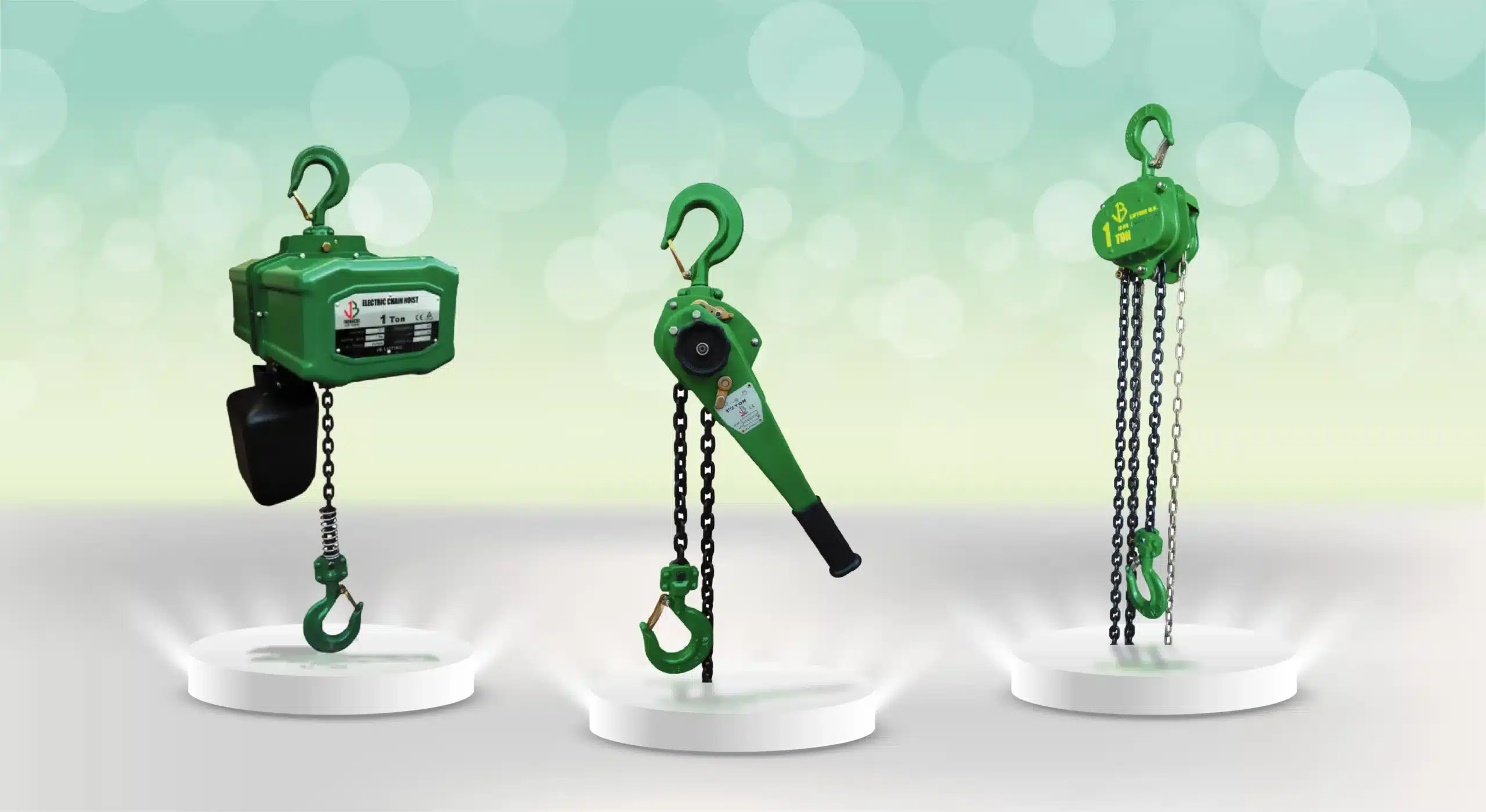
Electric Chain Hoist: Avoid These Mistakes
Selecting the right electric chain hoist is a critical decision for any business involved in material handling. An electric chain hoist can significantly improve efficiency and safety in various industrial applications. However, choosing the wrong hoist or neglecting proper maintenance can lead to costly mistakes. As experts at Safe and Secure Trading Company (SSTC), we’ve seen firsthand how these errors can impact operations. Let’s delve into the common pitfalls to avoid when selecting and maintaining an electric chain hoist.
Key Takeaways
- Selecting the right electric chain hoist requires careful consideration of capacity, lift height, and environmental factors.
- Ignoring duty cycle limitations can lead to premature wear and failure.
- Proper maintenance and inspections are crucial for safety and longevity.
Common Mistakes When Choosing an Electric Chain Hoist ⚠️
Many businesses rush the selection process, overlooking key factors that impact performance and safety. We often encounter companies that prioritize immediate needs without considering long-term implications. This short-sighted approach can result in choosing a hoist that isn’t suitable for their specific application, leading to inefficiencies, safety hazards, and increased maintenance costs.
We’ve seen clients struggle when they prioritize price over quality, leading to frequent breakdowns and costly repairs. In our experience with clients here in Dammam, Saudi Arabia, we’ve seen this repeatedly. A slightly more expensive, high-quality hoist can often provide a better return on investment in the long run. It’s essential to consider the total cost of ownership, including maintenance, repairs, and downtime, when making your selection.
Mistake #1: Ignoring the Required Lifting Capacity
- The Error: Underestimating the weight of the loads you’ll be lifting.
- The Risk: Overloading can damage the hoist, the load, and potentially cause serious accidents.
- The Solution: Always choose a hoist with a capacity that exceeds the maximum weight you’ll be lifting by at least 20%. Account for any additional weight from slings or other lifting accessories.
One of the most common mistakes is failing to accurately assess the required hoist capacity. Underestimating the weight of the loads can lead to dangerous overloading situations. This not only damages the electric chain hoist itself but also poses a significant safety risk to personnel and the surrounding environment. In our experience, it’s always better to err on the side of caution and select a hoist with a higher capacity than initially anticipated.
Overloading an electric chain hoist can have severe consequences. It can cause the chain to break, the motor to burn out, or the entire hoist to collapse. A common mistake we help businesses fix is the habit of relying on assumed weights rather than verified measurements. We once worked with a client who struggled with frequent hoist failures. By accurately measuring the weights of their loads and upgrading to a hoist with adequate capacity, they saw a significant improvement in safety and reliability.
Always factor in the weight of any lifting accessories, such as slings, shackles, or lifting beams, when calculating the total load weight. These accessories can add significant weight and should not be overlooked. As a general rule, we recommend choosing an electric chain hoist with a capacity that exceeds the maximum anticipated load weight by at least 20%. This provides a safety margin and helps to prevent overloading.
Mistake #2: Neglecting the Lifting Height 📏
- The Error: Failing to accurately measure the required lifting height.
- The Risk: A hoist with insufficient chain length won’t be able to lift the load to the desired height.
- The Solution: Measure the distance from the hoist mounting point to the desired load height. Add a safety margin to ensure adequate chain length.
Another frequent oversight is neglecting to accurately measure the required lifting height. Selecting an electric chain hoist with insufficient chain length can render it useless for the intended application. This can lead to project delays, increased costs, and frustration. It’s crucial to carefully measure the distance from the hoist’s mounting point to the desired load height and select a hoist with adequate chain length.
Failing to consider the lifting height can create significant limitations. If the hoist chain is too short, you won’t be able to lift the load to the required height, preventing you from completing the task. We’ve consistently seen that businesses often forget to account for overhead obstructions or the height of the load itself when determining the necessary lifting height.
Always measure the lifting height under the most demanding conditions. Consider the maximum height you’ll need to lift the load, and add a safety margin to ensure you have sufficient chain length. We advise our clients to add at least a few extra feet to the measurement to account for any unforeseen circumstances or changes in their lifting requirements.
Mistake #3: Overlooking the Duty Cycle
- The Error: Using a hoist beyond its intended duty cycle (the amount of time it can operate safely within a given period).
- The Risk: Overheating, premature wear, and potential failure of the hoist motor.
- The Solution: Select a hoist with a duty cycle that matches your application’s demands. Consider the frequency and duration of lifting operations.
The duty cycle of an electric chain hoist is a critical factor that is often overlooked. The duty cycle refers to the amount of time the hoist can operate safely within a given period, typically expressed as a percentage. Exceeding the hoist’s duty cycle can lead to overheating, premature wear, and ultimately, failure of the motor. It’s essential to select a hoist with a duty cycle that matches the demands of your application.
Different applications require different duty cycles. For example, a hoist used in a high-volume production environment will require a higher duty cycle than a hoist used for occasional maintenance tasks. If you’re unsure about the duty cycle requirements for your application, it’s best to consult with a qualified lifting equipment specialist. When our team in KSA tackles this issue, they often find businesses operating their hoists far beyond the recommended duty cycle.
We recommend carefully assessing the frequency and duration of lifting operations when selecting an electric chain hoist. Consider how often the hoist will be used, the average lifting time, and the amount of time between lifts. This information will help you determine the appropriate duty cycle for your application. Choosing a hoist with a higher duty cycle than required is always preferable to selecting one that is inadequate.
Mistake #4: Ignoring Power Supply Requirements ⚡
- The Error: Mismatching the hoist’s voltage and phase requirements with your facility’s power supply.
- The Risk: Damage to the hoist motor, electrical hazards, and potential downtime.
- The Solution: Verify that the hoist’s power requirements (voltage, phase, amperage) are compatible with your electrical system. Use appropriate wiring and circuit protection.
Failing to match the electric chain hoist’s power supply requirements with your facility’s electrical system can result in serious problems. A mismatch in voltage, phase, or amperage can damage the hoist motor, create electrical hazards, and lead to costly downtime. Before purchasing a hoist, it’s crucial to verify that its power requirements are compatible with your electrical infrastructure.
Many facilities have different power supply configurations. Some may have single-phase power, while others have three-phase power. The voltage levels can also vary. It’s essential to know the voltage and phase of your power supply and select an electric chain hoist that is compatible. In our experience, the easiest and most cost effective way to solve the problem is to choose an electric chain hoist with compatible electrical requirements.
We advise our clients to consult with a qualified electrician to ensure that the hoist’s power requirements are met. The electrician can verify the voltage and phase of your power supply and recommend the appropriate wiring and circuit protection. Using the wrong wiring or circuit protection can create electrical hazards and damage the hoist.
Mistake #5: Neglecting Environmental Factors 🌡️
- The Error: Failing to consider the operating environment (temperature, humidity, dust, corrosive substances).
- The Risk: Corrosion, motor damage, and reduced hoist lifespan.
- The Solution: Choose a hoist designed for the specific environment. Consider features like corrosion-resistant coatings, enclosed motors, and IP ratings for protection against dust and moisture.
The operating environment can significantly impact the performance and lifespan of an electric chain hoist. Neglecting to consider environmental factors such as temperature, humidity, dust, and corrosive substances can lead to corrosion, motor damage, and reduced hoist lifespan. It’s important to choose a hoist that is designed for the specific environment in which it will be used.
For example, in environments with high humidity or exposure to corrosive substances, it’s essential to select a hoist with corrosion-resistant coatings and sealed components. In dusty environments, a hoist with an enclosed motor and an IP rating for dust protection is recommended. In our experience, businesses located near the sea often struggle with corrosion issues.
“Properly selecting equipment designed for your specific environment can drastically reduce maintenance costs and extend the lifespan of your equipment.” – Omar Hassan, Lead Mechanical Engineer
We advise our clients to carefully assess the operating environment and choose an electric chain hoist with appropriate features and protections. This will help to prevent damage and ensure the hoist’s longevity. Consider features like corrosion-resistant coatings, enclosed motors, IP ratings for dust and moisture protection, and temperature ratings.
Mistake #6: Skipping Pre-Operational Inspections 🔎
- The Error: Failing to inspect the hoist before each use.
- The Risk: Undetected damage or wear can lead to accidents and equipment failure.
- The Solution: Conduct a thorough pre-operational inspection, checking for frayed or damaged chains, worn hooks, and proper functioning of controls and limit switches.
One of the most critical safety measures is performing a pre-operational inspection before each use of the electric chain hoist. Failing to do so can result in undetected damage or wear, leading to accidents and equipment failure. A thorough pre-operational inspection should include checking the chain for wear, damage, and proper lubrication, inspecting the hooks for cracks or deformation, and verifying the proper functioning of controls and limit switches.
A pre-operational inspection is a simple yet effective way to identify potential problems before they escalate into serious issues. It only takes a few minutes to perform, but it can significantly reduce the risk of accidents and equipment damage. We’ve consistently seen that companies with robust pre-operational inspection programs have fewer accidents and lower maintenance costs.
We recommend developing a checklist for pre-operational inspections to ensure that all critical components are checked. The checklist should include items such as:
- Chain condition (wear, damage, lubrication)
- Hook condition (cracks, deformation)
- Controls and limit switches (proper functioning)
- Wiring and connections (damage, loose connections)
- Emergency stop button (proper functioning)
Mistake #7: Improper Chain Maintenance ⚙️
- The Error: Neglecting chain lubrication and regular inspections.
- The Risk: Chain wear, corrosion, and potential failure.
- The Solution: Regularly lubricate the chain with a manufacturer-recommended lubricant. Inspect the chain for wear, damage, and elongation. Replace the chain if it exceeds wear limits.
Proper chain maintenance is essential for ensuring the safe and reliable operation of an electric chain hoist. Neglecting chain lubrication and regular inspections can lead to chain wear, corrosion, and potential failure. The chain is a critical component of the hoist, and its condition directly impacts safety and performance.
Regular lubrication helps to reduce friction and wear, extending the lifespan of the chain. We recommend using a manufacturer-recommended lubricant and applying it evenly along the entire length of the chain. Avoid over-lubrication, which can attract dirt and debris. We once worked with a client who struggled with frequent chain failures. By implementing a regular chain lubrication program, they significantly reduced chain wear and extended the chain’s lifespan.
Regular inspections are also crucial for identifying potential problems. Inspect the chain for wear, damage, and elongation. Consult the manufacturer’s guidelines for acceptable wear limits. If the chain exceeds these limits, it must be replaced immediately.
Mistake #8: Ignoring Load Limit Devices 🚫
- The Error: Tampering with or disabling load limit devices.
- The Risk: Overloading the hoist, which can lead to accidents and equipment damage.
- The Solution: Ensure that load limit devices are properly functioning and never bypassed. Train operators on the importance of load limits and the consequences of exceeding them.
Load limit devices are designed to prevent overloading the electric chain hoist. Tampering with or disabling these devices can have catastrophic consequences, leading to accidents and equipment damage. Load limit devices should never be bypassed or disabled. They are a critical safety feature that protects both personnel and equipment.
Load limit devices typically consist of a sensor that detects when the hoist is approaching its maximum capacity. When the load exceeds the limit, the device will automatically stop the hoist from lifting further. This prevents overloading and reduces the risk of accidents. In our experience, some operators may be tempted to bypass load limit devices to lift heavier loads. This is extremely dangerous and should never be done.
We advise our clients to ensure that load limit devices are properly functioning and never bypassed. Train operators on the importance of load limits and the consequences of exceeding them. Regularly inspect load limit devices to ensure they are working correctly. Replace any damaged or malfunctioning devices immediately.
Mistake #9: Lack of Operator Training 🧑🏫
- The Error: Allowing untrained personnel to operate the hoist.
- The Risk: Improper operation, accidents, and damage to equipment and property.
- The Solution: Provide comprehensive training to all operators on safe operating procedures, inspection requirements, and emergency procedures.
Allowing untrained personnel to operate an electric chain hoist is a recipe for disaster. Improper operation can lead to accidents, equipment damage, and even injuries. It’s crucial to provide comprehensive training to all operators on safe operating procedures, inspection requirements, and emergency procedures. In our experience with clients, this is one of the most common oversights and the easiest to fix.
Operator training should cover topics such as:
- Safe operating procedures
- Pre-operational inspection requirements
- Load limit awareness
- Emergency procedures
- Proper use of slings and other lifting accessories
- Lockout/tagout procedures
Training should be conducted by a qualified instructor and should include both classroom instruction and hands-on practice. Operators should be required to demonstrate their understanding of safe operating procedures before being allowed to operate the hoist independently. We’ve consistently seen that well-trained operators are more likely to operate the hoist safely and efficiently.
| Mistake |
Risk |
Solution |
| Ignoring Lifting Capacity |
Overloading, damage, accidents |
Choose a hoist with at least 20% excess capacity. |
| Neglecting Lifting Height |
Inability to lift loads to desired height |
Accurately measure lifting height and add a safety margin. |
| Overlooking Duty Cycle |
Overheating, premature wear, failure |
Select a hoist with a duty cycle matching your application. |
| Ignoring Power Supply |
Motor damage, electrical hazards, downtime |
Verify compatibility and use appropriate wiring. |
| Neglecting Environment |
Corrosion, motor damage, reduced lifespan |
Choose a hoist designed for the specific environment. |
| Skipping Inspections |
Undetected damage, accidents, failure |
Conduct thorough pre-operational inspections. |
| Improper Chain Maintenance |
Chain wear, corrosion, failure |
Lubricate and inspect the chain regularly. |
| Ignoring Load Limits |
Overloading, accidents, damage |
Ensure load limit devices are functioning and never bypassed. |
| Lack of Training |
Improper operation, accidents, damage |
Provide comprehensive operator training. |
Conclusion
Selecting and maintaining an electric chain hoist correctly is paramount for workplace safety and operational efficiency. By avoiding these common mistakes, you can ensure a longer hoist lifespan, reduce the risk of accidents, and optimize your lifting operations. We understand the importance of safe and efficient material handling, and we’re dedicated to providing our clients with the highest quality lifting equipment and services. At SSTC, we’re dedicated to helping you make informed decisions and maintain a safe working environment.
FAQ Section
- Q: How often should I inspect my electric chain hoist?
A: A pre-operational inspection should be performed before each use. A more thorough inspection should be conducted at least monthly, or more frequently depending on the severity of use.
- Q: What are the signs of a worn or damaged chain?
A: Look for signs of wear, corrosion, cracks, nicks, and elongation. Consult the manufacturer’s guidelines for acceptable wear limits.
- Q: How do I lubricate the chain on my electric chain hoist?
A: Use a manufacturer-recommended lubricant and apply it evenly along the entire length of the chain. Avoid over-lubrication, which can attract dirt and debris.
- Q: What is the duty cycle of an electric chain hoist?
A: The duty cycle is the percentage of time the hoist can operate within a given period (usually an hour) without overheating. Consult the manufacturer’s specifications for the duty cycle of your specific hoist model.