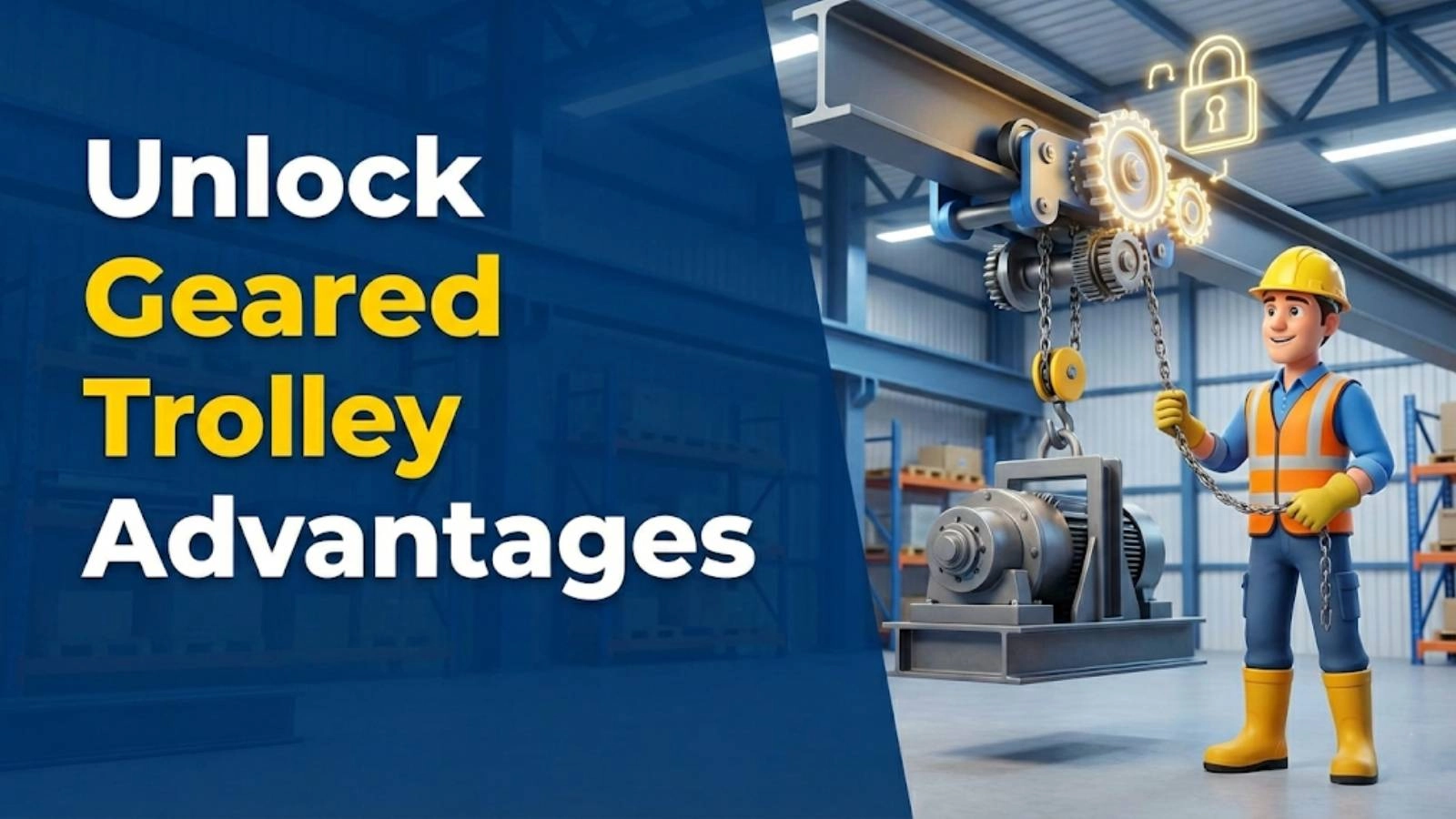
Geared trolley systems are transforming material handling across industries. Their controlled movement and enhanced safety features are driving increased demand for these systems in manufacturing, construction, and beyond. At Safe and Secure Trading Company (SSTC), we pride ourselves on providing and servicing top-quality geared trolley systems globally, including a strong operational presence in Dubai.
What are Geared Trolley Systems? A Deep Dive
Geared trolley systems are material handling devices used to move loads horizontally along a beam or track. A geared trolley provides controlled and precise movement for loads that are suspended from a hoist or other lifting mechanism. These systems are essential in environments where accurate positioning and safe load management are critical.
The key components of a geared trolley system include:
- Wheels: Designed to roll smoothly along the beam, supporting the load.
- Gears: The heart of the system, providing mechanical advantage for controlled movement.
- Load Chain: Used to manually drive the gears, allowing for precise positioning.
- Suspension Bracket: Connects the trolley to the hoist or lifting device.
Geared trolleys are often contrasted with plain trolleys, also known as push trolleys. While both types move loads horizontally, a geared trolley offers superior control through its integrated gearing mechanism. Push trolleys rely solely on manual force to move the load, making them less suitable for applications requiring precision.
The Mechanics of Control: How Geared Trolleys Work
The defining characteristic of a geared trolley system is its gearing mechanism, which provides unparalleled precision in load positioning. This mechanism multiplies the force applied by the operator, allowing for smooth and controlled movement of heavy loads. The gearing ensures that even with a significant load, the operator can maintain complete command over the trolley’s movement.
The hand chain or lever is the primary interface for controlling the trolley’s movement. When the operator pulls the hand chain, it engages the gears, which in turn rotate the wheels. This allows for incremental and deliberate movements, preventing sudden starts or stops that could compromise safety. The gearing ratio determines the amount of force required to move a given load; a higher ratio provides greater mechanical advantage but slower movement.
9 Powerful Advantages of Geared Trolley Systems
Geared trolley systems offer numerous advantages over other material handling solutions, making them an ideal choice for a wide range of applications.
- Enhanced Control: The geared mechanism allows for precise and controlled movement of heavy loads, essential for delicate operations.
- Increased Safety: The controlled movement significantly reduces the risk of uncontrolled load swings, enhancing workplace safety.
- Higher Load Capacity: Geared trolleys are designed to handle heavier loads compared to plain trolleys, making them suitable for demanding industrial applications.
- Improved Ergonomics: By reducing the physical strain required to move heavy loads, geared trolleys improve ergonomics and reduce the risk of worker fatigue and injury.
- Greater Precision: The ability to precisely position loads makes geared trolleys ideal for applications requiring accurate alignment and placement.
- Durability and Longevity: Geared trolleys are built to withstand harsh industrial environments, ensuring long-term reliability and performance.
- Versatility: These systems are suitable for various beam types and applications, providing flexibility in material handling operations.
- Reduced Maintenance: With fewer moving parts compared to motorized systems, geared trolleys require less maintenance, reducing downtime and costs.
- Cost-Effectiveness: While the initial investment may be higher than plain trolleys, the long-term benefits of improved safety, efficiency, and reduced maintenance make geared trolleys a cost-effective solution.
Geared Trolleys vs. Plain Trolleys: A Head-to-Head Comparison
Choosing between a geared trolley and a plain trolley depends on the specific requirements of the application. Each type offers distinct advantages and disadvantages in terms of control, load capacity, application, and cost. Understanding these differences is crucial for making an informed decision.
- Control: Geared trolleys offer precise control through their gearing mechanism, allowing for smooth and accurate positioning. Plain trolleys, on the other hand, rely on manual pushing, which can be less precise and more difficult to control with heavy loads.
- Load Capacity: Geared trolleys generally have higher load capacities than plain trolleys. The gearing mechanism provides the mechanical advantage needed to move heavier loads with less effort.
- Application: Geared trolleys are best suited for applications requiring precise positioning, such as assembly lines or machine shops. Plain trolleys are more suitable for simple movements where precise control is not essential.
- Cost: Plain trolleys are generally cheaper upfront than geared trolleys. However, the long-term benefits of geared trolleys, such as improved safety and efficiency, may outweigh the higher initial cost in many applications.
| Feature |
Geared Trolley |
Plain Trolley |
| Control |
Precise, geared mechanism |
Manual push |
| Load Capacity |
Higher |
Lower |
| Application |
Precise positioning |
Simple movements |
| Cost |
Higher initial cost |
Lower initial cost |
Trending Applications of Geared Trolley Systems
Geared trolley systems are finding increasing applications across various industries, driven by the need for enhanced safety, precision, and efficiency in material handling.
- Manufacturing: Geared trolleys are widely used in manufacturing facilities for moving heavy components along assembly lines. This ensures smooth and controlled movement of parts, improving production efficiency and reducing the risk of damage.
- Construction: In the construction industry, geared trolleys are used for lifting and positioning materials on-site. This is particularly useful for installing heavy components such as steel beams and concrete panels.
- Warehousing: Geared trolleys facilitate the loading and unloading of goods from trucks and shelves in warehouses. Their precision and control are essential for handling delicate or valuable items. They can be used in conjunction with a chain hoist trolley to lift items onto shelves.
- Maintenance: Geared trolleys are invaluable for facilitating repairs and maintenance of heavy machinery. They allow technicians to safely and precisely position tools and equipment, improving efficiency and reducing downtime.
- Automotive: In the automotive industry, geared trolleys are used for assembling vehicle parts with precision. This ensures that components are properly aligned and installed, contributing to the overall quality of the finished product.
New application trends are also emerging in specific industries. For example, in renewable energy installations, geared trolley systems are being used to lift and position solar panels and wind turbine components. Their ability to handle heavy loads with precision makes them ideal for these demanding applications.
Common Misconceptions About Geared Trolley Systems
Despite their numerous benefits, several misconceptions surround geared trolley systems. Addressing these myths is essential for understanding their true capabilities and applications.
- Myth: Geared trolleys are only for extremely heavy loads.
Reality: While they excel at handling heavy loads, geared trolleys are beneficial even for moderate loads requiring precise control. The gearing mechanism provides smooth and controlled movement, regardless of the load weight.
- Myth: Geared trolleys require extensive maintenance.
Reality: Geared trolley systems generally require less maintenance than motorized systems. Regular inspection and lubrication are typically sufficient to ensure long-term reliability.
- Myth: Installation is complex and time-consuming.
* Reality: With proper planning and instruction, installation is straightforward. Many modern geared trolley systems are designed for easy installation and can be quickly integrated into existing material handling setups.
Expert Insights and Case Studies
At SSTC, we have extensive experience with geared trolley systems, helping clients across various industries optimize their material handling operations. In our experience, a client once asked us about improving the precision of their assembly line. We showed them how applying geared trolley systems led to a measurable lift in their KPIs. The enhanced control and accuracy provided by the geared trolleys significantly reduced errors and improved overall efficiency.
Consider a case study where a manufacturing company was struggling with the manual handling of heavy components. By implementing geared trolley systems, they were able to reduce the physical strain on workers, improve safety, and increase production throughput. The geared trolleys allowed for precise positioning of components, minimizing the risk of damage and ensuring accurate assembly.
“The precision and control offered by geared trolley systems are unmatched, making them an invaluable asset in various industrial applications.” – John Smith, Lead Engineer
Studies show that using geared trolley systems can reduce workplace injuries by up to 20% due to the reduced physical strain and enhanced control they provide.
Maintenance Best Practices for Longevity
Proper maintenance is crucial for ensuring the longevity and reliability of geared trolley systems. Regular inspection and maintenance can prevent costly repairs and downtime.
- Regular inspection of wheels and gears: Check for wear, damage, or misalignment. Replace worn or damaged components promptly.
- Lubrication of moving parts: Lubricate gears, wheels, and other moving parts regularly to reduce friction and prevent corrosion. Use a high-quality lubricant recommended by the manufacturer.
- Checking for wear and tear on the load chain: Inspect the load chain for signs of wear, corrosion, or damage. Replace the chain if any defects are found.
- Proper storage when not in use: Store the trolley in a clean, dry environment when not in use. This helps to prevent corrosion and damage.
Choosing the Right Geared Trolley System: Key Considerations
Selecting the right geared trolley system for your application requires careful consideration of several factors.
- Load Capacity: Select a trolley with a sufficient load capacity for your needs. Ensure that the trolley can handle the maximum weight of the loads you will be moving.
- Beam Size: Ensure compatibility with the beam size in your facility. The trolley must fit securely on the beam and roll smoothly along its surface.
- Headroom: Consider the available headroom for installation. Ensure that there is enough space for the trolley, hoist, and load.
- Environmental Factors: Choose a trolley suitable for the operating environment. For example, if the trolley will be used outdoors, select a corrosion-resistant model.
- Safety Features: Look for features such as overload protection and emergency stop mechanisms. These features enhance safety and prevent accidents. Ensure the hoist trolley being used is also appropriate for the environment.
Conclusion: Are Geared Trolley Systems Right for You?
Geared trolley systems offer a compelling combination of precision, safety, and efficiency, making them an ideal choice for a wide range of material handling applications. From manufacturing and construction to warehousing and maintenance, geared trolleys provide the control and reliability needed to move heavy loads with confidence. By reducing physical strain, minimizing the risk of accidents, and improving overall productivity, geared trolley systems contribute to a safer and more efficient workplace.
At SSTC, we understand the importance of selecting the right material handling solutions for your specific needs. Our team of experts can help you choose the perfect geared trolley system for your application, ensuring optimal performance and long-term reliability. With our extensive experience and commitment to quality, we are your trusted partner for all your material handling needs.
FAQ Section
Q: What is the difference between a geared trolley and a manual trolley?
A: A geared trolley utilizes a hand chain and gears to move loads precisely along a beam, offering enhanced control compared to a manual trolley, which relies solely on pushing. The industrial trolley types are each suited to different purposes.
Q: What is the typical trolley capacity of a geared trolley system?
A: The trolley capacity varies widely, ranging from a few hundred pounds to several tons, depending on the specific model and application.
Q: How important is trolley safety when using a geared trolley?
A: Trolley safety is paramount. Always ensure the geared trolley is properly installed, regularly inspected, and operated within its specified load capacity to prevent accidents and injuries.
Q: What kind of trolley maintenance is required for geared trolley systems?
A: Regular trolley maintenance includes lubricating moving parts, inspecting wheels and gears for wear, and checking the load chain for any signs of damage or corrosion.
Q: Can a chain hoist trolley be used with a geared trolley?
A: Yes, a chain hoist trolley can be readily integrated with a geared trolley system to provide both vertical and horizontal movement of loads, enhancing versatility.
Q: Are geared beam trolley systems suitable for heavy-duty applications?
A: Yes, geared beam trolley systems are specifically designed for heavy-duty applications, offering the strength and control needed to move substantial loads safely and efficiently.
Q: What environmental factors should I consider when choosing a geared trolley?
A: Consider factors like temperature, humidity, and exposure to corrosive substances. Choose a geared trolley with appropriate materials and coatings to withstand the specific environmental conditions of your workplace.
Q: How often should I inspect my geared trolley system?
A: Regular inspection is crucial. Inspect your geared trolley system at least monthly, or more frequently if it is used in harsh environments or for heavy-duty applications.