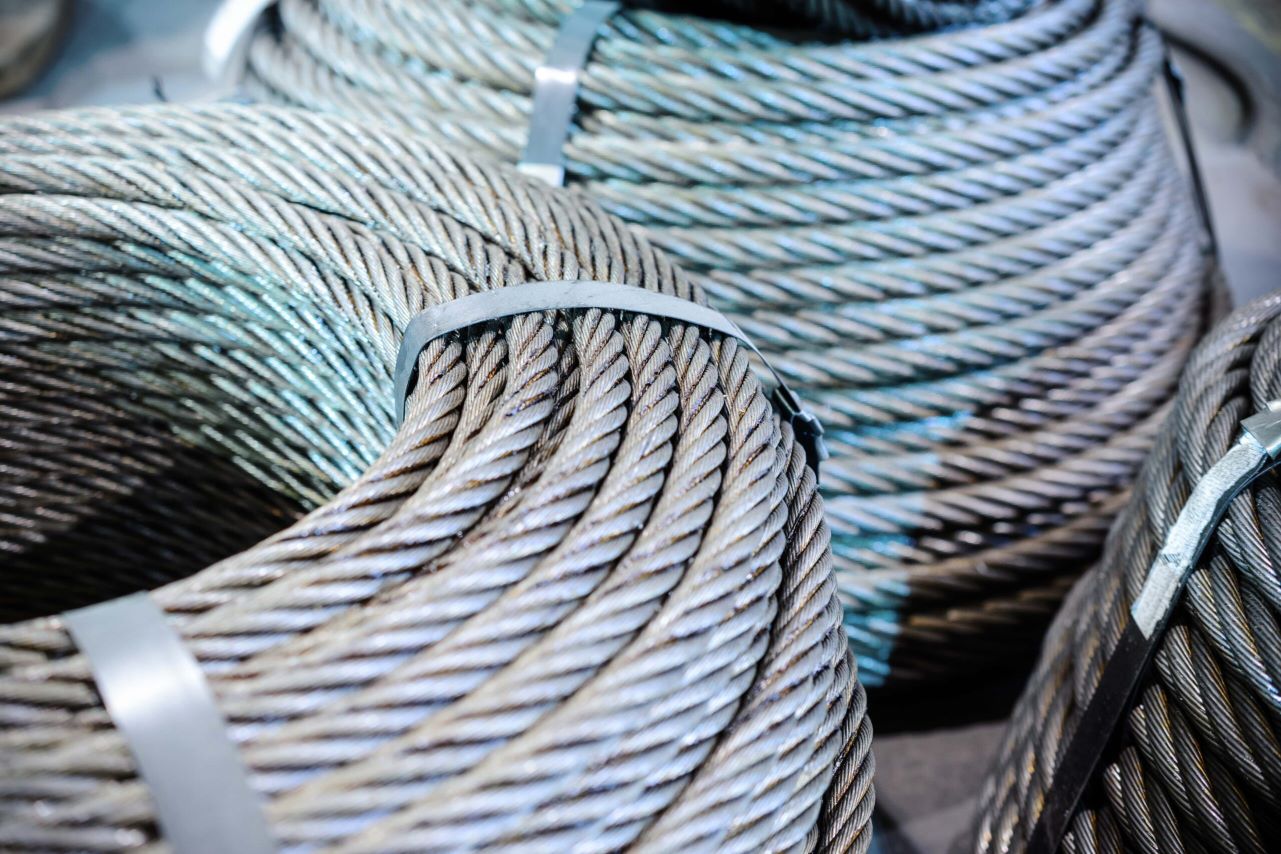
5X19 S (1-9-9) + FC Steel Wire Rope: When it comes to heavy-duty industrial operations—reliability, safety, and strength aren’t negotiable. The 5X19 S (1-9-9) + FC steel wire rope is a staple in sectors that demand flexibility with adequate strength, such as marine, construction, and general lifting. As we head into 2025–26, knowing what makes this wire rope unique, and how to buy it responsibly, can mean the difference between smooth operations and costly downtime.
At SSTC (Safe and Secure Trading Company), we supply rigorously tested wire ropes in Saudi Arabia for critical use cases. In this blog post, we’ll walk you through everything you need to know before buying 5X19 S + FC steel wire ropes.

What Is 5X19 S (1-9-9) + FC Wire Rope?
The 5X19 S (1-9-9) + FC refers to a specific construction pattern of wire rope.
5 strands, each with 19 wires
Strand pattern: 1 center wire, surrounded by 9 inner wires, and 9 outer wires
S stands for Seale construction
FC is a fiber core, often made from sisal, polypropylene, or jute
This configuration delivers flexibility, moderate strength, and excellent handling characteristics.
With increasing demand for versatile lifting solutions and cost-effective rigging equipment, the 5X19 S + FC wire rope continues to gain popularity due to:
Balanced performance for load handling
Compatibility with winches, pulleys, and cranes
Lower cost compared to steel core options
Improved bend fatigue resistance
In the context of Saudi Arabia’s growing infrastructure, logistics, and oil sectors, this rope is increasingly being used for non-critical lifting, guide lines, and control cables.
Core Components: Strand and Core Explained
Seale Construction (1-9-9)
This pattern has:
A single central wire
9 intermediate wires placed around it
An outer layer of 9 wires with larger diameter
This layering provides:
A smooth outer surface
High abrasion resistance
Good crush resistance (although not as high as IWRC ropes)
Fiber Core (FC)
The FC acts as the central support and offers:
Superior flexibility
Shock absorption
Reduced weight
However, FC ropes are less resistant to heat and corrosion than steel core ropes (IWRC), making them ideal for non-extreme environments.


Common Applications in Saudi Arabia

The 5X19 S + FC is widely used across industries such as:
Industry
Application
Marine and Shipping
Mooring lines, winch lines, boat rigging
Construction
Lifting slings, pulley systems, general hoisting
Manufacturing
Conveyor systems, tension cables

Utilities
Cable bracing, light lifting, safety lines
Agriculture
Livestock enclosures, fencing, and irrigation support
Benefits of 5X19 S (1-9-9) + FC Steel Wire Rope
Excellent Flexibility: Ideal for applications involving pulleys or constant bending.
Lightweight: Easier to handle and transport.
Better Fatigue Resistance: Compared to more rigid strand constructions.
Cost-Effective: Lower price point than IWRC (steel core) variants.
Versatile: Can be used in many industries from farming to logistics.
Buying 5X19 S (1-9-9) + FC Steel Wire Rope: What You Should Know in 2025-26
Safety and Inspection Guidelines
Before Use:
Inspect for broken wires, rust, or bird-caging
Ensure end fittings (thimbles, sockets) are securely attached
Check manufacturer’s load capacity vs. application requirement
During Use:
Avoid shock loading
Keep the rope well-lubricated
Don’t exceed minimum bend radius
After Use:
Store in dry, shaded conditions
Periodically re-lubricate and inspect
How to Choose the Right Wire Rope
When choosing a 5X19 S + FC wire rope:
Determine Load Capacity: Know the max load you’ll lift or pull.
Measure Rope Diameter: Ensure it fits your equipment specifications.
Select the Right Core: FC for flexibility; IWRC if you need extra strength.
Review Operating Conditions:
Humid or marine? Choose galvanized wire
Dry or indoor? Standard carbon steel may suffice
Inspect for Certification:
Look for ISO, EN, or DIN standards
Ask SSTC for traceability documents
Common Pitfalls to Avoid
Mistake
Impact
Choosing wrong core type (FC vs IWRC)
Shortened rope life or premature failure
Ignoring bend radius
Rope fatigue and potential breakage
Exceeding load capacity
Dangerous lifting failure
Improper storage
Corrosion, mold (in FC ropes), and internal damage
When sourced responsibly and used within proper parameters, this rope can be a dependable workhorse across various sectors. Always choose a trusted supplier like SSTC to ensure compliance, quality, and safety.
This mode enables people with epilepsy to use the website safely by eliminating the risk of seizures that result from flashing or blinking animations and risky color combinations.
Visually Impaired Mode
Improves website's visuals
This mode adjusts the website for the convenience of users with visual impairments such as Degrading Eyesight, Tunnel Vision, Cataract, Glaucoma, and others.
Cognitive Disability Mode
Helps to focus on specific content
This mode provides different assistive options to help users with cognitive impairments such as Dyslexia, Autism, CVA, and others, to focus on the essential elements of the website more easily.
ADHD Friendly Mode
Reduces distractions and improve focus
This mode helps users with ADHD and Neurodevelopmental disorders to read, browse, and focus on the main website elements more easily while significantly reducing distractions.
Blindness Mode
Allows using the site with your screen-reader
This mode configures the website to be compatible with screen-readers such as JAWS, NVDA, VoiceOver, and TalkBack. A screen-reader is software for blind users that is installed on a computer and smartphone, and websites must be compatible with it.
Online Dictionary
Readable Experience
Content Scaling
Default
Text Magnifier
Readable Font
Dyslexia Friendly
Highlight Titles
Highlight Links
Font Sizing
Default
Line Height
Default
Letter Spacing
Default
Left Aligned
Center Aligned
Right Aligned
Visually Pleasing Experience
Dark Contrast
Light Contrast
Monochrome
High Contrast
High Saturation
Low Saturation
Adjust Text Colors
Adjust Title Colors
Adjust Background Colors
Easy Orientation
Mute Sounds
Hide Images
Hide Emoji
Reading Guide
Stop Animations
Reading Mask
Highlight Hover
Highlight Focus
Big Dark Cursor
Big Light Cursor
Cognitive Reading
Virtual Keyboard
Navigation Keys
Voice Navigation
Accessibility Statement
safeandsecureksa.com
19 February 2026
Compliance status
We firmly believe that the internet should be available and accessible to anyone, and are committed to providing a website that is accessible to the widest possible audience,
regardless of circumstance and ability.
To fulfill this, we aim to adhere as strictly as possible to the World Wide Web Consortium’s (W3C) Web Content Accessibility Guidelines 2.1 (WCAG 2.1) at the AA level.
These guidelines explain how to make web content accessible to people with a wide array of disabilities. Complying with those guidelines helps us ensure that the website is accessible
to all people: blind people, people with motor impairments, visual impairment, cognitive disabilities, and more.
This website utilizes various technologies that are meant to make it as accessible as possible at all times. We utilize an accessibility interface that allows persons with specific
disabilities to adjust the website’s UI (user interface) and design it to their personal needs.
Additionally, the website utilizes an AI-based application that runs in the background and optimizes its accessibility level constantly. This application remediates the website’s HTML,
adapts Its functionality and behavior for screen-readers used by the blind users, and for keyboard functions used by individuals with motor impairments.
If you’ve found a malfunction or have ideas for improvement, we’ll be happy to hear from you. You can reach out to the website’s operators by using the following email
Screen-reader and keyboard navigation
Our website implements the ARIA attributes (Accessible Rich Internet Applications) technique, alongside various different behavioral changes, to ensure blind users visiting with
screen-readers are able to read, comprehend, and enjoy the website’s functions. As soon as a user with a screen-reader enters your site, they immediately receive
a prompt to enter the Screen-Reader Profile so they can browse and operate your site effectively. Here’s how our website covers some of the most important screen-reader requirements,
alongside console screenshots of code examples:
Screen-reader optimization: we run a background process that learns the website’s components from top to bottom, to ensure ongoing compliance even when updating the website.
In this process, we provide screen-readers with meaningful data using the ARIA set of attributes. For example, we provide accurate form labels;
descriptions for actionable icons (social media icons, search icons, cart icons, etc.); validation guidance for form inputs; element roles such as buttons, menus, modal dialogues (popups),
and others. Additionally, the background process scans all the website’s images and provides an accurate and meaningful image-object-recognition-based description as an ALT (alternate text) tag
for images that are not described. It will also extract texts that are embedded within the image, using an OCR (optical character recognition) technology.
To turn on screen-reader adjustments at any time, users need only to press the Alt+1 keyboard combination. Screen-reader users also get automatic announcements to turn the Screen-reader mode on
as soon as they enter the website.
These adjustments are compatible with all popular screen readers, including JAWS and NVDA.
Keyboard navigation optimization: The background process also adjusts the website’s HTML, and adds various behaviors using JavaScript code to make the website operable by the keyboard. This includes the ability to navigate the website using the Tab and Shift+Tab keys, operate dropdowns with the arrow keys, close them with Esc, trigger buttons and links using the Enter key, navigate between radio and checkbox elements using the arrow keys, and fill them in with the Spacebar or Enter key.Additionally, keyboard users will find quick-navigation and content-skip menus, available at any time by clicking Alt+1, or as the first elements of the site while navigating with the keyboard. The background process also handles triggered popups by moving the keyboard focus towards them as soon as they appear, and not allow the focus drift outside it.
Users can also use shortcuts such as “M” (menus), “H” (headings), “F” (forms), “B” (buttons), and “G” (graphics) to jump to specific elements.
Disability profiles supported in our website
Epilepsy Safe Mode: this profile enables people with epilepsy to use the website safely by eliminating the risk of seizures that result from flashing or blinking animations and risky color combinations.
Visually Impaired Mode: this mode adjusts the website for the convenience of users with visual impairments such as Degrading Eyesight, Tunnel Vision, Cataract, Glaucoma, and others.
Cognitive Disability Mode: this mode provides different assistive options to help users with cognitive impairments such as Dyslexia, Autism, CVA, and others, to focus on the essential elements of the website more easily.
ADHD Friendly Mode: this mode helps users with ADHD and Neurodevelopmental disorders to read, browse, and focus on the main website elements more easily while significantly reducing distractions.
Blindness Mode: this mode configures the website to be compatible with screen-readers such as JAWS, NVDA, VoiceOver, and TalkBack. A screen-reader is software for blind users that is installed on a computer and smartphone, and websites must be compatible with it.
Keyboard Navigation Profile (Motor-Impaired): this profile enables motor-impaired persons to operate the website using the keyboard Tab, Shift+Tab, and the Enter keys. Users can also use shortcuts such as “M” (menus), “H” (headings), “F” (forms), “B” (buttons), and “G” (graphics) to jump to specific elements.
Additional UI, design, and readability adjustments
Font adjustments – users, can increase and decrease its size, change its family (type), adjust the spacing, alignment, line height, and more.
Color adjustments – users can select various color contrast profiles such as light, dark, inverted, and monochrome. Additionally, users can swap color schemes of titles, texts, and backgrounds, with over seven different coloring options.
Animations – person with epilepsy can stop all running animations with the click of a button. Animations controlled by the interface include videos, GIFs, and CSS flashing transitions.
Content highlighting – users can choose to emphasize important elements such as links and titles. They can also choose to highlight focused or hovered elements only.
Audio muting – users with hearing devices may experience headaches or other issues due to automatic audio playing. This option lets users mute the entire website instantly.
Cognitive disorders – we utilize a search engine that is linked to Wikipedia and Wiktionary, allowing people with cognitive disorders to decipher meanings of phrases, initials, slang, and others.
Additional functions – we provide users the option to change cursor color and size, use a printing mode, enable a virtual keyboard, and many other functions.
Browser and assistive technology compatibility
We aim to support the widest array of browsers and assistive technologies as possible, so our users can choose the best fitting tools for them, with as few limitations as possible. Therefore, we have worked very hard to be able to support all major systems that comprise over 95% of the user market share including Google Chrome, Mozilla Firefox, Apple Safari, Opera and Microsoft Edge, JAWS and NVDA (screen readers).
Notes, comments, and feedback
Despite our very best efforts to allow anybody to adjust the website to their needs. There may still be pages or sections that are not fully accessible, are in the process of becoming accessible, or are lacking an adequate technological solution to make them accessible. Still, we are continually improving our accessibility, adding, updating and improving its options and features, and developing and adopting new technologies. All this is meant to reach the optimal level of accessibility, following technological advancements. For any assistance, please reach out to