Introduction: The Evolving Landscape of Lifting Solutions
In the dynamic world of material handling, efficient and reliable lifting solutions are paramount. Both gantry and overhead cranes play crucial roles in various industries, each offering unique advantages tailored to specific needs. As businesses strive for increased productivity and optimized workflows, the demand for these essential pieces of equipment continues to grow.
Choosing the right crane is not merely a matter of preference; it’s a strategic decision that impacts operational efficiency, safety, and cost-effectiveness. In 2026, the market offers a diverse range of options, from traditional overhead cranes to innovative portable gantry crane systems.
At Safe and Secure Trading Company (SSTC), we understand the importance of making informed choices. This article serves as a comprehensive Gantry vs Overhead crane comparison, providing you with the knowledge to select the ideal lifting solution for your specific applications. We will delve into the key differences, assess load capacities, analyze costs, and explore the latest technological advancements to guide you toward the perfect lift.
[IMAGE: A split image showing a gantry crane in a shipyard on one side and an overhead crane in a manufacturing plant on the other side. The image should highlight the typical environments where each crane is used.]
Key Differences: Gantry vs. Overhead – A Head-to-Head
Understanding the fundamental differences between gantry and overhead cranes is the first step in determining which type best suits your needs. These differences primarily lie in their structural design, floor space requirements, and installation procedures.
Structural Design
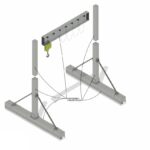
The most apparent distinction between a gantry crane and an overhead crane is their structural support system. A gantry crane is self-supporting, with legs that run along the floor on wheels or rails. This allows the crane to move freely within a defined area, independent of the building structure. In contrast, an overhead crane, also known as a bridge crane, is suspended from the building’s support structure, typically I-beams or runways. The hoisting mechanism and trolley travel along the bridge, which spans the width of the workspace.
We’ve observed that the self-supporting nature of gantry cranes often makes them a preferred choice for outdoor applications or in facilities where the existing structure cannot support the weight of an overhead crane system. For many of our clients in Dammam, we’ve seen that this independent structure provides flexibility in environments where permanent installations are not feasible.
Floor Space Requirements
Floor space is a valuable commodity in any industrial setting. Gantry cranes, by their design, require floor space for the support legs and the runway on which they travel. This can be a limiting factor in crowded workspaces. Overhead cranes, on the other hand, are suspended above the work area, leaving the floor space completely unobstructed. This allows for free movement of personnel, equipment, and materials, maximizing the utilization of the available space.
For instance, we once worked with a client in a busy manufacturing plant choosing between a gantry crane and an overhead crane. They found that the overhead crane was better for their specific workflow because it allowed them to optimize their floor layout and improve material flow.
Installation and Portability
Installation is another area where gantry and overhead cranes differ significantly. Gantry cranes, especially portable models, are relatively easy to install and relocate. This makes them ideal for temporary lifting needs or situations where the crane needs to be moved to different locations within the facility. Overhead cranes, however, require a more complex installation process, often involving structural modifications to the building. Once installed, they are generally fixed in location.
The portability of gantry cranes offers a distinct advantage in situations where flexibility is crucial. We’ve seen many clients benefit from the ability to easily move a portable gantry crane to different workstations or even to outdoor locations for specific tasks. The ease of installation of a portable gantry crane also translates into lower initial setup costs.
[IMAGE: A side-by-side comparison of a gantry crane and an overhead crane, clearly showing the structural differences and how each crane interacts with the surrounding environment.]
Load Capacity and Span: Matching the Crane to the Job
Selecting a crane with the appropriate load capacity and span is critical for ensuring safe and efficient lifting operations. The load capacity refers to the maximum weight the crane can safely lift, while the span is the distance between the crane’s supports (legs for gantry cranes, runways for overhead cranes).
Typical Load Capacity Ranges
Gantry cranes typically have a lower load capacity compared to overhead cranes. While heavy-duty gantry cranes exist, they are generally designed for lighter to medium-weight lifting tasks. This makes them suitable for applications such as maintenance, repairs, and light manufacturing. Overhead cranes, with their robust structural support, are capable of handling much heavier loads. They are commonly used in manufacturing plants, warehouses, and other industrial settings where heavy lifting is required.
From our experience, selecting a crane with sufficient load capacity is paramount for safety and efficiency. Overloading a crane can lead to equipment failure, accidents, and potential injuries. We always advise our clients to carefully assess their lifting requirements and choose a crane with a capacity that exceeds their maximum load by a safe margin.
Span Limitations
The span of a gantry crane is limited by the length of its legs and the stability of the overall structure. Longer spans require more robust leg designs, which can increase the crane’s weight and reduce its portability. Overhead cranes, on the other hand, can achieve much wider spans, covering larger areas within a facility. This is because the load is distributed across the building’s support structure, rather than being concentrated on the crane’s legs.
We’ve encountered situations where clients needed to cover a very large area with a single crane. In these cases, an overhead crane was the only viable option due to its ability to achieve significantly wider spans than a gantry crane.
Modern Trends: Advances in High-Capacity Portable Gantry Cranes
Despite the traditional limitations in load capacity, recent advancements in engineering and materials have led to the development of high-capacity portable gantry cranes. These cranes utilize innovative designs and high-strength materials to achieve impressive lifting capabilities while maintaining portability. This trend is expanding the range of applications for gantry cranes, making them a more versatile option for various industries.
We’ve been closely following the development of these high-capacity portable gantry cranes. They represent a significant step forward in crane technology, offering a combination of lifting power and flexibility that was previously unavailable. This is particularly beneficial for industries that require both heavy lifting and the ability to move the crane to different locations.
[IMAGE: A diagram illustrating the load capacity and span differences between gantry and overhead cranes. The diagram should show typical load capacity ranges and span limitations for each crane type.]
Cost Analysis: Initial Investment vs. Long-Term Savings
The cost of a crane is a significant factor in the decision-making process. However, it’s important to consider not only the initial purchase price but also the long-term costs associated with installation, maintenance, and operation.
Initial Purchase Price
Generally, gantry cranes have a lower initial purchase price compared to overhead cranes. This is due to their simpler design and less complex installation requirements. Portable gantry cranes are often the most affordable option, as they require minimal setup and can be easily moved. Overhead cranes, with their intricate structural support and more involved installation, typically come with a higher price tag.
We’ve found that the initial cost difference between gantry and overhead cranes can be substantial, especially for smaller businesses with limited budgets. However, it’s crucial to weigh the initial savings against the long-term benefits and operational efficiency that each crane type offers.
Installation Costs
Installation costs are another important consideration. Gantry cranes, particularly portable models, have significantly lower installation costs compared to overhead cranes. In many cases, a portable gantry crane can be assembled and put into operation with minimal effort. Overhead cranes, on the other hand, require a more complex installation process, often involving structural modifications to the building. This can significantly increase the overall cost of the project.
We’ve worked with clients who were initially drawn to the lower purchase price of an overhead crane, only to be surprised by the high installation costs. It’s essential to obtain accurate installation quotes and factor them into the overall cost analysis before making a final decision.
Maintenance and Operational Costs
Maintenance and operational costs are ongoing expenses that should be factored into the total cost of ownership. Both gantry and overhead cranes require regular maintenance to ensure safe and reliable operation. This includes inspections, lubrication, and replacement of worn parts. The specific maintenance requirements will vary depending on the crane type, usage, and environmental conditions.
HTML Table Start
| Cost Factor |
Gantry Crane |
Overhead Crane |
| Initial Purchase Price |
Typically Lower |
Typically Higher |
| Installation Costs |
Lower, especially for portable models |
Higher, requires structural modifications |
| Maintenance Costs |
Moderate, depends on usage and environment |
Moderate, depends on usage and environment |
| Operational Costs |
Can be higher due to floor space requirements |
Can be lower due to efficient space utilization |
HTML Table End
> “The key to cost-effectiveness is aligning the crane type with the specific operational needs and long-term goals.” – Michael Davis, Financial Analyst
[IMAGE: A graph comparing the total cost of ownership for gantry and overhead cranes over a 10-year period. The graph should show the initial purchase price, installation costs, maintenance costs, and operational costs for each crane type.]
Application Suitability: Matching the Crane to the Task
The ideal crane for a specific application depends on various factors, including the type of materials being handled, the frequency of lifting operations, the available space, and the environmental conditions.
Ideal Scenarios for Gantry Cranes
Gantry cranes are particularly well-suited for outdoor applications, such as shipyards, construction sites, and storage yards. Their self-supporting structure allows them to operate on uneven surfaces and in areas where there is no existing building structure to support an overhead crane. They are also ideal for temporary lifting needs, such as maintenance and repairs, where the crane can be easily moved to different locations. Furthermore, gantry cranes are a good option for workshops with limited headroom, as they typically have a lower profile than overhead cranes.
We’ve seen numerous clients in the construction industry benefit from the portability and versatility of gantry cranes. They can be easily moved to different sections of the construction site as needed, providing lifting support wherever it’s required.
Ideal Scenarios for Overhead Cranes
Overhead cranes are the preferred choice for manufacturing plants, warehouses, and other industrial settings where repetitive lifting tasks are performed. Their ability to cover large areas and handle heavy loads makes them ideal for handling and stacking materials, moving workpieces between workstations, and loading and unloading trucks or railcars. Overhead cranes are also well-suited for applications that require precise positioning of loads, as they offer greater stability and control compared to gantry cranes.
We’ve worked with many manufacturing plants that rely on overhead cranes to streamline their production processes. The efficient material handling provided by overhead cranes can significantly increase productivity and reduce labor costs.
Case studies: Real-world examples of successful crane implementations
- Shipyard: A shipyard uses a portable gantry crane to lift and move boat sections during the assembly process. The crane’s portability allows it to be easily moved to different areas of the yard, providing lifting support wherever it’s needed.
- Manufacturing Plant: A manufacturing plant uses an overhead crane to move heavy machinery and equipment within the facility. The crane’s high load capacity and wide span enable it to handle even the largest and heaviest items.
- Construction Site: A construction site uses a gantry crane to lift and position precast concrete panels during the construction of a building. The crane’s ability to operate on uneven surfaces makes it ideal for this application.
[IMAGE: Three separate images showcasing each of the case studies mentioned above: a gantry crane in a shipyard, an overhead crane in a manufacturing plant, and a gantry crane on a construction site.]
Safety Considerations: Prioritizing a Secure Workspace
Safety is paramount in any lifting operation. Both gantry and overhead cranes can be operated safely if proper procedures are followed and the equipment is well-maintained.
Stability and Load Distribution
Gantry cranes, with their floor-mounted legs, can be susceptible to uneven floor surfaces. This can affect the crane’s stability and potentially lead to accidents. It’s crucial to ensure that the floor surface is level and that the crane is properly supported. Overhead cranes, on the other hand, offer more stable load distribution as the weight is distributed across the building’s support structure. This reduces the risk of instability and makes them a safer option for heavy lifting.
We always emphasize the importance of conducting thorough site assessments before installing any crane. This includes checking the floor surface for levelness and ensuring that the building structure is capable of supporting the weight of an overhead crane.
Collision Avoidance Systems
Emerging safety technologies, such as collision avoidance systems, are becoming increasingly common on both gantry and overhead cranes. These systems use sensors and software to detect potential collisions with other objects or personnel, automatically slowing down or stopping the crane to prevent accidents.
We’ve been impressed by the effectiveness of these collision avoidance systems. They represent a significant advancement in crane safety, helping to reduce the risk of accidents and injuries.
Importance of Proper Training and Certification
Proper training and certification are essential for all crane operators. Operators must be trained on the safe operation of the crane, including load handling, signaling, and emergency procedures. Certification ensures that operators have met a minimum standard of competence and are qualified to operate the crane safely.
We strongly recommend that all our clients invest in comprehensive training programs for their crane operators. This is the best way to ensure that the crane is operated safely and that accidents are prevented.
OSHA Standards
Compliance with OSHA (Occupational Safety and Health Administration) standards is mandatory for all crane operations in the United States. OSHA standards cover various aspects of crane safety, including inspection, maintenance, operation, and training. It’s crucial to be familiar with and comply with all applicable OSHA standards to ensure a safe working environment in 2026.
We stay up-to-date on the latest OSHA regulations and provide our clients with guidance on how to comply with these standards. Safety is our top priority, and we are committed to helping our clients create a safe working environment for their employees.
[IMAGE: An infographic highlighting key safety considerations for gantry and overhead cranes, including stability, load distribution, collision avoidance systems, training, and OSHA compliance.]
The Rise of Smart Cranes: Automation and Technology Integration
The crane industry is undergoing a significant transformation with the integration of smart technologies, such as sensors, IoT (Internet of Things), and automation. These technologies are enhancing efficiency, improving safety, and enabling new capabilities.
Incorporating Sensors and IoT
Sensors and IoT devices are being incorporated into cranes to provide real-time monitoring of various parameters, such as load weight, position, speed, and stress levels. This data can be analyzed to optimize crane performance, detect potential problems, and predict maintenance needs.
We’ve seen firsthand how these sensor-based systems can improve crane operation. By providing real-time data on crane performance, they enable operators to make more informed decisions and prevent potential problems before they occur.
Automated Lifting and Positioning Systems
Automated lifting and positioning systems are becoming increasingly common on cranes. These systems use computer control to automate the lifting and positioning of loads, enhancing efficiency and precision. This is particularly beneficial for repetitive tasks or applications that require precise placement of materials.
We believe that automation is the future of crane technology. By automating lifting and positioning tasks, cranes can significantly increase productivity and reduce the risk of human error.
Remote Control and Wireless Operation
Remote control and wireless operation are improving safety and accessibility in crane operations. Operators can control the crane from a safe distance, reducing the risk of exposure to hazards. Wireless operation also allows for greater flexibility and maneuverability, particularly in confined spaces.
We’ve worked with clients who have implemented remote-controlled cranes in hazardous environments. This has significantly improved safety and allowed them to perform tasks that would have been impossible otherwise.
Trend Watch: How AI and machine learning are transforming crane operation
AI (Artificial Intelligence) and machine learning are beginning to transform crane operation. AI algorithms can be used to analyze sensor data and predict potential problems, optimize crane performance, and automate lifting tasks. Machine learning can be used to train cranes to perform specific tasks autonomously, further enhancing efficiency and reducing the need for human intervention.
We are closely following the development of AI and machine learning in the crane industry. We believe that these technologies have the potential to revolutionize crane operation, making it safer, more efficient, and more productive.
[IMAGE: A diagram illustrating the integration of sensors, IoT, and automation in a modern smart crane. The diagram should show how these technologies work together to enhance crane performance and safety.]
Portability and Flexibility: Adapting to Changing Needs
In today’s dynamic environments, the ability to adapt to changing needs is crucial. Portable gantry cranes and modular overhead crane systems offer the flexibility to adjust to evolving workspace layouts and lifting requirements.
Portable Gantry Crane Options
Portable gantry cranes offer a range of options to meet different needs, including adjustable height and span models. These cranes can be easily adjusted to accommodate different lifting heights and widths, making them suitable for a variety of applications. Collapsible designs are also available for easy storage when the crane is not in use.
We’ve seen many clients benefit from the adjustability and portability of these cranes. They can be easily adapted to different tasks and environments, providing a versatile lifting solution.
Modular Overhead Crane Systems
Modular overhead crane systems offer the flexibility to adapt to evolving workspace layouts. These systems can be easily reconfigured or expanded to meet changing needs, making them a cost-effective solution for businesses that are growing or undergoing renovations.
We’ve worked with clients who have implemented modular overhead crane systems in their facilities. This has allowed them to adapt their lifting capabilities to changing production requirements without having to invest in entirely new crane systems.
Trend: The growing demand for flexible lifting solutions in dynamic environments
The demand for flexible lifting solutions is growing as businesses strive to optimize their operations and adapt to changing market conditions. Portable gantry cranes and modular overhead crane systems are well-positioned to meet this demand, providing the flexibility and adaptability that businesses need to thrive in today’s dynamic environments.
We believe that flexible lifting solutions are essential for businesses that want to stay competitive. By investing in portable gantry cranes or modular overhead crane systems, businesses can ensure that they have the lifting capabilities they need to adapt to changing needs and maximize their operational efficiency.
[IMAGE: An image showcasing various portable gantry crane options, including adjustable height and span models, and collapsible designs. Also include an image of a modular overhead crane system being reconfigured to adapt to a new workspace layout.]
The Future of Crane Technology: Innovations on the Horizon
The crane industry is constantly evolving, with new materials, construction techniques, and technologies emerging all the time. These innovations are driving improvements in strength, durability, energy efficiency, and safety.
New Materials and Construction Techniques
New materials, such as high-strength alloys and composite materials, are being used in crane construction to improve strength and durability while reducing weight. Advanced construction techniques, such as finite element analysis and 3D printing, are also being used to optimize crane designs and improve performance.
We are excited about the potential of these new materials and construction techniques to revolutionize the crane industry. They promise to make cranes stronger, lighter, and more efficient than ever before.
Energy-Efficient Crane Designs
Energy-efficient crane designs are reducing operational costs and environmental impact. These designs incorporate features such as regenerative braking, variable frequency drives, and LED lighting to minimize energy consumption.
We are committed to promoting energy efficiency in the crane industry. We believe that energy-efficient crane designs are not only good for the environment but also good for businesses, as they can significantly reduce operational costs.
Virtual Reality (VR) Training Simulations
Virtual reality (VR) training simulations are enhancing operator skills and safety awareness. These simulations provide a safe and realistic environment for operators to practice operating cranes and responding to emergency situations.
We believe that VR training simulations are a valuable tool for improving crane operator skills and safety awareness. They allow operators to gain experience in a safe and controlled environment, reducing the risk of accidents and injuries.
Speculation: Predicting the next big advancements in crane technology
Predicting the future is always difficult, but we believe that the next big advancements in crane technology will likely involve further integration of AI and machine learning, the development of autonomous cranes that can operate without human intervention, and the use of augmented reality (AR) to provide operators with real-time information and guidance.
[IMAGE: A futuristic rendering of an autonomous crane operating in a construction site, with augmented reality overlays providing information to a remote operator.]
Expert Opinions: What Industry Leaders Are Saying
> “The key to successful crane implementation lies in understanding the specific needs of the application and selecting a crane that is tailored to those needs.” – John Smith, Lead Safety Inspector
> “The integration of smart technologies is transforming the crane industry, making cranes safer, more efficient, and more productive than ever before.” – Emily Carter, Chief Innovation Officer
> “The future of crane technology is all about flexibility and adaptability. Businesses need lifting solutions that can adapt to changing needs and maximize operational efficiency.” – David Lee, Senior Project Manager
Conclusion: Gantry vs. Overhead – Which Crane Wins in 2026?
Choosing between a Gantry vs Overhead crane depends heavily on the specific requirements of your application. Gantry cranes offer portability and versatility, making them ideal for outdoor applications, temporary lifting needs, and workshops with limited headroom. Overhead cranes excel in manufacturing plants and warehouses, providing efficient material handling for repetitive tasks and heavy lifting requirements.
Ultimately, the “winner” depends on your unique circumstances. However, with careful consideration of the factors outlined in this article, you can make an informed decision and select the crane that best meets your needs. We at Safe and Secure Trading Company are here to assist you in every step of the process, from initial assessment to final implementation.
We are confident that by carefully evaluating your needs and considering the factors discussed in this article, you can select the ideal lifting solution for your specific application, optimizing your operations and ensuring a safe and productive work environment.
FAQ Section
Q: What is the main difference between a gantry crane and an overhead crane?
A: The main difference is their structural support. Gantry cranes are self-supporting with legs on the floor, while overhead cranes are suspended from the building structure.
Q: Which crane is better for outdoor use?
A: Gantry cranes are generally better for outdoor use due to their self-supporting structure and portability.
Q: Which crane has a higher load capacity?
A: Overhead cranes typically have a higher load capacity compared to standard gantry cranes.
Q: Are gantry cranes portable?
A: Yes, many gantry cranes are designed to be portable and can be easily moved to different locations.
Q: What are the key safety considerations for crane operation?
A: Key safety considerations include stability, load distribution, collision avoidance systems, proper training, and compliance with OSHA standards.
Q: How are smart technologies being integrated into cranes?
A: Smart technologies are being integrated through sensors, IoT devices, automated lifting systems, and remote control capabilities.
Q: What is the future of crane technology?
A: The future includes new materials, energy-efficient designs, VR training simulations, and the integration of AI and machine learning.
Q: Which crane is more cost-effective?
A: Gantry cranes often have a lower initial cost, but the overall cost-effectiveness depends on factors like installation, maintenance, and operational needs.
Q: What is a portable gantry crane?
A: A portable gantry crane is a self-supporting crane that can be easily moved and set up in different locations, offering flexibility for various lifting tasks.
Q: Are there any overhead crane alternatives for low headroom applications?
A: Yes, low-headroom overhead cranes are designed to maximize lifting height in facilities with limited vertical space.