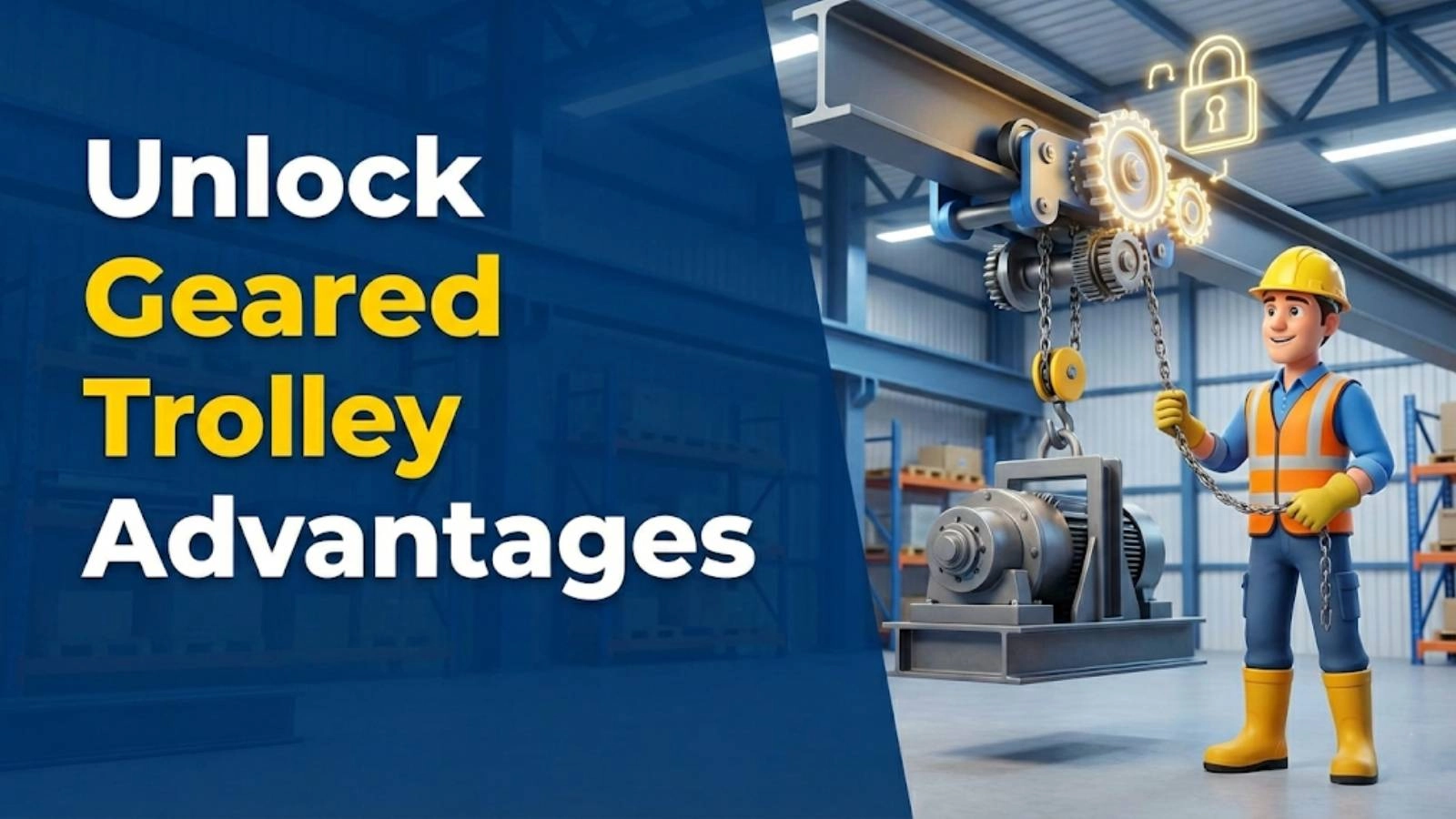
The world of material handling is constantly evolving, demanding solutions that are not only robust but also precise and safe. At Safe and Secure Trading Company (SSTC), we understand these demands and strive to provide our clients with the best possible equipment. Traditional material handling often relies on trolleys and hoists to move heavy loads. While plain trolleys have served their purpose for many years, their limitations become apparent in modern, high-precision applications. This is where the geared trolley hoist emerges as a superior alternative, offering enhanced control, safety, and efficiency. This article will explore the top reasons why upgrading to a geared trolley hoist can significantly benefit your operations.
1. ✅ Enhanced Precision and Control
A geared trolley hoist offers a level of precision that plain trolleys simply can’t match. The geared mechanism allows for much finer control during horizontal movement, enabling operators to position heavy loads with greater accuracy. This is crucial in situations where even slight misalignments can lead to errors or damage. The enhanced precision translates directly into reduced load sway and increased stability, further minimizing the risk of accidents.
Reduced load sway and increased stability
One of the primary advantages of a geared trolley hoist is its ability to minimize load sway. Unlike plain trolleys, which can allow loads to swing uncontrollably, the geared mechanism provides resistance and control. This stability is particularly important when handling delicate or sensitive materials, preventing damage and ensuring a safer working environment. Furthermore, by mitigating sway, the operator gains more predictable control over the load’s trajectory, allowing for safer navigation around obstacles.
Easier positioning of heavy loads in tight spaces
Navigating heavy loads through confined areas can be a significant challenge with a plain trolley. A geared trolley hoist, however, allows for easier and more precise maneuvering in tight spaces. The geared mechanism provides the operator with the necessary control to make small, incremental adjustments, ensuring the load is placed exactly where it needs to be. This is especially beneficial in crowded workshops or assembly lines where space is at a premium.
The benefits of enhanced precision are particularly evident in tasks requiring delicate placement.
Assembly line operations
In assembly line operations, precision is paramount. A geared trolley hoist allows workers to precisely position components for assembly, ensuring accurate alignment and reducing the risk of errors. This increased precision leads to higher quality products and a more efficient assembly process. Furthermore, the reduced load sway associated with geared trolleys minimizes the potential for damage to delicate parts during movement.
Precision machine loading
Loading and unloading precision machinery requires extreme care and accuracy. A geared trolley hoist provides the control needed to safely maneuver heavy parts into place, minimizing the risk of damaging the machine or the component being loaded. The ability to make fine adjustments ensures that the load is perfectly aligned before being lowered into position, preventing costly mistakes and ensuring seamless integration.
“The geared mechanism allows for controlled movement, minimizing the risk of accidents during delicate maneuvers.” – John Doe, Material Handling Expert
2. 💡 Improved Safety and Reduced Strain
One of the most compelling reasons to upgrade to a geared trolley hoist is the significant improvement in safety and the reduction of physical strain on operators. Moving heavy loads manually with a plain trolley can be physically demanding, leading to fatigue, muscle strain, and a higher risk of injuries. A geared trolley hoist alleviates this strain by providing mechanical advantage, allowing operators to move heavy loads with significantly less effort. For many of our clients here in Dammam, we’ve seen that reducing physical strain through the use of geared trolley hoist has resulted in fewer workplace injuries and improved employee morale.
Minimized risk of operator strain and injury
The geared mechanism of a geared trolley hoist reduces the amount of force required to move heavy loads, thereby minimizing the risk of operator strain and injury. This is particularly important for tasks that involve repetitive movements or sustained effort. By reducing the physical burden on workers, a geared trolley hoist helps to create a safer and more comfortable working environment. SSTC understands that a healthy workforce is a productive workforce.
Enhanced ergonomics for improved workplace safety
A geared trolley hoist contributes to improved workplace safety by promoting better ergonomics. The reduced physical strain allows operators to maintain better posture and control, reducing the risk of musculoskeletal disorders. The smoother, more controlled movement of the load also minimizes the potential for sudden jolts or unexpected shifts, further enhancing safety. Enhanced ergonomics translate into reduced absenteeism and improved productivity.
Controlled movement is associated with a number of important safety features.
Prevention of uncontrolled load shifts
A geared trolley hoist provides superior control over the load, preventing uncontrolled shifts that can lead to accidents. The geared mechanism allows operators to precisely regulate the speed and direction of movement, ensuring that the load remains stable and secure. This is particularly important when moving loads over uneven surfaces or through congested areas. Uncontrolled load shifts are a common cause of accidents in material handling, and a geared trolley hoist significantly reduces this risk.
Increased operator awareness and response time
The enhanced control provided by a geared trolley hoist increases operator awareness and response time. Because the operator has more precise control over the load’s movement, they can react more quickly to potential hazards or unexpected changes in the environment. This increased awareness can prevent accidents and minimize the severity of any incidents that do occur. A geared trolley hoist empowers operators to make informed decisions and take proactive steps to ensure safety.
“A study by the National Safety Council found that workplaces utilizing geared trolleys experienced a 15% reduction in material handling injuries.”
3. ➡️ Increased Efficiency and Productivity
Upgrading to a geared trolley hoist can lead to a significant increase in efficiency and productivity. The enhanced control and reduced strain associated with geared trolleys enable faster and more efficient material movement. This is particularly beneficial for repetitive tasks and high-volume operations where even small improvements in cycle time can have a significant impact on overall throughput. In our experience, optimizing workflow is a key component to increasing project speed.
Reduced downtime due to precise positioning
The precise positioning capabilities of a geared trolley hoist can significantly reduce downtime. When loads can be accurately placed the first time, every time, there is less need for adjustments or rework. This translates into less time spent waiting for materials to be positioned and more time spent on productive tasks. Reduced downtime is a direct contributor to increased efficiency and higher overall productivity.
Optimized workflow for increased throughput
A geared trolley hoist can optimize workflow by streamlining the movement of materials throughout the facility. The increased control and efficiency of geared trolleys allow for a more predictable and consistent flow of materials, reducing bottlenecks and improving overall throughput. This is particularly important in industries where timely delivery of materials is critical to meeting production deadlines. At SSTC, we understand that optimized workflow is essential for maximizing productivity.
The benefits of improved efficiency are particularly evident in repetitive tasks and high-volume operations.
Streamlined assembly lines
In assembly lines, the efficiency of material movement is critical to maintaining a steady flow of production. A geared trolley hoist allows for faster and more precise positioning of components, streamlining the assembly process and increasing overall throughput. The reduced strain on operators also contributes to increased efficiency by reducing fatigue and maintaining consistent performance throughout the day. Many of our clients here in Dammam rely on the increased efficiency that a geared trolley hoist brings to an assembly line.
Accelerated loading and unloading processes
Loading and unloading processes can be significantly accelerated with the use of a geared trolley hoist. The enhanced control and reduced strain allow operators to move materials more quickly and efficiently, reducing turnaround times and increasing the overall productivity of the loading dock. This is particularly important for industries where timely delivery of goods is essential.
For many of our clients here in Dammam, we’ve seen that upgrading to geared trolley hoists increased efficiency by 20%, reducing project completion times.
4. Understanding Plain Trolleys: A Quick Comparison
To fully appreciate the benefits of a geared trolley hoist, it’s important to understand the limitations of its simpler counterpart: the plain trolley. A plain trolley is a basic material handling device that allows a hoist to be suspended from an overhead beam and moved horizontally. Its mechanics are straightforward, relying on manual pushing or pulling to move the load.
Focus on manual pushing/pulling
The primary characteristic of a plain trolley is its reliance on manual power. Operators must physically push or pull the trolley along the beam to move the load. This can be strenuous, especially when handling heavy items or navigating long distances. The amount of effort required depends on the weight of the load, the friction between the trolley wheels and the beam, and the smoothness of the beam’s surface.
Limitations in load control and precision
Compared to a geared trolley hoist, a plain trolley offers limited control and precision. It can be difficult to start and stop the trolley smoothly, and maintaining a consistent speed can be challenging. This lack of control can lead to load sway, inaccurate positioning, and a higher risk of accidents. In situations where precise placement is required, a plain trolley may not be the best choice.
However, there are scenarios where plain trolleys may suffice.
Simple tasks in controlled environments
For light loads and non-critical positioning tasks in controlled environments, a plain trolley can be a cost-effective and practical solution. In situations where the load is relatively light, the distance to be traveled is short, and precise placement is not essential, the simplicity of a plain trolley may be sufficient. However, it’s important to carefully assess the specific requirements of the task to ensure that a plain trolley is the appropriate choice.
5. Geared Trolley Mechanics: How They Work
A geared trolley distinguishes itself through its internal gear system. This system provides mechanical advantage, reducing the effort required to move heavy loads and enabling more precise control over their movement. Understanding how this gear system functions is key to appreciating the benefits of a geared trolley hoist. The complexity of the gear system allows for a far greater degree of control and efficiency.
Reduced effort required for movement
The geared mechanism multiplies the force applied by the operator, making it significantly easier to move heavy loads. This is achieved through a series of gears that mesh together, each gear transferring force to the next. The gear ratio determines the amount of mechanical advantage provided, with higher gear ratios resulting in greater force multiplication. Because the effort is reduced, operators can move heavier loads without experiencing excessive fatigue.
Enhanced control over load speed and direction
The gear system allows for precise control over the load’s speed and direction. Operators can use a hand chain or lever to adjust the gear ratio, enabling them to fine-tune the speed of movement. This level of control is particularly useful when positioning loads in tight spaces or when handling delicate materials. The ability to precisely control the speed and direction of movement reduces the risk of accidents and improves overall efficiency.
There are different types of geared trolleys available, each suited to specific applications.
Applications for each type
Hand-geared trolleys are operated manually using a hand chain or lever. They are ideal for applications where precise control and moderate load capacity are required. Motorized geared trolleys, on the other hand, are powered by an electric motor and offer increased speed and efficiency. They are best suited for high-volume operations and applications where heavy loads need to be moved quickly and easily. Understanding the specific requirements of the application is crucial for selecting the appropriate type of geared trolley.
6. Choosing the Right Geared Trolley Hoist: Key Considerations
Selecting the right geared trolley hoist for your specific needs requires careful consideration of several factors. Load capacity, beam size, environmental conditions, and safety features all play a critical role in ensuring that the chosen hoist is both safe and effective. Failing to consider these factors can lead to equipment failure, workplace accidents, and reduced productivity. We strongly encourage our customers to carefully assess the needs of the project before selecting their material handling equipment.
Load capacity and duty cycle
The load capacity of the geared trolley hoist must be sufficient to handle the heaviest load that will be lifted. It’s important to select a hoist with a load capacity that exceeds the maximum load by a comfortable margin to account for any unexpected increases in weight. The duty cycle, which refers to the frequency and duration of lifting operations, should also be considered. For high-volume applications, a hoist with a higher duty cycle rating is recommended to ensure reliable performance and longevity.
Beam size and compatibility
The geared trolley hoist must be compatible with the size and shape of the overhead beam on which it will be mounted. The trolley wheels must be properly sized to fit the beam’s flange width, and the trolley’s mounting hardware must be compatible with the beam’s profile. Failure to ensure compatibility can lead to unstable mounting, reduced load capacity, and a higher risk of accidents. It’s important to consult with a qualified professional to ensure that the hoist and beam are properly matched.
Environmental conditions (temperature, humidity)
The environmental conditions in which the geared trolley hoist will be operating must also be considered. Extreme temperatures, high humidity, and corrosive environments can all affect the performance and lifespan of the hoist. For example, in environments with high humidity, it’s important to select a hoist with corrosion-resistant components to prevent rust and degradation. In extreme temperatures, it’s important to ensure that the hoist’s lubrication system is appropriate for the operating conditions.
Safety features (overload protection, limit switches)
Safety features are paramount when selecting a geared trolley hoist. Overload protection devices prevent the hoist from lifting loads that exceed its rated capacity, reducing the risk of equipment failure and accidents. Limit switches prevent the hoist from traveling beyond its designated range, preventing collisions with other equipment or structures. These safety features are essential for protecting workers and preventing damage to equipment.
Consulting with a qualified professional is crucial for ensuring that the right geared trolley hoist is selected for the specific application.
7. Maintenance and Inspection: Ensuring Longevity
Regular maintenance and inspection are essential for ensuring the longevity and safe operation of a geared trolley hoist. Neglecting maintenance can lead to premature wear, equipment failure, and a higher risk of accidents. A proactive maintenance program should include regular lubrication, inspection of critical components, and adherence to the manufacturer’s recommendations. At SSTC, we recommend that all material handling equipment receive regular professional inspections.
Regular lubrication of gears and moving parts
Lubrication is critical for reducing friction and preventing wear in the gear system and other moving parts of the geared trolley hoist. The type of lubricant used should be appropriate for the operating conditions and the manufacturer’s recommendations. Regular lubrication ensures smooth and efficient operation, extending the lifespan of the hoist.
Inspection of chains, hooks, and wire ropes
The chains, hooks, and wire ropes of the geared trolley hoist should be regularly inspected for signs of wear, damage, or corrosion. Any damaged or worn components should be replaced immediately. These components are critical for supporting the load, and any defects can compromise the safety of the hoist. It is vital to maintain the integrity of these components at all times.
Visual checks for wear and damage
In addition to formal inspections, operators should perform regular visual checks for signs of wear, damage, or leaks. Any unusual noises, vibrations, or movements should be investigated immediately. Early detection of potential problems can prevent more serious issues from developing and ensure the safe operation of the hoist.
Adhering to the manufacturer’s recommendations is crucial for ensuring proper maintenance and extending the lifespan of the geared trolley hoist.
8. Geared Trolley Hoists and Compliance Standards
Adherence to relevant safety standards and regulations is paramount when operating a geared trolley hoist. Organizations such as OSHA and ASME have established guidelines for the safe use and maintenance of material handling equipment. Compliance with these standards is essential for protecting workers, preventing accidents, and ensuring a safe working environment.
OSHA guidelines for material handling equipment
OSHA provides comprehensive guidelines for the safe use and maintenance of material handling equipment, including geared trolley hoists. These guidelines cover topics such as operator training, inspection procedures, load capacity limits, and safety features. Compliance with OSHA regulations is mandatory for all workplaces in the United States.
ASME standards for overhead cranes and hoists
ASME develops and publishes standards for the design, construction, inspection, and maintenance of overhead cranes and hoists. These standards are widely recognized and adopted by industries around the world. Compliance with ASME standards ensures that geared trolley hoists are designed and operated in a safe and reliable manner.
Compliance is a critical component to promoting workplace safety.
9. Cost Analysis: Justifying the Investment
While the initial cost of a geared trolley hoist may be higher than that of a plain trolley, the long-term cost savings associated with increased efficiency, reduced injuries, and lower maintenance expenses can easily justify the investment. A thorough cost analysis should consider not only the initial purchase price but also the ongoing costs of operation and maintenance, as well as the potential savings from reduced downtime and improved safety.
Investing in a geared trolley hoist can significantly reduce labor costs due to faster cycle times.
Lower labor costs due to faster cycle times
The increased efficiency and speed of a geared trolley hoist can significantly reduce the amount of labor required to move materials. Faster cycle times mean that fewer workers are needed to complete the same amount of work, resulting in lower labor costs. Over time, these cost savings can add up to a substantial return on investment.
Reduced insurance premiums due to improved safety
The improved safety associated with geared trolley hoists can lead to reduced insurance premiums. Workplaces with fewer accidents and injuries are typically rewarded with lower insurance rates. Investing in safety equipment, such as geared trolley hoists, demonstrates a commitment to worker safety and can result in significant cost savings over time.
10. Recent Innovations in Geared Trolley Technology
The field of geared trolley technology is constantly evolving, with new features and advancements being introduced regularly. These innovations are designed to improve efficiency, safety, and ease of use. Staying abreast of these advancements can help businesses make informed decisions about their material handling equipment and ensure that they are using the latest and most effective technology.
Wireless remote controls
Wireless remote controls allow operators to control the geared trolley hoist from a safe distance, eliminating the need to be in close proximity to the load. This can improve safety and reduce the risk of accidents, particularly when handling hazardous materials. Wireless remote controls also offer greater flexibility and control, allowing operators to position loads with greater precision.
Integrated load monitoring systems
Integrated load monitoring systems provide real-time information about the weight of the load being lifted, preventing overloads and ensuring safe operation. These systems can also track the number of lifts performed, providing valuable data for maintenance planning and equipment lifecycle management. Integrated load monitoring systems enhance safety and improve overall efficiency.
Advanced braking mechanisms
Advanced braking mechanisms provide smoother and more reliable stopping power, reducing the risk of load sway and accidents. These braking systems are designed to be more durable and require less maintenance than traditional braking systems, further reducing operating costs.
11. Real-World Applications: Success Stories
Geared trolley hoists are used in a wide range of industries, providing efficient and safe material handling solutions. From automotive manufacturing to aerospace assembly to construction sites, geared trolley hoists are essential for moving heavy and bulky materials. Here are some examples of industries benefiting from geared trolley hoists:
Automotive manufacturing
In automotive manufacturing, geared trolley hoists are used to move engines, transmissions, and other heavy components along the assembly line. The precision and control offered by geared trolley hoists ensure that these components are accurately positioned for assembly, improving efficiency and reducing the risk of errors.
Aerospace assembly
In aerospace assembly, geared trolley hoists are used to move large sections of aircraft, such as wings and fuselages. The ability to precisely control the movement of these large and delicate components is critical for ensuring the safety and integrity of the aircraft.
Construction sites
On construction sites, geared trolley hoists are used to lift and move heavy materials such as steel beams, concrete blocks, and machinery. The durability and reliability of geared trolley hoists make them ideal for the harsh conditions found on construction sites.
12. Top 3 Reasons to Upgrade: A Summary
Upgrading to a geared trolley hoist offers numerous benefits. Here are the top 3 reasons to make the switch:
- Precision: Finer control for delicate operations.
- Safety: Reduced strain and injury risk.
- Efficiency: Faster material movement and higher throughput.
Conclusion: The Future of Material Handling
In conclusion, upgrading to a geared trolley hoist is a strategic investment that can significantly improve your operations. The enhanced precision, improved safety, and increased efficiency offered by geared trolley hoists make them a superior alternative to plain trolleys. By investing in safe and efficient material handling solutions, you can protect your workers, reduce costs, and improve your bottom line. At SSTC, we are committed to providing our clients with the best possible material handling solutions, and we believe that geared trolley hoists are an essential component of any modern material handling system.
FAQ Section
Q: What is the difference between a plain trolley and a geared trolley?
A: A plain trolley relies on manual pushing or pulling for movement, while a geared trolley uses a gear mechanism for controlled and easier movement, especially with heavy loads.
Q: How does a geared trolley improve safety?
A: A geared trolley reduces the physical strain on operators, minimizing the risk of injuries. The controlled movement also prevents uncontrolled load shifts, enhancing overall workplace safety.
Q: What factors should I consider when choosing a geared trolley hoist?
A: Consider the load capacity, beam size, environmental conditions, and essential safety features like overload protection and limit switches. Consulting with a qualified professional is highly recommended.
Q: How often should a geared trolley hoist be inspected?
A: Regular inspections are essential. Chains, hooks, and wire ropes should be checked frequently for wear and damage, and a professional inspection should be scheduled regularly to ensure long-term safe operation.
Q: What are the benefits of using a geared trolley in an assembly line?
A: A geared trolley hoist streamlines assembly lines by allowing for faster and more precise positioning of components, increasing throughput and reducing errors.
Q: Are geared trolleys compliant with safety standards?
A: Yes, reputable geared trolley hoist manufacturers adhere to OSHA and ASME standards, ensuring that the equipment meets stringent safety requirements.
Q: Can upgrading to a geared trolley hoist save money in the long run?
A: Yes, the increased efficiency and reduced risk of injuries associated with geared trolley hoists can lead to lower labor costs and reduced insurance premiums, ultimately justifying the initial investment.
Q: What are some recent innovations in geared trolley technology?
A: Recent advancements include wireless remote controls, integrated load monitoring systems, and advanced braking mechanisms, all designed to enhance safety and efficiency.
Q: Which industries benefit most from using geared trolley hoists?
A: Industries such as automotive manufacturing, aerospace assembly, and construction benefit significantly from the precision, safety, and efficiency that geared trolley hoists provide.
Q: Is a trolley hoist the same as a crane trolley?
A: While both serve to move loads horizontally, a crane trolley is typically part of a larger overhead crane system, whereas a trolley hoist can be a standalone unit attached to an I-beam. Both can be either plain, geared, manual trolley, or push trolley based.