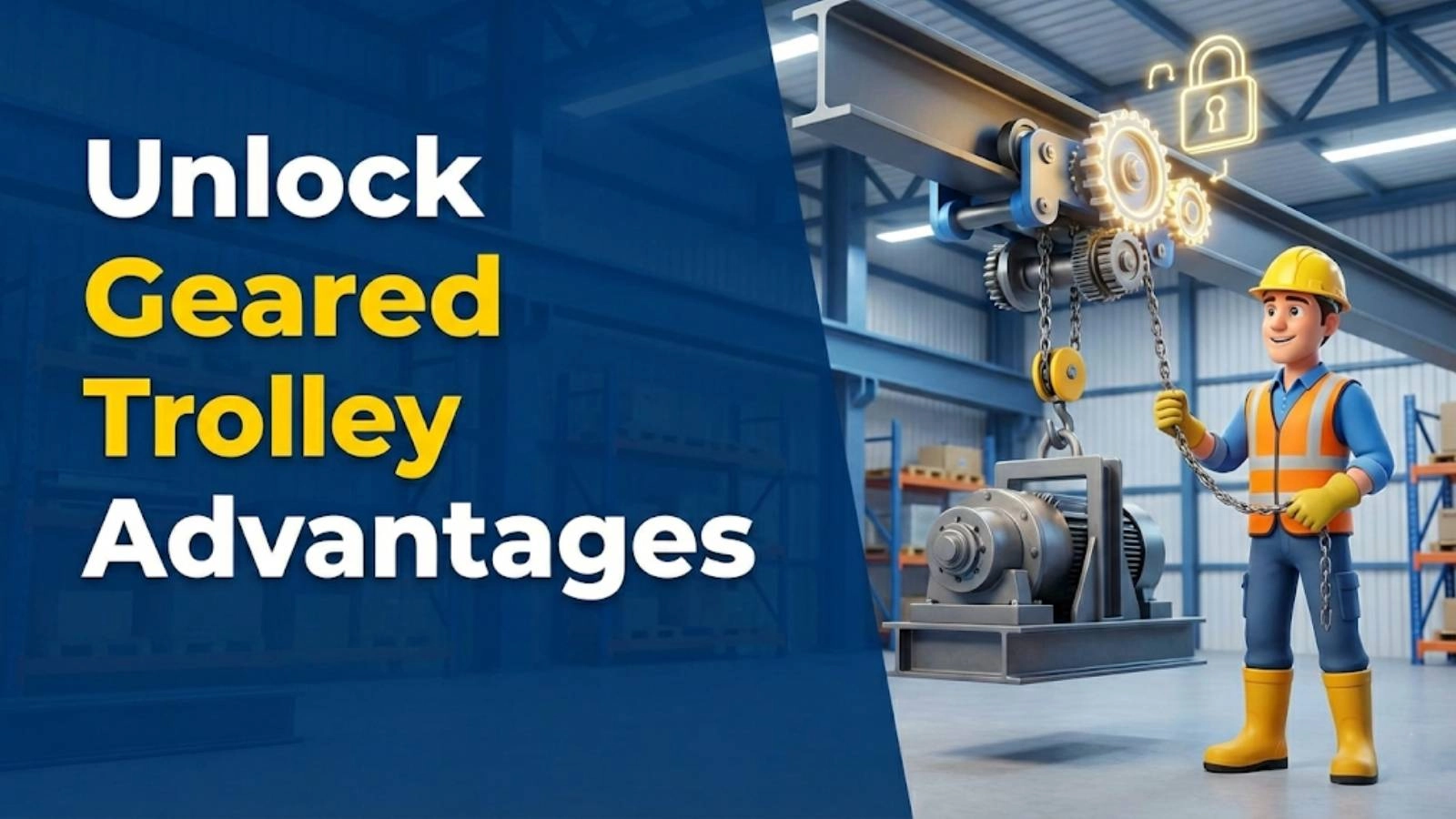
Discover the often-overlooked geared trolley benefits that can transform your material handling processes. Learn how these systems boost efficiency, enhance safety, and provide cost-effective solutions for various industries.
Geared trolleys are indispensable tools in various industries, facilitating the movement of heavy loads with precision and ease. Often used in conjunction with hoists and crane systems, they provide a reliable and efficient method for material handling. This article delves into some of the lesser-known, yet highly significant, geared trolley benefits that many businesses often overlook. The problem is that many businesses overlook the full potential of geared trolley systems. We’re presenting 10 underrated benefits to maximize their value.
1. ✅ Enhanced Precision in Load Positioning
Manual lifting and moving of heavy objects often lacks the finesse required for delicate or precise placement. Aligning heavy machinery components or positioning materials in tight spaces can be particularly challenging. This can lead to misalignment, material damage, and increased project completion times. The geared mechanism of a geared trolley offers controlled movement, enabling operators to make fine-tuned adjustments with ease. This precision significantly reduces the risk of misalignment and damage, ensuring accurate placement every time. For example, we’ve worked with manufacturing plants using geared trolleys to align machine parts with millimeter accuracy, drastically improving their production efficiency.
H3: Difficulty aligning heavy objects accurately.
One of the primary challenges in manual material handling is the inherent difficulty in achieving accurate alignment, especially with heavy or bulky objects. The lack of controlled movement makes it difficult to position items precisely where they need to be, often requiring multiple attempts and adjustments. This not only wastes time but also increases the risk of errors and potential damage to the materials.
H3: Risk of damage to materials during positioning.
When precision is lacking, there’s a greater chance of materials being bumped, scraped, or otherwise damaged during the positioning process. This is especially true for delicate or fragile items that require careful handling. The cost of replacing damaged materials can quickly add up, making precision a critical factor in efficient material handling.
H3: Geared mechanisms allow for fine-tuned adjustments.
Geared trolleys overcome these challenges by providing a geared mechanism that allows for incredibly fine-tuned adjustments. Operators can move loads with small, controlled increments, ensuring precise alignment and placement. This level of control is simply not possible with manual lifting or other less precise material handling methods.
H3: Reduces the risk of misalignment and material damage.
By providing precise control over load positioning, geared trolleys significantly reduce the risk of misalignment and material damage. This not only saves time and money but also ensures the quality and integrity of the materials being handled. The investment in a geared trolley system can quickly pay for itself through reduced waste and improved efficiency.
2. ✅ Improved Operator Ergonomics and Reduced Strain
Manually pushing, pulling, or lifting heavy loads places significant physical strain on workers, leading to fatigue, discomfort, and an increased risk of musculoskeletal disorders (MSDs). This not only affects worker health and well-being but also impacts productivity and increases the potential for workplace injuries. Geared trolleys minimize physical exertion, promoting better ergonomics and reducing the risk of MSDs. The geared mechanism reduces the force needed to move heavy loads, contributing to a safer and more comfortable working environment. For our clients, particularly those in the construction and manufacturing industries, we’ve emphasized the importance of worker safety, and geared trolleys are a cornerstone of those efforts.
H3: Increased risk of musculoskeletal disorders (MSDs).
Manual material handling is a major contributor to MSDs, which are injuries and disorders that affect the muscles, tendons, nerves, ligaments, and joints. These conditions can range from minor aches and pains to chronic, debilitating injuries that require extensive medical treatment and time off work. The repetitive motions, awkward postures, and heavy lifting involved in manual handling all contribute to the increased risk of MSDs.
H3: Fatigue and reduced productivity among workers.
The physical strain of manual material handling can lead to fatigue, which in turn reduces worker productivity and increases the likelihood of errors. Tired workers are more prone to making mistakes that can result in material damage, accidents, and delays. By reducing physical exertion, geared trolleys help to combat fatigue and maintain a higher level of productivity throughout the workday.
H3: The geared mechanism reduces the force needed to move heavy loads.
The key to the ergonomic benefits of geared trolleys lies in their geared mechanism, which multiplies the force applied by the operator. This means that workers can move heavy loads with significantly less physical effort compared to manual handling. The reduction in force required minimizes strain on the muscles and joints, reducing the risk of injury and fatigue.
H3: Contributes to a safer and more comfortable working environment.
By minimizing physical exertion and reducing the risk of MSDs, geared trolleys contribute to a safer and more comfortable working environment for employees. This not only improves worker morale but also reduces absenteeism and turnover, leading to a more stable and productive workforce. Investing in ergonomic solutions like geared trolleys is a smart way to prioritize worker health and well-being.
“Implementing geared trolley systems not only boosts efficiency but also drastically reduces the risk of worker injury, leading to a healthier and more productive workforce.” – Dr. Emily Carter, Ergonomics Specialist
According to the U.S. Bureau of Labor Statistics, in 2026, over 380,000 workplace injuries and illnesses involving musculoskeletal disorders were reported, highlighting the critical need for ergonomic solutions like geared trolleys.
3. ✅ Scalability and Adaptability to Diverse Workspaces
Many material handling solutions are limited by space constraints or load requirements, making it difficult to adapt to changing workspace layouts or increased inventory demands. Fixed systems may not be suitable for evolving production processes, while load capacity restrictions can hinder workflow. Geared trolleys offer flexible solutions that are easily adaptable to various environments. They can be installed on existing I-beams or crane systems, are available in a wide range of load capacities, and are easy to reconfigure as workspace needs evolve. We’ve seen firsthand how clients in rapidly expanding warehouses have benefited from the adaptability of geared trolley systems.
H3: Fixed systems may not be suitable for changing layouts.
Fixed material handling systems, such as conveyor belts or permanently installed cranes, can be difficult or expensive to modify when workspace layouts change. This lack of flexibility can be a major drawback for businesses that need to adapt quickly to changing production demands or inventory requirements. Geared trolleys, on the other hand, offer a more adaptable solution that can be easily reconfigured to suit different layouts.
H3: Load capacity restrictions can hinder workflow.
Some material handling solutions have limited load capacities, which can restrict the size and weight of the items that can be moved. This can hinder workflow, especially when dealing with heavy or bulky materials. Geared trolleys are available in a wide range of load capacities, allowing businesses to choose a system that meets their specific needs.
H3: Can be installed on existing I-beams or crane systems.
One of the key advantages of geared trolleys is their ability to be installed on existing I-beams or crane systems. This eliminates the need for costly and time-consuming infrastructure modifications, making them a cost-effective and efficient solution for upgrading material handling capabilities. The ease of installation also minimizes disruption to ongoing operations.
H3: Available in a wide range of load capacities.
Geared trolleys are manufactured in a variety of load capacities, ranging from a few hundred pounds to several tons. This allows businesses to select a trolley that is perfectly suited to their specific needs, ensuring safe and efficient material handling. Choosing the right load capacity is crucial for maximizing the performance and longevity of the geared trolley system.
H3: Easy to reconfigure as workspace needs evolve.
As workspace needs evolve, geared trolley systems can be easily reconfigured to accommodate new layouts or production processes. This flexibility is a major advantage over fixed material handling systems, which can be difficult or expensive to modify. The ability to reconfigure the system allows businesses to adapt quickly to changing demands and maintain optimal workflow efficiency.
4. ✅ Cost-Effectiveness Through Increased Efficiency
Inefficient material handling leads to wasted time, increased labor costs, and potential damage to materials. Delays in production, rework due to damaged goods, and increased labor requirements all contribute to higher operating expenses. Geared trolleys streamline operations, saving time and money. They enable faster and more efficient movement of materials, reduce labor requirements, and lower the risk of material damage, minimizing waste. We have data showcasing significant cost reductions for several of our clients who’ve transitioned from manual handling to geared trolley systems.
H3: Delays in production and increased labor costs.
Inefficient material handling can cause significant delays in production, as workers spend more time moving materials than actually working on them. This can lead to missed deadlines, reduced output, and increased labor costs. Geared trolleys help to streamline the material handling process, reducing delays and freeing up workers to focus on more productive tasks.
H3: Damage to materials requiring rework or replacement.
Manual handling increases the risk of material damage, which can lead to rework or replacement. This not only wastes time and money but also disrupts production schedules. Geared trolleys provide controlled and stable movement, minimizing the risk of damage and ensuring the quality of the materials being handled.
H3: Faster and more efficient movement of materials.
Geared trolleys enable faster and more efficient movement of materials compared to manual handling. The geared mechanism allows workers to move heavy loads with less effort, reducing the time required to complete material handling tasks. This increased efficiency translates into higher productivity and lower operating costs.
H3: Reduced labor requirements.
By streamlining the material handling process, geared trolleys can reduce the number of workers required to move materials. This can lead to significant labor cost savings, especially for businesses that handle large volumes of materials on a regular basis. The reduced labor requirements also free up workers to focus on other tasks, further increasing overall productivity.
H3: Lower risk of material damage, minimizing waste.
The controlled and stable movement provided by geared trolleys minimizes the risk of material damage, reducing waste and the need for rework or replacement. This not only saves money but also improves the quality and consistency of the finished product. The reduction in waste also contributes to a more sustainable and environmentally friendly operation.
Moderate (Initial investment in trolley and hoist)
Long-Term Savings
Low
High (Reduced labor, less damage, increased efficiency)
5. ✅ Enhanced Safety Compared to Manual Lifting
Manual lifting is inherently risky, leading to accidents and injuries, with the risk of dropped loads and worker strain being primary concerns. Unpredictable movements and the potential for collisions further exacerbate these hazards. Geared trolleys provide controlled and stable lifting, reducing these hazards. Precise control minimizes the risk of dropped loads, while smooth and predictable movements prevent collisions. Furthermore, the reduced physical strain on workers helps prevent injuries. We advise our clients to strictly adhere to safety standards like OSHA guidelines when using geared trolley systems.
H3: Risk of dropped loads and worker strain.
Manual lifting poses a significant risk of dropped loads, which can cause serious injuries to workers and damage to materials. The physical strain of lifting heavy objects can also lead to worker strain, resulting in back injuries, muscle sprains, and other MSDs. These risks are significantly reduced with the use of geared trolleys.
H3: Unpredictable movements and potential for collisions.
Manual handling often involves unpredictable movements, which can increase the risk of collisions between workers, equipment, and materials. This is especially true in congested workspaces where visibility is limited. Geared trolleys provide controlled and predictable movement, minimizing the risk of collisions and creating a safer working environment.
H3: Precise control minimizes the risk of dropped loads.
Geared trolleys offer precise control over the lifting and movement of loads, minimizing the risk of dropped loads. The geared mechanism allows workers to make fine-tuned adjustments, ensuring that loads are securely positioned and moved without any sudden or unexpected movements. This is a major safety advantage over manual lifting.
H3: Smooth and predictable movements prevent collisions.
The smooth and predictable movements provided by geared trolleys help to prevent collisions in the workplace. Workers can easily control the speed and direction of the load, ensuring that it moves safely and efficiently through the workspace. This reduces the risk of accidents and injuries, creating a safer and more productive working environment.
H3: Reduced physical strain on workers, preventing injuries.
By minimizing physical exertion, geared trolleys reduce the physical strain on workers, preventing injuries such as back injuries, muscle sprains, and other MSDs. The geared mechanism allows workers to move heavy loads with less effort, reducing the risk of overexertion and injury. This not only improves worker health and well-being but also reduces absenteeism and turnover.
6. ✅ Simplified Maintenance and Reduced Downtime
Complex material handling systems often require extensive maintenance, leading to frequent breakdowns, costly repairs, and prolonged downtime disrupting operations. Geared trolleys are relatively simple to maintain, minimizing downtime. With fewer moving parts compared to motorized systems, they offer easy access for inspection and lubrication and boast durable construction for long-term reliability. A simple maintenance checklist is crucial for ensuring the longevity of your geared trolley system.
H3: Frequent breakdowns and costly repairs.
Complex material handling systems are prone to frequent breakdowns, which can lead to costly repairs and prolonged downtime. The more moving parts a system has, the greater the likelihood of something going wrong. Geared trolleys, with their simpler design and fewer moving parts, are less prone to breakdowns and require less frequent maintenance.
H3: Prolonged downtime disrupting operations.
Downtime can be a major disruption to operations, leading to missed deadlines, reduced output, and increased costs. The longer it takes to repair a material handling system, the greater the impact on overall productivity. Geared trolleys, with their simplified maintenance requirements, can be quickly and easily repaired, minimizing downtime and keeping operations running smoothly.
H3: Fewer moving parts compared to motorized systems.
Geared trolleys have fewer moving parts compared to motorized systems, making them less prone to breakdowns and easier to maintain. The simpler design also reduces the risk of wear and tear, extending the lifespan of the system. This translates into lower maintenance costs and reduced downtime.
H3: Easy access for inspection and lubrication.
The design of geared trolleys provides easy access for inspection and lubrication, making it easier to perform routine maintenance tasks. This allows workers to quickly identify and address any potential problems before they lead to breakdowns. Regular lubrication is essential for maintaining the smooth operation and extending the lifespan of the geared trolley system.
H3: Durable construction for long-term reliability.
Geared trolleys are typically constructed from durable materials that are designed to withstand the rigors of industrial use. This ensures long-term reliability and reduces the need for frequent replacements. The durable construction also minimizes the risk of damage from impacts or other external factors.
7. ✅ Improved Inventory Management
Disorganized material handling hinders inventory tracking and control, leading to difficulty locating items, inaccurate stock levels, and an increased risk of misplaced or lost inventory. Geared trolleys facilitate organized movement, enhancing inventory management. They allow for designated routes and storage locations, simplify the process of tracking materials, and contribute to more accurate inventory control. We recommend integrating your geared trolley system with inventory management software for optimal results.
H3: Difficulty locating items and inaccurate stock levels.
Disorganized material handling makes it difficult to locate items in a timely manner, leading to delays and inefficiencies. Inaccurate stock levels can also result in overstocking or stockouts, both of which can negatively impact profitability. Geared trolleys help to improve inventory management by providing a more organized and efficient way to move materials.
H3: Increased risk of misplaced or lost inventory.
When materials are not properly tracked and managed, there is an increased risk of misplaced or lost inventory. This can lead to significant financial losses, especially for businesses that handle high-value items. Geared trolleys help to reduce the risk of misplaced or lost inventory by providing a clear and organized system for moving materials.
H3: Allows for designated routes and storage locations.
Geared trolleys allow for the establishment of designated routes and storage locations, making it easier to track the movement of materials throughout the facility. This helps to improve inventory accuracy and reduce the risk of misplaced or lost items. The designated routes also help to streamline the material handling process, reducing congestion and improving overall efficiency.
H3: Simplifies the process of tracking materials.
The organized movement of materials facilitated by geared trolleys simplifies the process of tracking inventory. Workers can easily identify the location of materials at any given time, allowing for more accurate and efficient inventory management. This is especially important for businesses that need to maintain strict control over their inventory levels.
H3: Contributes to more accurate inventory control.
By improving the accuracy and efficiency of inventory tracking, geared trolleys contribute to more accurate inventory control. This allows businesses to optimize their inventory levels, reducing the risk of overstocking or stockouts. Accurate inventory control also helps to improve customer service and reduce the risk of lost sales.
8. ✅ Optimized Workflow in Confined Spaces
Limited space restricts the use of large material handling equipment, making it difficult to maneuver forklifts in tight areas and reducing efficiency due to congestion. Geared trolleys offer a compact and efficient solution for confined spaces. They can be installed overhead, freeing up floor space, allow for smooth and controlled movement in tight areas, and optimize workflow in congested environments. We have clients who operate small workshops and rely heavily on the space-saving benefits of geared trolleys.
H3: Difficulty maneuvering forklifts in tight areas.
Forklifts and other large material handling equipment can be difficult to maneuver in tight spaces, leading to congestion and reduced efficiency. The limited maneuverability also increases the risk of accidents and injuries. Geared trolleys offer a more compact and maneuverable solution for moving materials in confined spaces.
H3: Reduced efficiency due to congestion.
Congestion in the workplace can significantly reduce efficiency, as workers spend more time navigating around obstacles than actually working on their tasks. This can lead to delays, missed deadlines, and reduced output. Geared trolleys help to reduce congestion by providing a more organized and efficient way to move materials.
H3: Can be installed overhead, freeing up floor space.
One of the key advantages of geared trolleys is their ability to be installed overhead, freeing up valuable floor space. This is especially important in confined spaces where every square foot counts. By moving materials overhead, geared trolleys help to reduce congestion and improve overall workflow efficiency.
H3: Allows for smooth and controlled movement in tight areas.
Geared trolleys allow for smooth and controlled movement in tight areas, minimizing the risk of collisions and improving overall safety. The geared mechanism allows workers to make fine-tuned adjustments, ensuring that loads are moved safely and efficiently through the workspace. This is especially important in confined spaces where visibility may be limited.
H3: Optimizes workflow in congested environments.
By providing a more organized and efficient way to move materials in confined spaces, geared trolleys optimize workflow in congested environments. This leads to increased productivity, reduced delays, and improved overall efficiency. The streamlined material handling process also helps to reduce stress and improve worker morale.
9. ✅ Integration with Existing Crane Systems
Replacing entire crane systems can be expensive and disruptive, incurring high upfront costs and significant downtime, as well as potential compatibility issues with existing infrastructure. Geared trolleys can be easily integrated with existing crane systems, offering a simple installation process with minimal disruption, providing a cost-effective way to upgrade crane capabilities, and enhancing the versatility and efficiency of existing equipment. We always emphasize the importance of seamless integration when recommending geared trolley solutions.
H3: High upfront costs and significant downtime.
Replacing an entire crane system involves high upfront costs for new equipment and installation, as well as significant downtime during the replacement process. This can be a major financial burden for businesses, especially those that rely heavily on crane systems for their operations. Geared trolleys offer a more cost-effective alternative by allowing businesses to upgrade their existing crane systems without replacing them entirely.
H3: Compatibility issues with existing infrastructure.
When replacing a crane system, there is always the potential for compatibility issues with existing infrastructure. This can lead to additional costs and delays as businesses attempt to integrate the new system with their existing facilities. Geared trolleys are designed to be easily integrated with existing crane systems, minimizing the risk of compatibility issues and simplifying the upgrade process.
H3: Simple installation process with minimal disruption.
The installation process for geared trolleys is typically simple and straightforward, requiring minimal disruption to ongoing operations. This allows businesses to quickly upgrade their crane systems without experiencing significant downtime. The ease of installation also reduces the cost of the upgrade process.
H3: Cost-effective way to upgrade crane capabilities.
Integrating geared trolleys into existing crane systems is a cost-effective way to upgrade crane capabilities. By adding a geared trolley to an existing crane, businesses can improve its precision, ergonomics, and safety without investing in an entirely new system. This can lead to significant cost savings over the long term.
H3: Enhances the versatility and efficiency of existing equipment.
Geared trolleys enhance the versatility and efficiency of existing crane equipment by providing a more controlled and ergonomic way to move materials. This allows businesses to handle a wider range of materials and improve the overall efficiency of their operations. The increased versatility and efficiency also contribute to a more productive and profitable business.
10. ✅ Noise Reduction in the Workplace
Noisy material handling equipment contributes to a stressful work environment, leading to distractions and communication difficulties, and potentially causing hearing damage over time. Geared trolleys operate relatively quietly compared to motorized systems, reducing noise pollution in the workplace. This contributes to a more comfortable and productive environment, improves communication, and reduces distractions. Noise reduction is often an overlooked, yet significant, geared trolley benefit.
H3: Distractions and communication difficulties.
High levels of noise in the workplace can lead to distractions and communication difficulties, making it harder for workers to focus on their tasks and communicate effectively with one another. This can result in reduced productivity, increased errors, and a higher risk of accidents. Geared trolleys, with their quieter operation, help to reduce these distractions and improve communication in the workplace.
H3: Potential for hearing damage over time.
Prolonged exposure to high levels of noise can lead to hearing damage over time, resulting in permanent hearing loss. This is a serious health concern that can significantly impact a worker’s quality of life. Geared trolleys, with their quieter operation, help to reduce the risk of hearing damage by lowering the overall noise levels in the workplace.
H3: Reduces noise pollution in the workplace.
Geared trolleys help to reduce noise pollution in the workplace by operating more quietly than motorized systems. This creates a more comfortable and productive environment for workers, reducing stress and improving overall well-being. The reduction in noise pollution also contributes to a more sustainable and environmentally friendly operation.
H3: Contributes to a more comfortable and productive environment.
By reducing noise levels, geared trolleys contribute to a more comfortable and productive environment for workers. This can lead to increased morale, reduced absenteeism, and improved overall efficiency. The quieter environment also makes it easier for workers to concentrate on their tasks, reducing the risk of errors and accidents.
H3: Improves communication and reduces distractions.
The quieter operation of geared trolleys improves communication in the workplace by reducing background noise and making it easier for workers to hear one another. This also reduces distractions, allowing workers to focus more effectively on their tasks. The improved communication and reduced distractions contribute to a safer and more productive working environment.
Conclusion: Geared Trolley Benefits – The Complete Package
We’ve explored 10 underrated geared trolley benefits, highlighting their impact on precision, ergonomics, scalability, cost-effectiveness, and safety. Geared trolleys offer a comprehensive solution for optimizing material handling processes. By increasing efficiency, enhancing safety, and reducing costs, geared trolley systems are an investment that pays dividends in the long run. The top 3 benefits are precision, ergonomics, and cost savings.
Q: What is a geared trolley system?
A: A geared trolley system is a material handling device designed to move heavy loads horizontally along a beam or track. It utilizes a geared mechanism, typically a hand chain, to provide controlled and precise movement, making it easier and safer to position heavy objects. Crane trolley, hoist trolley, manual trolley, and beam trolley are closely related.
Q: What are the main benefits of using a geared trolley?
A: The main geared trolley benefits include enhanced precision in load positioning, improved operator ergonomics and reduced strain, scalability and adaptability to diverse workspaces, cost-effectiveness through increased efficiency, and enhanced safety compared to manual lifting. Other benefits include simplified maintenance, improved inventory management, optimized workflow in confined spaces, integration with existing crane systems, and noise reduction in the workplace.
Q: How does a geared trolley improve operator ergonomics?
A: Geared trolleys improve operator ergonomics by minimizing physical exertion required to move heavy loads. The geared mechanism multiplies the force applied by the operator, reducing the strain on muscles and joints. This helps prevent musculoskeletal disorders (MSDs) and promotes a more comfortable and safer working environment.
Q: Can geared trolleys be used in confined spaces?
A: Yes, geared trolleys are an excellent solution for confined spaces. They can be installed overhead, freeing up floor space, and allow for smooth and controlled movement in tight areas. This optimizes workflow in congested environments where larger material handling equipment may not be suitable.
Q: Are geared trolleys easy to maintain?
A: Yes, geared trolleys are relatively simple to maintain. They have fewer moving parts compared to motorized systems, making them less prone to breakdowns. Easy access for inspection and lubrication further simplifies the maintenance process, minimizing downtime and ensuring long-term reliability. Regular trolley maintenance and trolley inspection are essential.
Q: How do geared trolleys contribute to cost-effectiveness?
A: Geared trolleys contribute to cost-effectiveness by increasing efficiency, reducing labor requirements, and lowering the risk of material damage. Faster and more efficient movement of materials streamlines operations, while reduced labor needs translate into cost savings. Additionally, the controlled movement minimizes the risk of damage, reducing waste and rework.
Q: What is the typical trolley load capacity?
A: The trolley load capacity can vary widely depending on the specific model and manufacturer. Geared trolleys are available in a wide range of load capacities, from a few hundred pounds to several tons, allowing businesses to choose a system that meets their specific needs. Always consult the manufacturer’s specifications to ensure the trolley is suitable for the intended load.
Q: Are there any safety standards I should be aware of when using geared trolleys?
A: Yes, it’s crucial to adhere to relevant safety standards when using geared trolleys. These may include OSHA guidelines or other industry-specific regulations. Proper training, regular geared trolley safety inspections, and adherence to the manufacturer’s instructions are essential for safe operation.
Q: Can geared trolleys be integrated with existing crane systems?
A: Yes, geared trolleys can be easily integrated with existing crane systems. This offers a cost-effective way to upgrade crane capabilities without replacing the entire system. The simple installation process minimizes disruption and enhances the versatility and efficiency of existing equipment.
Q: What is the difference between a geared trolley and a plain trolley?
A: A geared trolley utilizes a hand chain and gear mechanism to move loads, providing precise and controlled movement, while a plain trolley is moved manually by pushing or pulling the load. The geared mechanism allows for easier movement of heavier loads and more precise positioning. Manual trolley refers to the plain trolley type.
Q: How does a geared trolley system improve inventory management?
A: Geared trolleys improve inventory management by facilitating organized movement of materials, allowing for designated routes and storage locations. This simplifies the process of tracking materials and contributes to more accurate inventory control. Integration with inventory management software can further enhance these benefits.
Q: What are the key components of a geared trolley system?
A: The key components of a geared trolley system include the trolley body, wheels, geared mechanism (typically a hand chain and gears), load hook or attachment point, and safety features such as load limit indicators and chain stops. Understanding these components is essential for proper operation and maintenance.
Related Tags: efficiency, geared trolleys, Industrial Safety, Material Handling, overhead cranes
Navigating the geared trolley market can be complex. This guide simplifies your buying process, highlighting the must-have features to consider for optimal performance and safety. Make informed decisions and maximize your investment.
Choosing between a geared and plain trolley can be challenging. This guide breaks down the pros and cons of each, helping you select the right trolley for your specific lifting needs, ensuring safety and efficiency.
Discover the 7 most common geared trolley problems that can halt your operations. Learn how to quickly diagnose and fix these issues to keep your workplace safe and efficient. Don't let trolley troubles slow you down – read our expert guide now!
This mode enables people with epilepsy to use the website safely by eliminating the risk of seizures that result from flashing or blinking animations and risky color combinations.
Visually Impaired Mode
Improves website's visuals
This mode adjusts the website for the convenience of users with visual impairments such as Degrading Eyesight, Tunnel Vision, Cataract, Glaucoma, and others.
Cognitive Disability Mode
Helps to focus on specific content
This mode provides different assistive options to help users with cognitive impairments such as Dyslexia, Autism, CVA, and others, to focus on the essential elements of the website more easily.
ADHD Friendly Mode
Reduces distractions and improve focus
This mode helps users with ADHD and Neurodevelopmental disorders to read, browse, and focus on the main website elements more easily while significantly reducing distractions.
Blindness Mode
Allows using the site with your screen-reader
This mode configures the website to be compatible with screen-readers such as JAWS, NVDA, VoiceOver, and TalkBack. A screen-reader is software for blind users that is installed on a computer and smartphone, and websites must be compatible with it.
Online Dictionary
Readable Experience
Content Scaling
Default
Text Magnifier
Readable Font
Dyslexia Friendly
Highlight Titles
Highlight Links
Font Sizing
Default
Line Height
Default
Letter Spacing
Default
Left Aligned
Center Aligned
Right Aligned
Visually Pleasing Experience
Dark Contrast
Light Contrast
Monochrome
High Contrast
High Saturation
Low Saturation
Adjust Text Colors
Adjust Title Colors
Adjust Background Colors
Easy Orientation
Mute Sounds
Hide Images
Hide Emoji
Reading Guide
Stop Animations
Reading Mask
Highlight Hover
Highlight Focus
Big Dark Cursor
Big Light Cursor
Cognitive Reading
Virtual Keyboard
Navigation Keys
Voice Navigation
Accessibility Statement
safeandsecureksa.com
14 March 2026
Compliance status
We firmly believe that the internet should be available and accessible to anyone, and are committed to providing a website that is accessible to the widest possible audience,
regardless of circumstance and ability.
To fulfill this, we aim to adhere as strictly as possible to the World Wide Web Consortium’s (W3C) Web Content Accessibility Guidelines 2.1 (WCAG 2.1) at the AA level.
These guidelines explain how to make web content accessible to people with a wide array of disabilities. Complying with those guidelines helps us ensure that the website is accessible
to all people: blind people, people with motor impairments, visual impairment, cognitive disabilities, and more.
This website utilizes various technologies that are meant to make it as accessible as possible at all times. We utilize an accessibility interface that allows persons with specific
disabilities to adjust the website’s UI (user interface) and design it to their personal needs.
Additionally, the website utilizes an AI-based application that runs in the background and optimizes its accessibility level constantly. This application remediates the website’s HTML,
adapts Its functionality and behavior for screen-readers used by the blind users, and for keyboard functions used by individuals with motor impairments.
If you’ve found a malfunction or have ideas for improvement, we’ll be happy to hear from you. You can reach out to the website’s operators by using the following email
Screen-reader and keyboard navigation
Our website implements the ARIA attributes (Accessible Rich Internet Applications) technique, alongside various different behavioral changes, to ensure blind users visiting with
screen-readers are able to read, comprehend, and enjoy the website’s functions. As soon as a user with a screen-reader enters your site, they immediately receive
a prompt to enter the Screen-Reader Profile so they can browse and operate your site effectively. Here’s how our website covers some of the most important screen-reader requirements,
alongside console screenshots of code examples:
Screen-reader optimization: we run a background process that learns the website’s components from top to bottom, to ensure ongoing compliance even when updating the website.
In this process, we provide screen-readers with meaningful data using the ARIA set of attributes. For example, we provide accurate form labels;
descriptions for actionable icons (social media icons, search icons, cart icons, etc.); validation guidance for form inputs; element roles such as buttons, menus, modal dialogues (popups),
and others. Additionally, the background process scans all the website’s images and provides an accurate and meaningful image-object-recognition-based description as an ALT (alternate text) tag
for images that are not described. It will also extract texts that are embedded within the image, using an OCR (optical character recognition) technology.
To turn on screen-reader adjustments at any time, users need only to press the Alt+1 keyboard combination. Screen-reader users also get automatic announcements to turn the Screen-reader mode on
as soon as they enter the website.
These adjustments are compatible with all popular screen readers, including JAWS and NVDA.
Keyboard navigation optimization: The background process also adjusts the website’s HTML, and adds various behaviors using JavaScript code to make the website operable by the keyboard. This includes the ability to navigate the website using the Tab and Shift+Tab keys, operate dropdowns with the arrow keys, close them with Esc, trigger buttons and links using the Enter key, navigate between radio and checkbox elements using the arrow keys, and fill them in with the Spacebar or Enter key.Additionally, keyboard users will find quick-navigation and content-skip menus, available at any time by clicking Alt+1, or as the first elements of the site while navigating with the keyboard. The background process also handles triggered popups by moving the keyboard focus towards them as soon as they appear, and not allow the focus drift outside it.
Users can also use shortcuts such as “M” (menus), “H” (headings), “F” (forms), “B” (buttons), and “G” (graphics) to jump to specific elements.
Disability profiles supported in our website
Epilepsy Safe Mode: this profile enables people with epilepsy to use the website safely by eliminating the risk of seizures that result from flashing or blinking animations and risky color combinations.
Visually Impaired Mode: this mode adjusts the website for the convenience of users with visual impairments such as Degrading Eyesight, Tunnel Vision, Cataract, Glaucoma, and others.
Cognitive Disability Mode: this mode provides different assistive options to help users with cognitive impairments such as Dyslexia, Autism, CVA, and others, to focus on the essential elements of the website more easily.
ADHD Friendly Mode: this mode helps users with ADHD and Neurodevelopmental disorders to read, browse, and focus on the main website elements more easily while significantly reducing distractions.
Blindness Mode: this mode configures the website to be compatible with screen-readers such as JAWS, NVDA, VoiceOver, and TalkBack. A screen-reader is software for blind users that is installed on a computer and smartphone, and websites must be compatible with it.
Keyboard Navigation Profile (Motor-Impaired): this profile enables motor-impaired persons to operate the website using the keyboard Tab, Shift+Tab, and the Enter keys. Users can also use shortcuts such as “M” (menus), “H” (headings), “F” (forms), “B” (buttons), and “G” (graphics) to jump to specific elements.
Additional UI, design, and readability adjustments
Font adjustments – users, can increase and decrease its size, change its family (type), adjust the spacing, alignment, line height, and more.
Color adjustments – users can select various color contrast profiles such as light, dark, inverted, and monochrome. Additionally, users can swap color schemes of titles, texts, and backgrounds, with over seven different coloring options.
Animations – person with epilepsy can stop all running animations with the click of a button. Animations controlled by the interface include videos, GIFs, and CSS flashing transitions.
Content highlighting – users can choose to emphasize important elements such as links and titles. They can also choose to highlight focused or hovered elements only.
Audio muting – users with hearing devices may experience headaches or other issues due to automatic audio playing. This option lets users mute the entire website instantly.
Cognitive disorders – we utilize a search engine that is linked to Wikipedia and Wiktionary, allowing people with cognitive disorders to decipher meanings of phrases, initials, slang, and others.
Additional functions – we provide users the option to change cursor color and size, use a printing mode, enable a virtual keyboard, and many other functions.
Browser and assistive technology compatibility
We aim to support the widest array of browsers and assistive technologies as possible, so our users can choose the best fitting tools for them, with as few limitations as possible. Therefore, we have worked very hard to be able to support all major systems that comprise over 95% of the user market share including Google Chrome, Mozilla Firefox, Apple Safari, Opera and Microsoft Edge, JAWS and NVDA (screen readers).
Notes, comments, and feedback
Despite our very best efforts to allow anybody to adjust the website to their needs. There may still be pages or sections that are not fully accessible, are in the process of becoming accessible, or are lacking an adequate technological solution to make them accessible. Still, we are continually improving our accessibility, adding, updating and improving its options and features, and developing and adopting new technologies. All this is meant to reach the optimal level of accessibility, following technological advancements. For any assistance, please reach out to