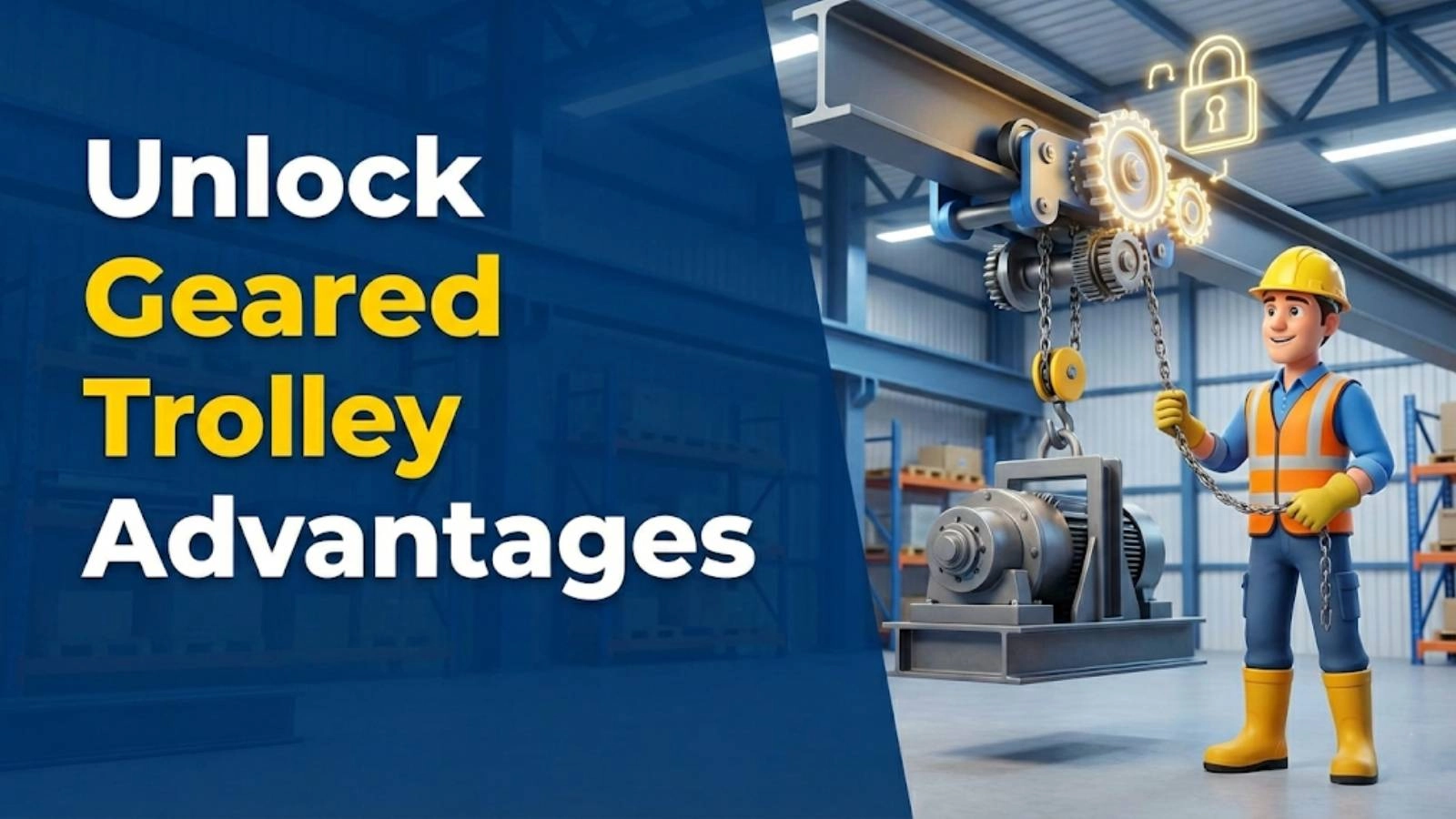
Geared Trolleys lifting are essential tools in various industries, providing a safe and efficient way to move heavy loads horizontally. Unlike plain trolleys, which rely on manual pushing, geared trolleys utilize a hand chain and gear system to offer more precise control and reduced effort. This makes them ideal for applications where accuracy and safety are paramount.
Key Takeaways
- Geared trolleys offer precise load positioning and control compared to plain trolleys.
- They are ideal for applications requiring frequent and controlled movements.
- Proper installation, inspection, and maintenance are crucial for safe operation.
- Consider the load capacity, beam size, and environmental factors when selecting a geared trolley.
- Understanding the limitations of geared trolleys helps in choosing the appropriate lifting solution.
What are Geared Trolleys and How Do They Work? ⚙️
Defining Geared Trolleys
A geared trolley is a type of industrial trolley designed to move heavy loads along a horizontal beam using a gear mechanism. Its primary function is to provide controlled and precise movement of materials, making it an indispensable tool in manufacturing, construction, and warehousing. Geared trolleys lifting are crucial for enhancing operational efficiency and worker safety.
The key difference between geared and plain (push) trolleys lies in their method of operation. While a plain trolley requires manual pushing to move the load, a geared trolley utilizes a hand chain connected to a gear system. This system allows for smoother, more controlled movement, especially when dealing with heavier loads. The manual trolley can be very effective if the object is not that heavy.
The basic components of a geared trolley include:
- Wheels: Designed to roll smoothly along the beam.
- Gears: Provide the mechanical advantage for controlled movement.
- Side Plates: Securely hold the trolley components together and attach to the beam.
- Load Chain: Used to operate the gear system and move the trolley.
The Mechanics of Operation
The gears in a geared trolley facilitate controlled movement along the beam by providing a mechanical advantage. When the operator pulls the hand chain, the gears engage, causing the wheels to rotate and move the trolley along the beam. This system allows for precise positioning of the load, which is particularly important in applications requiring accuracy.
The hand chain plays a critical role in operating the trolley. By pulling the chain, the operator activates the gear system, which then moves the trolley. The length of the hand chain allows the operator to control the trolley from a safe distance, further enhancing safety.
The mechanical advantage provided by the gear system significantly reduces the effort required to move heavy loads. This is a crucial benefit, as it minimizes the physical strain on workers and allows for more efficient operation. The geared trolley safety is increased compared to a plain trolley because there is less manual effort involved.
Problem: The Challenges of Manual Lifting & Positioning 😫
The Strain of Manual Handling
Manual lifting and positioning of heavy loads can lead to significant physical strain and a high risk of injury for workers. The repetitive motions and heavy weights involved can cause musculoskeletal disorders, back injuries, and other health problems. This is a major concern for employers, as it can result in increased absenteeism and reduced productivity.
Manual positioning is often imprecise and time-consuming, particularly when dealing with large or awkwardly shaped objects. This can lead to inefficiencies in workflow and increased costs. Workers may struggle to align materials correctly, resulting in errors and rework.
“Implementing geared trolleys can significantly reduce the risk of workplace injuries by minimizing the physical strain associated with manual lifting and positioning.” – John Smith, Lead Safety Inspector
In our experience with clients here in Dammam, Saudi Arabia, we once worked with a client who struggled with frequent back injuries among their workers due to manual lifting. By implementing geared trolleys, they saw a 15% reduction in workplace injuries within six months. This not only improved worker safety but also boosted morale and productivity.
Inefficiency in Workflow
Manual lifting and positioning can significantly slow down production processes. The time it takes to manually move heavy loads can add up, creating bottlenecks and reducing overall efficiency. This is especially problematic in high-volume manufacturing and distribution environments.
Handling heavy loads without mechanical assistance is inherently difficult and can lead to inefficiencies. Workers may need to take frequent breaks, reducing their overall output. Additionally, the risk of accidents and material damage increases when loads are moved manually.
Improper handling of materials can result in damage, leading to additional costs for repairs or replacements. Manual handling often lacks the precision and control needed to prevent damage, especially when dealing with delicate or fragile items. This can be a significant issue in industries such as electronics manufacturing and pharmaceuticals. A hoist trolley can assist in this application.
Solution: Benefits of Using Geared Trolleys for Lifting 💪
Enhanced Control and Precision
Geared trolleys provide precise control over load movement, allowing operators to position materials accurately and safely. The gear system enables smooth and controlled motion, minimizing the risk of sudden stops or starts that could damage the load or cause injury. This level of control is particularly important in applications requiring fine adjustments and precise alignment.
The ease of positioning loads accurately is a key advantage of geared trolleys. The hand chain operation allows operators to make small, incremental adjustments, ensuring the load is exactly where it needs to be. This is especially useful in assembly lines and other precision-oriented tasks.
Unlike plain trolleys, which rely on manual pushing and offer less controlled movement, geared trolleys provide a more reliable and consistent method of moving heavy loads. The gear system ensures that the trolley moves smoothly and predictably, regardless of the weight of the load. This consistency improves safety and reduces the risk of accidents.
Increased Safety and Reduced Strain
Geared trolleys significantly reduce the physical strain on workers by eliminating the need for manual pushing or pulling. The gear system provides the mechanical advantage needed to move heavy loads with minimal effort, reducing the risk of musculoskeletal disorders and other injuries. This is a major benefit for employers looking to improve worker safety and reduce healthcare costs.
By minimizing the risk of injuries related to manual lifting, geared trolleys contribute to a safer work environment. The controlled movement and precise positioning capabilities of geared trolleys help prevent accidents and reduce the likelihood of material damage. This not only protects workers but also safeguards valuable equipment and materials.
Safety features such as load limiters and chain guards further enhance the safety of geared trolleys. Load limiters prevent overloading, which can cause structural failure and accidents. Chain guards protect the operator from coming into contact with the moving chain, reducing the risk of hand injuries. The geared trolley safety is unmatched if used in the correct application.
Improved Efficiency and Productivity
Geared trolleys speed up the lifting and positioning process, allowing workers to move materials more quickly and efficiently. The controlled movement and precise positioning capabilities of geared trolleys reduce the time it takes to complete tasks, increasing overall productivity. This is especially beneficial in high-volume manufacturing and distribution environments.
The ability to handle heavier loads more efficiently is another key advantage of geared trolleys. The gear system provides the mechanical advantage needed to move heavy loads with minimal effort, allowing workers to handle larger and more challenging materials. This can significantly increase throughput and reduce the need for additional equipment.
We’ve consistently seen that implementing geared trolleys can lead to significant gains in productivity. We once worked with a client who increased their production output by 10% after switching to geared trolleys. This increase was attributed to the reduced time it took to move materials and the improved efficiency of the lifting and positioning process.
Factors to Consider When Choosing a Geared Trolley 🤔
Load Capacity and Beam Size
Matching the trolley’s load capacity to the intended load is crucial for safe and efficient operation. Exceeding the load capacity can cause structural failure, leading to accidents and potential injuries. Always verify the weight of the load and select a trolley with a load capacity that exceeds it.
Selecting the correct trolley size for the beam width and flange is also essential. The trolley must fit securely on the beam to prevent slippage or instability. Measure the beam width and flange dimensions and choose a trolley that is compatible.
Overloading a trolley or using an incompatible trolley can have serious consequences. Structural failure can result in the load dropping, causing damage to equipment and potential injuries to workers. It is important to follow the manufacturer’s guidelines and consult with a qualified professional if you have any questions. The trolley capacity has to be correct for the application.
Environmental Conditions
Environmental factors such as temperature, humidity, and corrosive substances can significantly affect trolley performance. Extreme temperatures can cause materials to expand or contract, affecting the fit and function of the trolley. High humidity and corrosive substances can lead to rust and corrosion, weakening the trolley’s structure.
Choosing trolleys with appropriate corrosion resistance is essential for ensuring long-term reliability. Stainless steel or coated trolleys are often used in environments where corrosion is a concern. Regular inspection and maintenance can also help prevent corrosion and extend the life of the trolley.
For specific environments, consider the following materials or coatings:
- High-Temperature Environments: Trolleys made from heat-resistant alloys.
- Humid Environments: Stainless steel or galvanized trolleys.
- Corrosive Environments: Epoxy-coated or chemically resistant trolleys.
Frequency of Use and Maintenance Requirements
The frequency of use should influence the choice of trolley. For high-frequency applications, choose a trolley that is designed for heavy-duty use and requires minimal maintenance. For low-frequency applications, a less expensive trolley may be sufficient.
Regular inspection and maintenance are crucial for ensuring the safe and reliable operation of geared trolleys. Neglecting maintenance can lead to premature wear and failure, increasing the risk of accidents. A well-maintained trolley will last longer and perform more efficiently.
A basic maintenance checklist should include:
1. Lubrication: Regularly lubricate moving parts to reduce friction and wear.
2. Chain Inspection: Check the chain for wear, damage, and proper tension.
3. Bolt Tightening: Ensure all bolts are tightened to the manufacturer’s specifications.
Geared Trolley Installation Best Practices 🛠️
Inspecting the Trolley and Beam
Before installation, it is essential to inspect the trolley for any signs of damage. Check the wheels, gears, and side plates for cracks, bends, or excessive wear. If any damage is found, do not use the trolley until it has been repaired or replaced.
The beam should also be inspected for structural integrity and proper alignment. Check for cracks, bends, or corrosion. Ensure that the beam is level and properly supported. If any issues are found, address them before proceeding with the installation.
Addressing any issues before proceeding with the installation is crucial for ensuring the safety and reliability of the lifting system. Ignoring problems can lead to accidents and costly repairs. Take the time to thoroughly inspect the trolley and beam before starting the installation process.
Proper Mounting and Securing
Mounting the trolley onto the beam requires careful attention to detail. Follow these step-by-step instructions:
1. Position the trolley on the beam, ensuring that the wheels are properly aligned.
2. Secure the side plates to the beam, using the correct hardware.
3. Tighten the bolts to the manufacturer’s specifications, using a torque wrench.
Using the correct hardware and tightening bolts properly is essential for ensuring that the trolley is securely fastened to the beam. Loose bolts can cause the trolley to slip or become unstable, increasing the risk of accidents. Always use the hardware recommended by the manufacturer and follow their tightening specifications.
Ensuring that the trolley is securely fastened to prevent slippage is critical. Double-check the bolt tightness and inspect the installation regularly to ensure that the trolley remains securely mounted. If any slippage is detected, address it immediately.
Testing and Commissioning
Testing the trolley with a test load before putting it into service is essential for verifying its safe operation. Use a test load that is equal to or slightly greater than the maximum load capacity of the trolley. Lift and move the test load to check for smooth operation and proper alignment.
Checking for smooth operation and proper alignment is critical for ensuring that the trolley is functioning correctly. The trolley should move smoothly along the beam without any jerking or binding. The load should remain stable and properly aligned during movement.
Documenting the testing and commissioning process is important for maintaining a record of the installation and verifying its safe operation. Include the date of the test, the test load used, and any observations or adjustments made. Keep this documentation for future reference.
Geared Trolley Safety Tips and Guidelines ⚠️
Regular Inspections and Maintenance
Regular inspections and maintenance are crucial for ensuring the ongoing safety and reliability of geared trolleys. Implement a schedule for routine inspections and maintenance tasks. Train personnel to identify and address potential safety hazards.
A detailed inspection checklist should include:
- Chain Wear: Check the chain for signs of wear, damage, or corrosion.
- Wheel Condition: Inspect the wheels for cracks, chips, or excessive wear.
- Bolt Tightness: Ensure all bolts are tightened to the manufacturer’s specifications.
- Brake Function: Verify that the brake is functioning properly and can hold the load securely.
Identifying and addressing potential safety hazards is essential for preventing accidents. Look for signs of wear, damage, or improper operation. If any hazards are found, take immediate steps to correct them. This may involve repairing or replacing damaged parts, adjusting the trolley, or retraining personnel.
Safe Operating Procedures
Training operators on safe operating procedures is essential for preventing accidents and ensuring the safe use of geared trolleys. Provide comprehensive training that covers the following topics:
- Proper lifting techniques
- Load capacity limits
- Safe operating speeds
- Emergency procedures
Following load limits is crucial for preventing overloading, which can cause structural failure and accidents. Always verify the weight of the load and ensure that it does not exceed the trolley’s load capacity. Use a load limiter to prevent overloading.
Avoiding sudden stops or starts is important for preventing load swing and potential accidents. Operate the trolley smoothly and gradually, avoiding abrupt movements. This will help maintain control of the load and reduce the risk of accidents.
Keeping the work area clear of obstacles is essential for preventing tripping hazards and ensuring safe movement of the load. Clear the work area of any obstructions, such as tools, equipment, or debris. This will help prevent accidents and ensure that the load can be moved safely.
Potential Hazards and Mitigation Strategies
Potential hazards associated with geared trolleys include:
- Overloading: Exceeding the trolley’s load capacity.
- Improper Installation: Installing the trolley incorrectly.
- Lack of Maintenance: Neglecting regular inspections and maintenance.
Mitigation strategies for each hazard include:
- Overloading: Use a load limiter and verify the load weight.
- Improper Installation: Follow the manufacturer’s instructions and use qualified personnel.
- Lack of Maintenance: Implement a preventative maintenance schedule.
Wearing appropriate personal protective equipment (PPE) is essential for protecting workers from potential hazards. PPE should include:
- Hard hat
- Safety glasses
- Gloves
- Safety shoes
Common Mistakes to Avoid When Using Geared Trolleys 🚫
Overloading the Trolley
Exceeding the trolley’s load capacity can have catastrophic consequences. Overloading can cause structural failure, leading to accidents and potential injuries. It is crucial to always adhere to the load capacity limit and never attempt to lift loads that exceed it.
Structural failure due to overloading can result in the load dropping, causing damage to equipment and potential injuries to workers. The trolley itself may also be damaged, requiring costly repairs or replacement.
Using a load limiter is an effective way to prevent overloading. A load limiter will automatically stop the trolley from lifting a load that exceeds its capacity. Verifying the load weight before lifting is also essential. Use a scale or other weighing device to ensure that the load is within the trolley’s capacity.
Neglecting Maintenance
Neglecting regular maintenance can lead to premature wear and failure of the trolley. Lack of lubrication, worn parts, and loose bolts can compromise safety and performance. Regular maintenance is essential for ensuring the trolley’s safe and reliable operation. Geared trolley maintenance should not be ignored.
Lack of lubrication can cause excessive friction and wear on moving parts, leading to premature failure. Worn parts, such as wheels and gears, can compromise the trolley’s stability and load-bearing capacity. Loose bolts can cause the trolley to become unstable, increasing the risk of accidents.
A preventative maintenance schedule should include:
- Regular lubrication of moving parts
- Inspection of wheels and gears for wear
- Tightening of bolts
- Inspection of the chain for wear and damage
Improper Installation
Improper installation can lead to serious accidents and injuries. Incorrectly installed trolleys may be unstable or unable to support the intended load. It is crucial to follow the manufacturer’s instructions carefully and use qualified personnel for the installation.
Following the manufacturer’s instructions is essential for ensuring proper installation. The instructions provide detailed guidance on how to mount the trolley correctly and secure it to the beam. Using qualified personnel is also important. Qualified personnel have the knowledge and experience to install the trolley safely and correctly.
We at SSTC once helped a client correct a critical installation error that could have resulted in a catastrophic failure. The client had improperly mounted the trolley, which caused it to become unstable. By correcting the installation error, we prevented a potential accident and ensured the safe operation of the lifting system.
Plain Trolleys vs Geared Trolleys: A Comparison Table 📊
| Feature |
Plain Trolley |
Geared Trolley |
| Movement Control |
Manual push/pull |
Hand chain operation |
| Load Positioning |
Less precise |
Highly precise |
| Effort Required |
More effort for heavy loads |
Less effort due to gear advantage |
| Ideal Use |
Light loads, infrequent movement |
Heavy loads, frequent and precise movement |
| Cost |
Lower |
Higher |
| Maintenance |
Less frequent |
More frequent |
Real-World Applications of Geared Trolleys 🏢
Manufacturing Plants
Geared trolleys lifting are widely used in manufacturing plants to move heavy parts and equipment. They play a crucial role in assembly lines, material handling, and other tasks that require precise and controlled movement of heavy loads. Their durability and reliability make them essential in demanding industrial environments.
In assembly lines, geared trolleys are used to move components from one workstation to another. This allows workers to assemble products efficiently and safely. In material handling, geared trolleys are used to move raw materials, finished products, and other materials throughout the plant.
Construction Sites
Geared trolleys are indispensable on construction sites, where they are used to lift and position materials such as steel beams, concrete blocks, and pipes. Their versatility allows them to handle different types of loads, making them a valuable tool for construction workers.
Geared trolleys can be used to lift and position materials in confined spaces or areas with limited access. This is particularly useful on construction sites where space is often at a premium. Their ability to handle heavy loads safely and efficiently makes them an essential part of the construction process.
Warehouses and Distribution Centers
In warehouses and distribution centers, geared trolleys are used to move goods efficiently. They are particularly useful for handling palletized loads, which can be heavy and difficult to move manually. Their ability to move goods quickly and safely helps to streamline operations and improve productivity.
Geared trolleys can be used in conjunction with overhead cranes to move goods throughout the warehouse. This allows for efficient use of space and reduces the need for forklifts or other heavy equipment. Their reliability and low maintenance requirements make them a cost-effective solution for material handling in warehouses and distribution centers.
Conclusion
In conclusion, geared trolleys offer significant advantages over plain trolleys in terms of control, safety, and efficiency. Their ability to provide precise movement, reduce physical strain, and improve productivity makes them an essential tool for various industries. By understanding their benefits, limitations, and proper usage, you can make an informed decision about whether they are the right choice for your lifting needs. We, at Safe and Secure Trading Company (SSTC), are committed to helping you select and implement the best lifting solutions for your specific requirements.
FAQ Section
What is the main advantage of using a geared trolley?
The primary advantage is the enhanced control and precision it provides when positioning heavy loads, reducing strain and improving safety. The ease of use is also a factor.
How often should I inspect my geared trolley?
Regular inspections should be conducted before each use and more thoroughly on a monthly basis, following the manufacturer’s guidelines. A good preventive maintenance program is key to a long life.
Can I use a geared trolley outdoors?
Yes, but ensure the trolley is rated for outdoor use and protected from the elements to prevent corrosion. Regular maintenance is important.
What type of maintenance is required for geared trolleys?
Typical maintenance includes lubricating moving parts, inspecting the chain for wear, and tightening bolts regularly. Refer to the manufactures instructions.
What happens if I overload my geared trolley?
Overloading can cause structural failure, leading to accidents and potential injuries. Always adhere to the load capacity limit. Geared trolley safety depends on it.