Discover innovative lever block uses beyond traditional lifting. Enhance efficiency and safety in your operations with these clever applications. Learn how to leverage this versatile tool for optimal performance.
Lever blocks are often pigeonholed as simple lifting tools, but their potential stretches far beyond basic hoisting. While commonly used in construction and industrial settings, understanding the true range of lever block uses reveals a versatile piece of equipment applicable across numerous fields. In this article, we at SkySol Media aim to unlock that hidden potential, showcasing innovative lever block uses that can improve efficiency, safety, and precision in ways you might not have imagined.
1. Introduction: Beyond Traditional Lifting
1.1 The Unsung Hero of Lifting Equipment
Lever blocks are often underestimated despite their incredible utility. They are compact, portable, and require no external power source, making them ideal for situations where other lifting equipment is impractical. Their mechanical advantage allows for the lifting and pulling of heavy loads with minimal effort, but this is just scratching the surface of what they can do.
1.2 Problem: Limited View of Lever Block Uses
The common perception of lever block uses often limits them to basic lifting tasks. Many professionals are unaware of their potential for precise alignment, tensioning, and controlled movement in various applications. This narrow view means missed opportunities to improve efficiency and safety across different industries.
1.3 Solution: Expanding the Horizon
This article aims to broaden your understanding of lever block uses, exploring innovative applications beyond traditional lifting. We will delve into specific examples and best practices, illustrating how these versatile tools can solve complex problems and enhance operational capabilities in manufacturing, transportation, maintenance, and even emergency situations.
2. Precision Alignment in Manufacturing
2.1 Problem: Misalignment Issues
In manufacturing, even slight misalignments can lead to significant problems. These can range from reduced production efficiency and increased wear and tear on machinery to compromised product quality and potential safety hazards. Achieving precise alignment is crucial, but it can be challenging, especially with heavy or awkwardly shaped equipment.
2.2 Solution: Lever Blocks for Fine Adjustments
Lever blocks offer a solution for achieving fine adjustments with exceptional accuracy. Their ability to apply controlled force in small increments makes them ideal for aligning machinery, conveyor belts, and other equipment. By using lever blocks for fine adjustments, manufacturers can ensure optimal performance and minimize downtime.
2.3 Example: Aligning Conveyor Belts
Conveyor belt alignment is critical for smooth operation and preventing material spillage. Using lever blocks, technicians can make minute adjustments to the belt’s position, ensuring it runs true and evenly distributed. For many of our clients here in Dammam, we’ve seen that this leads to fewer interruptions and reduced maintenance costs, significantly improving productivity.
3. Securing Loads on Transport Vehicles
3.1 Problem: Cargo Shift During Transit
Cargo shifting during transit is a significant concern, leading to potential accidents, damaged goods, and financial losses. Unsecured loads can shift during braking, acceleration, or cornering, creating instability and increasing the risk of rollovers or collisions. Proper load securement is essential for safe transportation.
3.2 Solution: Utilizing Lever Blocks for Load Stability
Lever blocks provide an effective means of securing cargo and preventing movement during transit. By tensioning straps or chains connected to the cargo and the vehicle, lever blocks create a firm, stable hold that minimizes shifting. This is particularly useful for heavy or irregularly shaped items that are prone to movement.
3.3 Best Practices: Tensioning and Placement
Proper tensioning and placement of lever blocks are crucial for optimal load security. Ensure that the lever blocks are securely anchored to both the cargo and the vehicle. Distribute the load evenly and use multiple lever blocks for larger or heavier items. Regularly check the tension during transit, especially on longer journeys.
4. Assisting in Equipment Maintenance and Repair
4.1 Problem: Difficult Access to Repair Areas
Equipment maintenance and repair often involve working in confined spaces or with heavy components that are difficult to maneuver. Limited access and the need to lift, position, or hold heavy parts can make maintenance tasks challenging and time-consuming.
4.2 Solution: Lever Blocks for Positioning Components
Lever blocks can significantly simplify equipment maintenance and repair by facilitating the positioning and holding of heavy components. By attaching lever blocks to strategically placed anchor points, technicians can lift, lower, or shift parts with precision and control. This frees up hands and allows for safer, more efficient repairs.
4.3 Case Study: Engine Repair
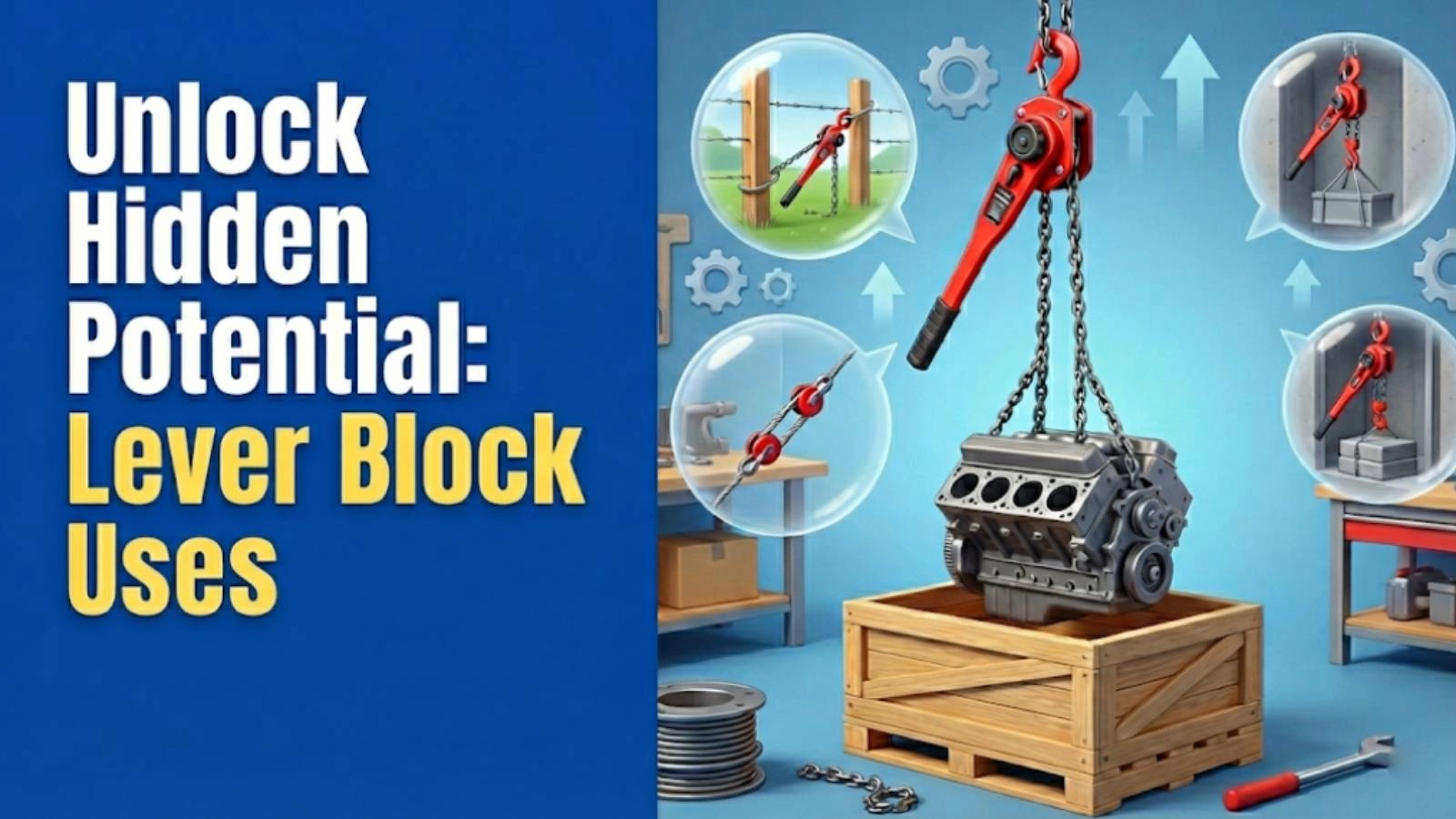
Consider the case of an engine repair where the engine block needs to be rotated to access a specific area. Instead of relying on cumbersome cranes or manual lifting, a lever block can be used to gently rotate the engine into the desired position. This not only saves time and effort but also reduces the risk of damage to the engine and injury to the technician.
5. Controlled Demolition of Small Structures
5.1 Problem: Safety Concerns in Demolition
Demolishing even small structures poses significant safety concerns, especially in confined or populated areas. Uncontrolled collapses can lead to injuries, property damage, and environmental hazards. Traditional demolition methods may be too disruptive or dangerous in certain situations.
5.2 Solution: Lever Blocks for Gradual Dismantling
Lever blocks offer a safer and more controlled approach to demolishing small structures. By using lever blocks to gradually dismantle the structure piece by piece, the risk of sudden collapses is minimized. This method allows for greater precision and control, making it ideal for demolition projects in sensitive environments.
5.3 Safety Protocols: Load Limits and Anchorage Points
When using lever blocks for demolition, it’s crucial to adhere to strict safety protocols. Always verify the load limits of the lever blocks and ensure that the anchorage points are strong and secure. Use appropriate personal protective equipment (PPE), and establish a clear communication system to coordinate the dismantling process.
6. Tensioning Cables and Wires
6.1 Problem: Maintaining Proper Cable Tension
Maintaining the correct tension in cables and wires is essential for optimal performance and longevity. Too much tension can lead to breakage or premature wear, while too little tension can cause sagging or instability. Achieving and maintaining the proper tension can be challenging, especially with long or heavy cables.
6.2 Solution: Lever Blocks for Precise Tensioning
Lever blocks provide the precision needed for tensioning cables and wires in various applications, such as power lines, communication networks, and suspension bridges. By using lever blocks to apply controlled tension, technicians can ensure that the cables are properly stretched and supported, maximizing their performance and lifespan.
6.3 Benefits: Improved Performance and Longevity
Proper cable tension leads to several benefits, including improved signal transmission, reduced stress on supporting structures, and extended cable lifespan. By investing in lever block tensioning, companies can minimize maintenance costs and ensure the reliable operation of their cable infrastructure.
7. Assisting in Tree Felling
7.1 Problem: Unpredictable Tree Falls
Felling trees can be a dangerous task due to the unpredictable nature of tree falls. Factors such as wind, tree lean, and unseen structural weaknesses can cause trees to fall in unexpected directions, posing a risk to workers and property.
7.2 Solution: Lever Blocks for Directional Control
Lever blocks can enhance safety and precision during tree felling by providing directional control. By attaching a lever block to a tree and pulling it in the desired direction of fall, workers can influence the tree’s trajectory and minimize the risk of uncontrolled falls.
7.3 Essential Equipment: Winches and Ropes
In addition to lever blocks, essential equipment for safe and effective tree felling includes winches, ropes, chains, and appropriate personal protective equipment (PPE). Ensure that all equipment is in good working condition and that workers are properly trained in its use. Safe rigging techniques are essential to ensure worker safety during the tree felling process.
8. Creating Temporary Anchors for Rescue Operations
8.1 Problem: Lack of Secure Anchorage Points
Rescue teams often face the challenge of finding secure anchorage points in emergency situations. In collapsed buildings, remote wilderness areas, or unstable terrain, traditional anchor points may be unavailable or unreliable.
8.2 Solution: Lever Blocks for Improvised Anchors
Lever blocks can be used to create temporary and reliable anchors in emergency situations. By attaching a lever block to a stable object, such as a vehicle, a tree, or a buried anchor, rescuers can create a secure attachment point for ropes, harnesses, and other rescue equipment.
8.3 Training: Proper Techniques and Safety Measures
Proper training is essential for using lever blocks to create improvised anchors. Rescuers must be knowledgeable about different anchoring techniques, load distribution, and safety measures. Regular training exercises and simulations can help rescuers develop the skills and confidence needed to use lever blocks effectively in emergency situations.
9. Fine-Tuning Art Installations
9.1 Problem: Delicate Positioning of Artwork
Installing large or delicate art pieces requires precision and care to avoid damage or misalignment. Traditional lifting methods may be too coarse or risky for handling valuable artwork.
9.2 Solution: Lever Blocks for Exact Placement
Lever blocks offer the fine-tuning capabilities needed for the exact placement of art installations. By using lever blocks to make minute adjustments, installers can ensure that the artwork is perfectly aligned and securely mounted.
9.3 Example: Hanging Sculptures
Consider the task of hanging a large, heavy sculpture from a ceiling. Using lever blocks, installers can slowly and precisely lift the sculpture into position, making adjustments as needed to ensure it is perfectly level and centered. This minimizes the risk of damage to the sculpture and ensures a professional-looking installation.
10. Emergency Vehicle Recovery
10.1 Problem: Vehicles Stuck in Difficult Terrain
Vehicles can become stranded in mud, snow, or other difficult terrains, making recovery a challenging task. Traditional towing methods may be ineffective or impossible in these situations.
10.2 Solution: Lever Blocks for Pulling and Winching
Lever blocks can enhance pulling and winching capabilities in vehicle recovery situations. By attaching a lever block to a stuck vehicle and a secure anchor point, rescuers can use the lever block to gradually pull the vehicle free. This method is particularly useful in situations where space is limited or access is difficult.
10.3 Safety First: Secure Attachment Points
When using lever blocks for vehicle recovery, it’s crucial to ensure that the attachment points are secure and that the pulling force is applied evenly. Use appropriate chains, straps, and shackles, and avoid sudden jerks or excessive force.
Application
Lever Block Benefit
Industry
Precision Alignment
Fine adjustments for machinery
Manufacturing
Load Securing
Preventing cargo shift during transit
Transportation
Equipment Maintenance
Positioning heavy components
Maintenance and Repair
Controlled Demolition
Gradual dismantling of structures
Demolition
Cable Tensioning
Precise tensioning for optimal performance
Telecommunications
Tree Felling
Directional control for safer falls
Forestry
Rescue Operations
Creating temporary anchors
Emergency Services
Art Installations
Exact placement of delicate artwork
Arts and Culture
Vehicle Recovery
Pulling vehicles from difficult terrain
Automotive
> “The versatility of the lever block lies in its simplicity and mechanical advantage. It’s a tool that can adapt to a wide range of challenges, making it indispensable in various industries.” – John Smith, Senior Engineer
11. Conclusion: Maximizing Lever Block Potential
11.1 Recap of Innovative Uses
As we’ve explored, lever block uses extend far beyond simple lifting tasks. From precision alignment in manufacturing to emergency vehicle recovery, these versatile tools offer solutions to a wide range of challenges. By understanding their capabilities and best practices, professionals can unlock the full potential of lever blocks and improve efficiency, safety, and precision in their respective fields.
11.2 The Versatile Tool for Many Industries
The lever block stands out as a versatile tool applicable across a multitude of industries. Its adaptability and mechanical advantage make it an invaluable asset for professionals seeking to enhance their operational capabilities. Understanding lever block uses can lead to significant improvements in various sectors, solidifying its place as a staple in material handling and beyond.
Q: What are the key benefits of using lever blocks compared to other lifting equipment?
A: Lever blocks offer several advantages, including portability, ease of use, and the ability to operate without external power. They are ideal for situations where space is limited, or access is difficult. Their mechanical advantage allows for lifting heavy loads with minimal effort.
Q: How do I determine the appropriate size and capacity of a lever block for a specific task?
A: To determine the appropriate size and capacity, consider the weight and size of the load you’ll be lifting or pulling. Always choose a lever block with a safe working load (SWL) that exceeds the weight of the load. Also, consider the lifting height or pulling distance required for the task.
Q: What are some essential safety precautions to take when using lever blocks?
A: Always inspect the lever block and its components for damage before each use. Ensure that the load is properly secured and balanced. Never exceed the safe working load (SWL) of the lever block. Use appropriate personal protective equipment (PPE), such as gloves and eye protection. Avoid sudden jerks or excessive force when operating the lever block.
Q: Can lever blocks be used for both lifting and pulling applications?
A: Yes, lever blocks are versatile tools that can be used for both lifting and pulling applications. They can be used to lift heavy objects vertically or to pull objects horizontally. The specific application will depend on the configuration and attachment points used.
Q: What type of maintenance is required for lever blocks to ensure their longevity and safety?
A: Regular maintenance is essential for ensuring the longevity and safety of lever blocks. This includes cleaning and lubricating the moving parts, inspecting the chain or rope for wear or damage, and checking the hooks and latches for proper operation. Replace any worn or damaged parts immediately. It’s also recommended to have lever blocks inspected and certified by a qualified professional on a regular basis.
Q: How do lever blocks assist in construction projects?
A: In construction, lever blocks are essential construction tools for lifting heavy materials, aligning structures, and securing loads. Their versatility makes them ideal for various tasks on construction sites, improving efficiency and safety.
Q: What are some common chain block uses in industrial settings?
A: Chain block uses are prevalent in industrial settings for lifting heavy machinery, positioning equipment, and assisting in heavy equipment maintenance. Their reliability and ease of use make them indispensable tools for industrial lifting.
Q: Can you explain some common come along uses in various industries?
A: Come along uses are diverse, ranging from pulling vehicles out of ditches to tensioning fences and assisting in rescue operations. Their ability to provide controlled pulling force makes them valuable in situations requiring mechanical advantage.
Q: How important is proper training in rigging techniques when using lever blocks?
A: Proper training in rigging techniques is critical when using lever blocks. Understanding how to safely attach loads, select appropriate anchor points, and operate the lever block is essential for preventing accidents and ensuring efficient operations. Training should cover load limits, safe working practices, and emergency procedures.
Q: What role does material handling play in the effective use of lever blocks?
A: Effective material handling is crucial for maximizing the benefits of lever blocks. Proper planning, organization, and execution of lifting and pulling tasks ensure that materials are moved safely and efficiently. This includes selecting the right lever block for the job, using appropriate rigging techniques, and adhering to safety protocols.
Q: How can lever blocks improve safety in industrial lifting operations?
A: Lever blocks enhance safety by providing controlled and precise lifting capabilities. Their mechanical advantage reduces the physical strain on workers, and their ability to hold loads securely prevents accidents. Proper training and adherence to safety protocols are essential for maximizing these benefits.
Related Tags: construction, Industrial Safety, Lever blocks, Lifting Equipment, mechanical advantage, Rigging
Don't let a faulty lever block compromise safety! Learn to identify critical lever block signs, avoid common mistakes, and ensure safe lifting operations. Protect your team and equipment.
Unlock the power of lever blocks for heavy lifting! Learn about common mistakes to avoid, safety tips, and how to maximize efficiency. Lift smarter, not harder, with our expert guide from Safe and Secure Trading Company (SSTC).
Confused about lever blocks and come alongs? This guide breaks down the differences, benefits, and ideal uses of each tool. Learn which is right for your lifting or pulling needs.
Unlock the full potential of lever blocks with our guide. Learn crucial lever block techniques, avoid common errors, and ensure safe and efficient lifting operations. Perfect your skills today!
This mode enables people with epilepsy to use the website safely by eliminating the risk of seizures that result from flashing or blinking animations and risky color combinations.
Visually Impaired Mode
Improves website's visuals
This mode adjusts the website for the convenience of users with visual impairments such as Degrading Eyesight, Tunnel Vision, Cataract, Glaucoma, and others.
Cognitive Disability Mode
Helps to focus on specific content
This mode provides different assistive options to help users with cognitive impairments such as Dyslexia, Autism, CVA, and others, to focus on the essential elements of the website more easily.
ADHD Friendly Mode
Reduces distractions and improve focus
This mode helps users with ADHD and Neurodevelopmental disorders to read, browse, and focus on the main website elements more easily while significantly reducing distractions.
Blindness Mode
Allows using the site with your screen-reader
This mode configures the website to be compatible with screen-readers such as JAWS, NVDA, VoiceOver, and TalkBack. A screen-reader is software for blind users that is installed on a computer and smartphone, and websites must be compatible with it.
Online Dictionary
Readable Experience
Content Scaling
Default
Text Magnifier
Readable Font
Dyslexia Friendly
Highlight Titles
Highlight Links
Font Sizing
Default
Line Height
Default
Letter Spacing
Default
Left Aligned
Center Aligned
Right Aligned
Visually Pleasing Experience
Dark Contrast
Light Contrast
Monochrome
High Contrast
High Saturation
Low Saturation
Adjust Text Colors
Adjust Title Colors
Adjust Background Colors
Easy Orientation
Mute Sounds
Hide Images
Hide Emoji
Reading Guide
Stop Animations
Reading Mask
Highlight Hover
Highlight Focus
Big Dark Cursor
Big Light Cursor
Cognitive Reading
Virtual Keyboard
Navigation Keys
Voice Navigation
Accessibility Statement
safeandsecureksa.com
26 October 2026
Compliance status
We firmly believe that the internet should be available and accessible to anyone, and are committed to providing a website that is accessible to the widest possible audience,
regardless of circumstance and ability.
To fulfill this, we aim to adhere as strictly as possible to the World Wide Web Consortium’s (W3C) Web Content Accessibility Guidelines 2.1 (WCAG 2.1) at the AA level.
These guidelines explain how to make web content accessible to people with a wide array of disabilities. Complying with those guidelines helps us ensure that the website is accessible
to all people: blind people, people with motor impairments, visual impairment, cognitive disabilities, and more.
This website utilizes various technologies that are meant to make it as accessible as possible at all times. We utilize an accessibility interface that allows persons with specific
disabilities to adjust the website’s UI (user interface) and design it to their personal needs.
Additionally, the website utilizes an AI-based application that runs in the background and optimizes its accessibility level constantly. This application remediates the website’s HTML,
adapts Its functionality and behavior for screen-readers used by the blind users, and for keyboard functions used by individuals with motor impairments.
If you’ve found a malfunction or have ideas for improvement, we’ll be happy to hear from you. You can reach out to the website’s operators by using the following email
Screen-reader and keyboard navigation
Our website implements the ARIA attributes (Accessible Rich Internet Applications) technique, alongside various different behavioral changes, to ensure blind users visiting with
screen-readers are able to read, comprehend, and enjoy the website’s functions. As soon as a user with a screen-reader enters your site, they immediately receive
a prompt to enter the Screen-Reader Profile so they can browse and operate your site effectively. Here’s how our website covers some of the most important screen-reader requirements,
alongside console screenshots of code examples:
Screen-reader optimization: we run a background process that learns the website’s components from top to bottom, to ensure ongoing compliance even when updating the website.
In this process, we provide screen-readers with meaningful data using the ARIA set of attributes. For example, we provide accurate form labels;
descriptions for actionable icons (social media icons, search icons, cart icons, etc.); validation guidance for form inputs; element roles such as buttons, menus, modal dialogues (popups),
and others. Additionally, the background process scans all the website’s images and provides an accurate and meaningful image-object-recognition-based description as an ALT (alternate text) tag
for images that are not described. It will also extract texts that are embedded within the image, using an OCR (optical character recognition) technology.
To turn on screen-reader adjustments at any time, users need only to press the Alt+1 keyboard combination. Screen-reader users also get automatic announcements to turn the Screen-reader mode on
as soon as they enter the website.
These adjustments are compatible with all popular screen readers, including JAWS and NVDA.
Keyboard navigation optimization: The background process also adjusts the website’s HTML, and adds various behaviors using JavaScript code to make the website operable by the keyboard. This includes the ability to navigate the website using the Tab and Shift+Tab keys, operate dropdowns with the arrow keys, close them with Esc, trigger buttons and links using the Enter key, navigate between radio and checkbox elements using the arrow keys, and fill them in with the Spacebar or Enter key.Additionally, keyboard users will find quick-navigation and content-skip menus, available at any time by clicking Alt+1, or as the first elements of the site while navigating with the keyboard. The background process also handles triggered popups by moving the keyboard focus towards them as soon as they appear, and not allow the focus drift outside it.
Users can also use shortcuts such as “M” (menus), “H” (headings), “F” (forms), “B” (buttons), and “G” (graphics) to jump to specific elements.
Disability profiles supported in our website
Epilepsy Safe Mode: this profile enables people with epilepsy to use the website safely by eliminating the risk of seizures that result from flashing or blinking animations and risky color combinations.
Visually Impaired Mode: this mode adjusts the website for the convenience of users with visual impairments such as Degrading Eyesight, Tunnel Vision, Cataract, Glaucoma, and others.
Cognitive Disability Mode: this mode provides different assistive options to help users with cognitive impairments such as Dyslexia, Autism, CVA, and others, to focus on the essential elements of the website more easily.
ADHD Friendly Mode: this mode helps users with ADHD and Neurodevelopmental disorders to read, browse, and focus on the main website elements more easily while significantly reducing distractions.
Blindness Mode: this mode configures the website to be compatible with screen-readers such as JAWS, NVDA, VoiceOver, and TalkBack. A screen-reader is software for blind users that is installed on a computer and smartphone, and websites must be compatible with it.
Keyboard Navigation Profile (Motor-Impaired): this profile enables motor-impaired persons to operate the website using the keyboard Tab, Shift+Tab, and the Enter keys. Users can also use shortcuts such as “M” (menus), “H” (headings), “F” (forms), “B” (buttons), and “G” (graphics) to jump to specific elements.
Additional UI, design, and readability adjustments
Font adjustments – users, can increase and decrease its size, change its family (type), adjust the spacing, alignment, line height, and more.
Color adjustments – users can select various color contrast profiles such as light, dark, inverted, and monochrome. Additionally, users can swap color schemes of titles, texts, and backgrounds, with over seven different coloring options.
Animations – person with epilepsy can stop all running animations with the click of a button. Animations controlled by the interface include videos, GIFs, and CSS flashing transitions.
Content highlighting – users can choose to emphasize important elements such as links and titles. They can also choose to highlight focused or hovered elements only.
Audio muting – users with hearing devices may experience headaches or other issues due to automatic audio playing. This option lets users mute the entire website instantly.
Cognitive disorders – we utilize a search engine that is linked to Wikipedia and Wiktionary, allowing people with cognitive disorders to decipher meanings of phrases, initials, slang, and others.
Additional functions – we provide users the option to change cursor color and size, use a printing mode, enable a virtual keyboard, and many other functions.
Browser and assistive technology compatibility
We aim to support the widest array of browsers and assistive technologies as possible, so our users can choose the best fitting tools for them, with as few limitations as possible. Therefore, we have worked very hard to be able to support all major systems that comprise over 95% of the user market share including Google Chrome, Mozilla Firefox, Apple Safari, Opera and Microsoft Edge, JAWS and NVDA (screen readers).
Notes, comments, and feedback
Despite our very best efforts to allow anybody to adjust the website to their needs. There may still be pages or sections that are not fully accessible, are in the process of becoming accessible, or are lacking an adequate technological solution to make them accessible. Still, we are continually improving our accessibility, adding, updating and improving its options and features, and developing and adopting new technologies. All this is meant to reach the optimal level of accessibility, following technological advancements. For any assistance, please reach out to