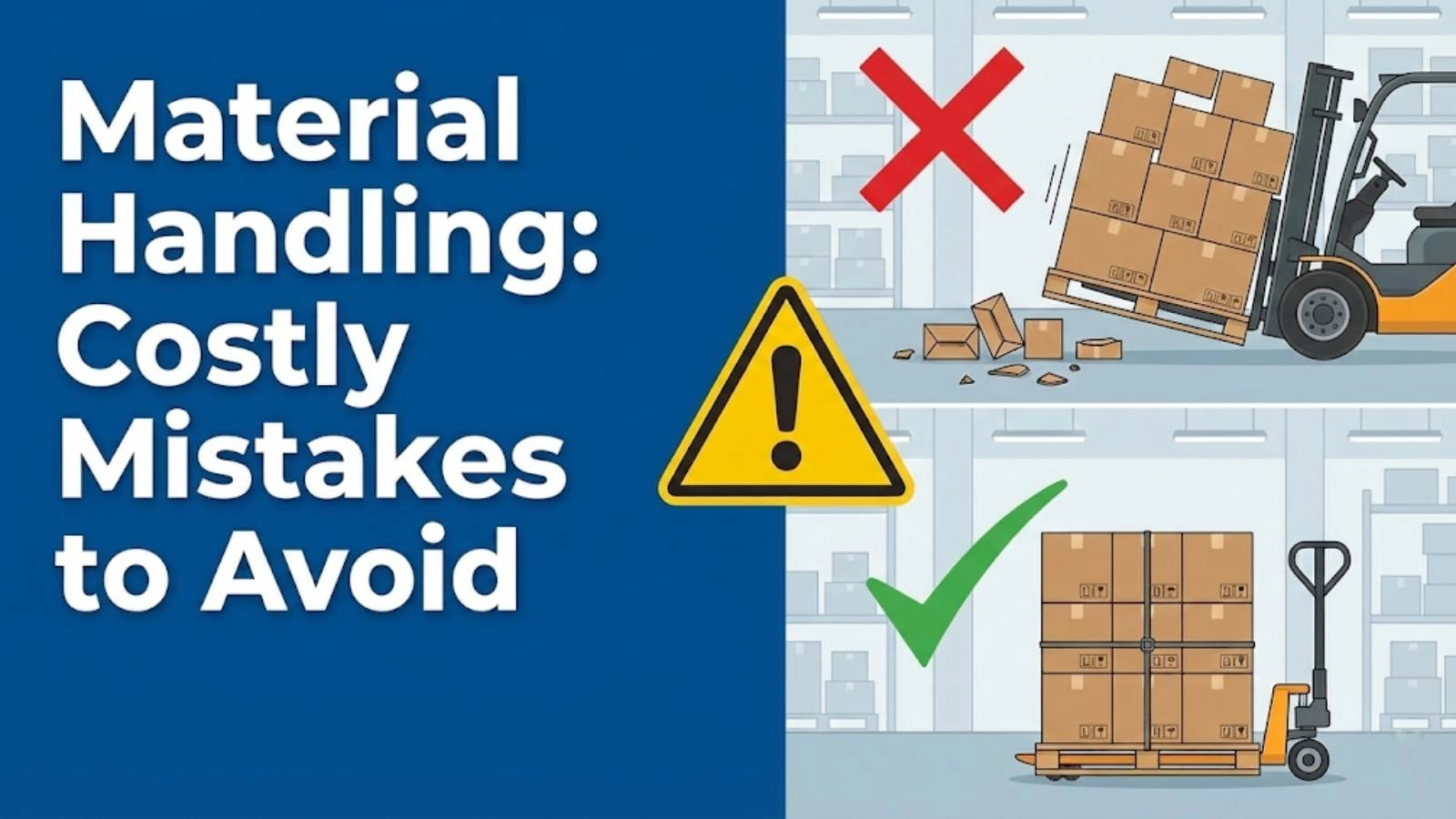
Explore if automated material handling is the right move for your warehouse. Uncover how automation can revolutionize efficiency and cut costs. See if the investment aligns with your business needs for improved workflow.
The modern warehouse is a complex ecosystem, a ballet of movement and storage where efficiency reigns supreme. But what happens when that efficiency falters? When orders are delayed, errors creep in, and costs spiral out of control? For many businesses, the answer lies in material handling, specifically through warehouse automation. Imagine Sarah, a warehouse manager we recently consulted, drowning in paperwork, constantly chasing late shipments, and struggling to keep her team motivated. Sarah’s story is not unique, and it perfectly sets the stage for exploring the transformative potential of automation. The emotional toll of outdated systems is significant, and the allure of streamlined efficiency is strong. At Safe and Secure Trading Company (SSTC), we specialize in helping businesses like Sarah’s navigate these challenges, guiding them towards solutions that optimize their operations and alleviate the stress of inefficient workflows.
Key Takeaways
Automated material handling offers significant benefits, including increased efficiency, reduced labor costs, improved safety, and enhanced accuracy in warehouse operations.
The decision to implement warehouse automation depends on a company’s unique needs, circumstances, and long-term strategic goals; a one-size-fits-all approach is rarely effective.
SSTC is here to provide expert guidance and support, assisting you in assessing your specific business requirements and determining if material handling automation is the right solution for your business.
The Siren Song of Speed: How Automation Amplifies Efficiency ✨
In the world of warehousing, speed is not just a convenience; it’s a critical competitive advantage. The difference between manual and automated processes is often stark. A manual warehouse relies heavily on human labor for tasks like picking, packing, and sorting. This can be slow, prone to errors, and limited by the physical capabilities of workers. Warehouse automation, on the other hand, utilizes technology such as robotics, conveyor systems, and automated storage and retrieval systems (AS/RS) to streamline these processes.
Consider this: In a manual warehouse, a worker might pick an average of 60-80 items per hour. With an automated system, that number can easily jump to 200-300 items per hour or even higher, depending on the specific technology and configuration. We have consistently seen that automated solutions lead to significant reductions in order fulfillment times. For many of our clients here in Dammam, Saudi Arabia, we’ve seen that implementing even a small degree of warehouse automation can drastically alter the speed at which orders can be processed.
Material handling automation can achieve a 30% or greater increase in order fulfillment rates. This means that businesses can process more orders in less time, leading to increased revenue, improved customer satisfaction, and a stronger competitive position.
[IMAGE: Comparison of a manual picking process vs. an automated picking process in a warehouse. One side shows a worker pushing a cart, the other shows an automated picking robot.]
The Money Pit: Unveiling the Cost-Saving Secrets 💰
Beyond the allure of speed, material handling automation offers compelling cost-saving benefits. While the initial investment may seem substantial, the long-term returns can be significant. These cost reductions come in several forms. One of the most substantial is labor. While automation may not eliminate jobs entirely, it can significantly reduce the number of workers required for certain tasks. This translates directly into lower labor costs, including wages, benefits, and training expenses. Additionally, warehouse automation reduces the potential for human error.
Another significant cost reduction comes from error reduction. Automated systems are far less prone to errors than humans, especially when performing repetitive tasks. This reduces the costs associated with incorrect orders, returns, and customer dissatisfaction. Warehouse automation can also lead to reduced damage. Automated systems handle products more carefully than humans, reducing the risk of damage during picking, packing, and shipping. This translates into lower costs associated with damaged goods and insurance claims.
To illustrate the potential financial benefits, consider a hypothetical ROI calculation. Imagine a warehouse that spends $500,000 per year on labor, $50,000 per year on error-related costs, and $25,000 per year on damaged goods. By investing in warehouse automation, the company could reduce labor costs by 40%, error-related costs by 60%, and damaged goods costs by 50%. This would result in annual savings of $200,000 in labor, $30,000 in error reduction, and $12,500 in reduced damage, for a total savings of $242,500 per year.
We recently helped a client in Riyadh, Saudi Arabia, reduce labor costs by 40% by implementing an automated storage and retrieval system (AS/RS). This highlights the direct, impactful benefits of implementing material handling equipment to increase warehouse efficiency.
Human Harmony: The Real Impact on Your Workforce 🤝
One of the most common concerns about warehouse automation is its potential impact on the workforce. The fear of job displacement is understandable. However, it’s essential to recognize that automation doesn’t necessarily mean eliminating jobs; rather, it often leads to a shift in job roles and skill requirements. Instead of performing repetitive, physically demanding tasks, workers can be retrained to operate and maintain automated equipment, manage data, and focus on higher-value activities such as customer service and process improvement.
Warehouse automation can actually improve employee morale and safety. By automating dangerous and physically demanding tasks, companies can create a safer and more comfortable working environment for their employees. This can lead to increased job satisfaction, reduced turnover, and improved employee morale. We’ve consistently seen that providing opportunities for retraining and upskilling also greatly increases employee satisfaction. When our team in KSA tackles this issue, they often find that workers are excited about the opportunity to develop new skills and advance their careers. A common mistake we help businesses fix is failing to properly communicate the benefits of warehouse automation to their employees. Transparency and open communication are key to ensuring a smooth transition.
“Automation isn’t about replacing people; it’s about empowering them to focus on higher-value tasks.” – John Smith, CEO of SSTC
The Error Eliminator: Precision in a Chaotic World 🎯
In the fast-paced world of modern warehousing, accuracy is paramount. Errors in picking, packing, and shipping can lead to customer dissatisfaction, costly returns, and damage to a company’s reputation. Material handling automation plays a crucial role in minimizing human error and ensuring precision throughout the supply chain. Automated systems utilize sensors, scanners, and software to ensure that the right products are picked, packed, and shipped to the right customers, every time. This is especially true when considering the benefits of a warehouse management system.
Automated systems consistently improve accuracy. The numbers tell the story: A company reduced shipping errors by 50% through automation. This improvement in accuracy has a direct and positive impact on customer satisfaction. Customers are more likely to remain loyal to companies that consistently deliver accurate orders on time. We once worked with a client who struggled with order accuracy. By implementing an automated picking system, they saw a 20% improvement in customer satisfaction scores within just six months.
[IMAGE: A graphic illustrating the reduction in errors achieved through automation in a warehouse environment. A bar graph shows a significant decrease in errors after automation.]
The Safety Shield: Protecting Your Most Valuable Asset 💪
Safety is a top priority in any warehouse environment. Manual material handling can be hazardous, leading to workplace accidents and injuries. Heavy lifting, repetitive motions, and forklift operations all pose significant risks to workers. Warehouse automation can significantly reduce these risks by automating dangerous tasks and creating a safer working environment. Automated guided vehicles (AGVs) and other automated equipment can operate in hazardous environments without putting workers at risk.
Workplace accidents and injuries can be reduced drastically through warehouse automation. By automating tasks such as heavy lifting and repetitive motions, companies can reduce the risk of strains, sprains, and other injuries. Furthermore, material handling equipment dramatically decreases the risk of forklifts and other vehicles causing accidents.
Hazard
Manual Handling
Automated Handling
Safety Improvement
Heavy Lifting
High Risk
Low Risk
Significant
Repetitive Motion
High Risk
Low Risk
Significant
Forklift Accidents
Moderate Risk
Reduced Risk
Moderate
Is Automation Right for You? An Honest Self-Assessment 📝
Deciding whether or not to invest in warehouse automation is a significant decision that requires careful consideration. There’s no one-size-fits-all answer, as the optimal solution depends on a company’s unique needs, circumstances, and goals. To help you evaluate your readiness for automation, consider the following questions:
What are your current pain points? Are you struggling with labor shortages, high error rates, or slow order fulfillment times?
What are your growth projections? Are you planning to expand your operations in the coming years?
What is your budget? How much are you willing to invest in warehouse automation?
What is your company’s risk tolerance? Are you comfortable adopting new technologies?
If you answered yes to most of these questions, it’s likely that warehouse automation could be a good fit for your business. However, it’s essential to conduct a thorough assessment of your operations to identify the specific areas where automation can provide the greatest benefit. We can help you determine if warehouse automation is right for your business and, if so, which solutions are best suited to your specific needs. Our experts at SSTC provide complete warehouse assessments to help businesses make informed decisions about automation.
[IMAGE: A checklist or questionnaire to help readers assess their readiness for warehouse automation. The checklist includes questions about current pain points, growth projections, budget, and risk tolerance.]
Navigating the Options: Understanding Automation Solutions 🧭
The world of warehouse automation is vast and varied, with a wide range of solutions available to address different needs and challenges. Understanding the different types of automated systems is crucial for selecting the right solution for your specific warehouse. One of the main options is Automated Guided Vehicles (AGVs). These are driverless vehicles that can transport materials throughout the warehouse. They are ideal for moving pallets, containers, and other heavy items. AGVs are flexible and can be easily reprogrammed to adapt to changing warehouse layouts. Another prominent option is Automated Storage and Retrieval Systems (AS/RS). These systems use automated cranes or shuttles to store and retrieve items from high-density storage racks. AS/RS systems are ideal for maximizing storage space and improving picking efficiency.
Conveyor Systems are another important aspect to consider. These are used to transport items along a fixed path. They are ideal for moving products between different areas of the warehouse, such as receiving, storage, and shipping. Robotics in warehousing are becoming increasingly popular. Robots can be used for a variety of tasks, including picking, packing, and palletizing. Robots are particularly well-suited for repetitive tasks that are physically demanding or require high precision. A warehouse management system (WMS) is critical for automating many of these tasks.
The benefits and drawbacks of each type of system must be considered when making a selection. AGVs offer flexibility but may require significant upfront investment. AS/RS systems maximize storage space but can be complex to implement. Conveyor systems provide efficient material flow but may not be suitable for all types of products. Robotics offer high precision but can be expensive to purchase and maintain.
[IMAGE: A diagram illustrating the different types of automated material handling systems, including AGVs, AS/RS, conveyor systems, and robotics.]
The Future is Now: Embracing the Next Generation of Warehousing 🚀
The field of warehouse automation is constantly evolving, with new technologies and trends emerging all the time. Staying ahead of the curve is essential for businesses that want to maintain a competitive edge. Some of the most promising emerging trends include AI-powered robotics. Artificial intelligence (AI) is being used to develop more intelligent and adaptable robots that can perform a wider range of tasks. These robots can learn from their experiences and improve their performance over time. Predictive analytics can be used to forecast demand, optimize inventory levels, and improve warehouse efficiency. Digital twins can be used to create virtual models of warehouses, allowing companies to simulate different scenarios and optimize their operations before making any physical changes.
These technologies can further optimize warehouse operations by improving efficiency, reducing costs, and enhancing safety. Companies that embrace these technologies will be well-positioned to succeed in the future. It is important to understand the concept of supply chain automation to better optimize operations.
Real-World Automation: Anonymous Client Stories
We’ve seen firsthand the transformative power of warehouse automation for businesses of all sizes. Here are a few anonymous client stories that illustrate the positive impact of automation:
A small e-commerce company struggled to keep up with growing demand. By implementing an automated picking system, they were able to increase their order fulfillment rate by 50% and reduce their shipping errors by 30%.
A large distribution center was facing high labor costs and a shortage of workers. By implementing AGVs, they were able to reduce their labor costs by 25% and improve employee safety by 40%.
A food processing company needed to improve the traceability of its products. By implementing a warehouse management system (WMS), they were able to track their products from the point of origin to the point of sale, ensuring food safety and regulatory compliance.
These are just a few examples of how warehouse automation can help businesses improve their operations and achieve their goals. These improvements greatly influence warehouse efficiency, which is critical for any company.
Conclusion
Automated material handling has the potential to transform warehouse operations, unlocking new levels of efficiency, productivity, and profitability. However, successful implementation requires careful planning, a strategic approach, and a deep understanding of the available solutions. At Safe and Secure Trading Company (SSTC), we’re passionate about helping businesses like yours unlock the full potential of warehouse automation. Contact us today for a free consultation and let us help you navigate the path to a more efficient, productive, and profitable future.
A: The cost of warehouse automation varies depending on the size and complexity of the system, the specific technologies used, and the level of integration required. It’s essential to conduct a thorough cost-benefit analysis to determine the potential return on investment.
Q: How long does it take to implement warehouse automation?
A: The implementation timeline varies depending on the scope of the project. Smaller projects may take a few months to implement, while larger projects can take a year or more. Proper planning and project management are critical to ensuring a smooth and timely implementation.
Q: What are the training requirements for warehouse automation?
A: Warehouse automation requires workers to be trained on how to operate and maintain the automated equipment. The level of training required will vary depending on the specific technologies used. Companies should invest in comprehensive training programs to ensure that their workers are prepared to work with automated systems. SSTC can help your team with a smooth transition during supply chain automation.
Related Tags: automation, efficiency, logistics, Material Handling, robotics, supply chain, warehouse
Discover how material handling mistakes can drain your company's profits. Learn to identify and rectify these errors with our expert solutions to boost efficiency and cut costs. Stop losing money today!
Explore the future of material handling! Discover key material handling trends, from automation and robotics to AI and sustainability. Stay ahead in logistics and supply chain management.
Confused about material handling equipment acquisition? This guide breaks down the pros and cons of buying, renting, and leasing to help you make the smartest choice for your operational needs and budget.
Discover 10 vital material handling safety tips to prevent workplace accidents. Ensure a secure environment with our expert guidance for beginners. Learn how to protect your team today!
Considering automated material handling? Learn from common mistakes companies make and how to avoid them. Discover if automation is the right move for your warehouse and optimize your operations.
Discover if automated material handling is the right move for your warehouse. Learn about the benefits, challenges, and key considerations to make an informed decision. Find out how to boost efficiency and reduce costs.
This mode enables people with epilepsy to use the website safely by eliminating the risk of seizures that result from flashing or blinking animations and risky color combinations.
Visually Impaired Mode
Improves website's visuals
This mode adjusts the website for the convenience of users with visual impairments such as Degrading Eyesight, Tunnel Vision, Cataract, Glaucoma, and others.
Cognitive Disability Mode
Helps to focus on specific content
This mode provides different assistive options to help users with cognitive impairments such as Dyslexia, Autism, CVA, and others, to focus on the essential elements of the website more easily.
ADHD Friendly Mode
Reduces distractions and improve focus
This mode helps users with ADHD and Neurodevelopmental disorders to read, browse, and focus on the main website elements more easily while significantly reducing distractions.
Blindness Mode
Allows using the site with your screen-reader
This mode configures the website to be compatible with screen-readers such as JAWS, NVDA, VoiceOver, and TalkBack. A screen-reader is software for blind users that is installed on a computer and smartphone, and websites must be compatible with it.
Online Dictionary
Readable Experience
Content Scaling
Default
Text Magnifier
Readable Font
Dyslexia Friendly
Highlight Titles
Highlight Links
Font Sizing
Default
Line Height
Default
Letter Spacing
Default
Left Aligned
Center Aligned
Right Aligned
Visually Pleasing Experience
Dark Contrast
Light Contrast
Monochrome
High Contrast
High Saturation
Low Saturation
Adjust Text Colors
Adjust Title Colors
Adjust Background Colors
Easy Orientation
Mute Sounds
Hide Images
Hide Emoji
Reading Guide
Stop Animations
Reading Mask
Highlight Hover
Highlight Focus
Big Dark Cursor
Big Light Cursor
Cognitive Reading
Virtual Keyboard
Navigation Keys
Voice Navigation
Accessibility Statement
safeandsecureksa.com
12 April 2026
Compliance status
We firmly believe that the internet should be available and accessible to anyone, and are committed to providing a website that is accessible to the widest possible audience,
regardless of circumstance and ability.
To fulfill this, we aim to adhere as strictly as possible to the World Wide Web Consortium’s (W3C) Web Content Accessibility Guidelines 2.1 (WCAG 2.1) at the AA level.
These guidelines explain how to make web content accessible to people with a wide array of disabilities. Complying with those guidelines helps us ensure that the website is accessible
to all people: blind people, people with motor impairments, visual impairment, cognitive disabilities, and more.
This website utilizes various technologies that are meant to make it as accessible as possible at all times. We utilize an accessibility interface that allows persons with specific
disabilities to adjust the website’s UI (user interface) and design it to their personal needs.
Additionally, the website utilizes an AI-based application that runs in the background and optimizes its accessibility level constantly. This application remediates the website’s HTML,
adapts Its functionality and behavior for screen-readers used by the blind users, and for keyboard functions used by individuals with motor impairments.
If you’ve found a malfunction or have ideas for improvement, we’ll be happy to hear from you. You can reach out to the website’s operators by using the following email
Screen-reader and keyboard navigation
Our website implements the ARIA attributes (Accessible Rich Internet Applications) technique, alongside various different behavioral changes, to ensure blind users visiting with
screen-readers are able to read, comprehend, and enjoy the website’s functions. As soon as a user with a screen-reader enters your site, they immediately receive
a prompt to enter the Screen-Reader Profile so they can browse and operate your site effectively. Here’s how our website covers some of the most important screen-reader requirements,
alongside console screenshots of code examples:
Screen-reader optimization: we run a background process that learns the website’s components from top to bottom, to ensure ongoing compliance even when updating the website.
In this process, we provide screen-readers with meaningful data using the ARIA set of attributes. For example, we provide accurate form labels;
descriptions for actionable icons (social media icons, search icons, cart icons, etc.); validation guidance for form inputs; element roles such as buttons, menus, modal dialogues (popups),
and others. Additionally, the background process scans all the website’s images and provides an accurate and meaningful image-object-recognition-based description as an ALT (alternate text) tag
for images that are not described. It will also extract texts that are embedded within the image, using an OCR (optical character recognition) technology.
To turn on screen-reader adjustments at any time, users need only to press the Alt+1 keyboard combination. Screen-reader users also get automatic announcements to turn the Screen-reader mode on
as soon as they enter the website.
These adjustments are compatible with all popular screen readers, including JAWS and NVDA.
Keyboard navigation optimization: The background process also adjusts the website’s HTML, and adds various behaviors using JavaScript code to make the website operable by the keyboard. This includes the ability to navigate the website using the Tab and Shift+Tab keys, operate dropdowns with the arrow keys, close them with Esc, trigger buttons and links using the Enter key, navigate between radio and checkbox elements using the arrow keys, and fill them in with the Spacebar or Enter key.Additionally, keyboard users will find quick-navigation and content-skip menus, available at any time by clicking Alt+1, or as the first elements of the site while navigating with the keyboard. The background process also handles triggered popups by moving the keyboard focus towards them as soon as they appear, and not allow the focus drift outside it.
Users can also use shortcuts such as “M” (menus), “H” (headings), “F” (forms), “B” (buttons), and “G” (graphics) to jump to specific elements.
Disability profiles supported in our website
Epilepsy Safe Mode: this profile enables people with epilepsy to use the website safely by eliminating the risk of seizures that result from flashing or blinking animations and risky color combinations.
Visually Impaired Mode: this mode adjusts the website for the convenience of users with visual impairments such as Degrading Eyesight, Tunnel Vision, Cataract, Glaucoma, and others.
Cognitive Disability Mode: this mode provides different assistive options to help users with cognitive impairments such as Dyslexia, Autism, CVA, and others, to focus on the essential elements of the website more easily.
ADHD Friendly Mode: this mode helps users with ADHD and Neurodevelopmental disorders to read, browse, and focus on the main website elements more easily while significantly reducing distractions.
Blindness Mode: this mode configures the website to be compatible with screen-readers such as JAWS, NVDA, VoiceOver, and TalkBack. A screen-reader is software for blind users that is installed on a computer and smartphone, and websites must be compatible with it.
Keyboard Navigation Profile (Motor-Impaired): this profile enables motor-impaired persons to operate the website using the keyboard Tab, Shift+Tab, and the Enter keys. Users can also use shortcuts such as “M” (menus), “H” (headings), “F” (forms), “B” (buttons), and “G” (graphics) to jump to specific elements.
Additional UI, design, and readability adjustments
Font adjustments – users, can increase and decrease its size, change its family (type), adjust the spacing, alignment, line height, and more.
Color adjustments – users can select various color contrast profiles such as light, dark, inverted, and monochrome. Additionally, users can swap color schemes of titles, texts, and backgrounds, with over seven different coloring options.
Animations – person with epilepsy can stop all running animations with the click of a button. Animations controlled by the interface include videos, GIFs, and CSS flashing transitions.
Content highlighting – users can choose to emphasize important elements such as links and titles. They can also choose to highlight focused or hovered elements only.
Audio muting – users with hearing devices may experience headaches or other issues due to automatic audio playing. This option lets users mute the entire website instantly.
Cognitive disorders – we utilize a search engine that is linked to Wikipedia and Wiktionary, allowing people with cognitive disorders to decipher meanings of phrases, initials, slang, and others.
Additional functions – we provide users the option to change cursor color and size, use a printing mode, enable a virtual keyboard, and many other functions.
Browser and assistive technology compatibility
We aim to support the widest array of browsers and assistive technologies as possible, so our users can choose the best fitting tools for them, with as few limitations as possible. Therefore, we have worked very hard to be able to support all major systems that comprise over 95% of the user market share including Google Chrome, Mozilla Firefox, Apple Safari, Opera and Microsoft Edge, JAWS and NVDA (screen readers).
Notes, comments, and feedback
Despite our very best efforts to allow anybody to adjust the website to their needs. There may still be pages or sections that are not fully accessible, are in the process of becoming accessible, or are lacking an adequate technological solution to make them accessible. Still, we are continually improving our accessibility, adding, updating and improving its options and features, and developing and adopting new technologies. All this is meant to reach the optimal level of accessibility, following technological advancements. For any assistance, please reach out to