Introduction to Geared Trolley Systems
Defining a Geared Trolley System
A geared trolley system is a crucial component in material handling, designed for the precise and controlled movement of heavy loads along a beam or track. At Safe and Secure Trading Company (SSTC), we understand the intricacies of these systems and their impact on operational efficiency and safety. Unlike plain or push trolley systems, which rely solely on manual force to move loads, a geared trolley system incorporates a gear mechanism. This mechanism allows for smoother, more controlled movement, especially when handling heavier loads or requiring precise positioning.
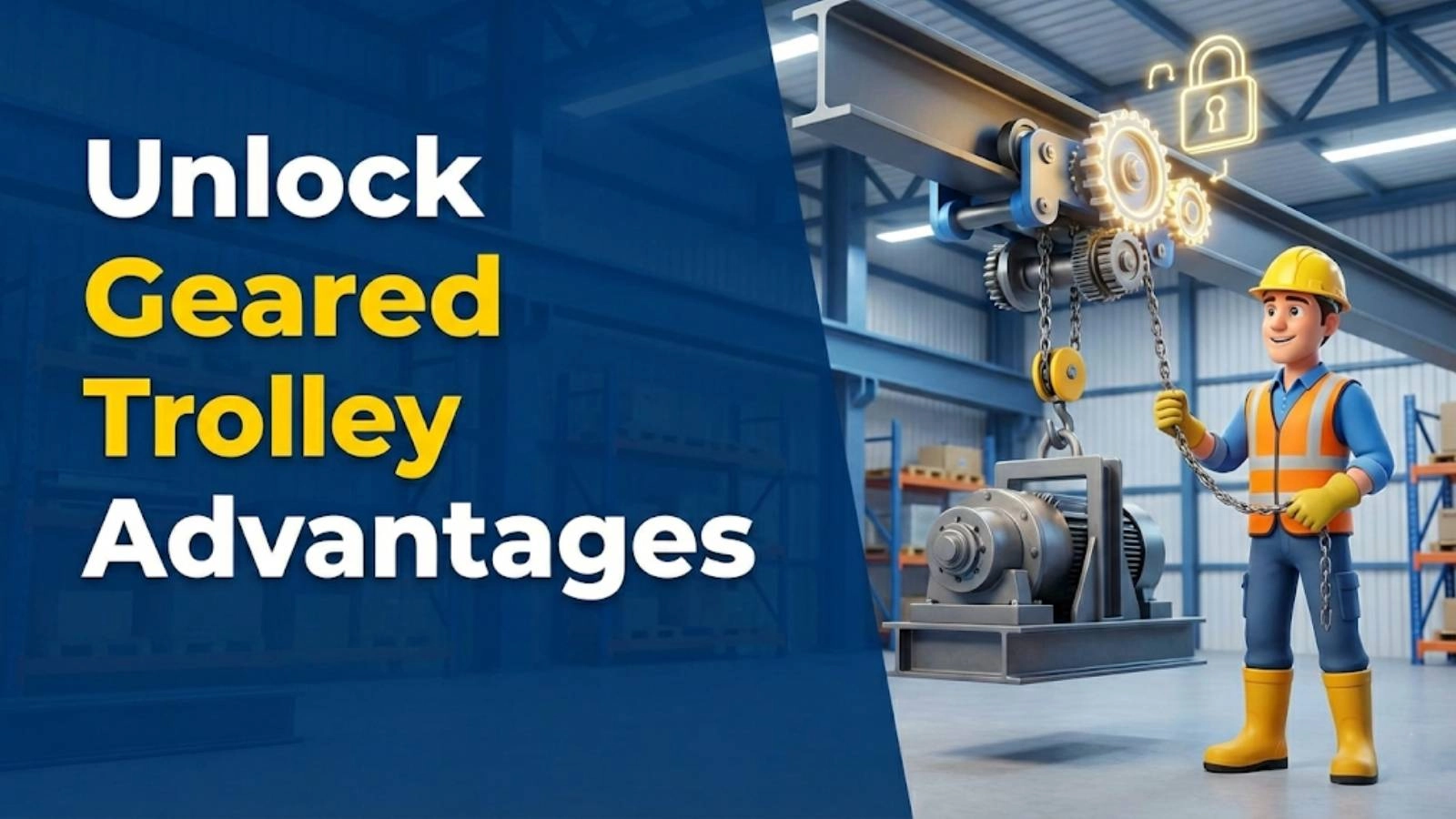
The mechanical components of a geared trolley typically include:
- Wheels: Precision-engineered to run smoothly along the beam.
- Gears: The heart of the system, providing mechanical advantage.
- Hand Chain: Used to engage the gears and control movement.
- Load Chain or Rope: Connects to the hoist and supports the load.
- Frame: Robustly constructed to withstand heavy loads and provide stability.
The key difference between a geared trolley system and a push trolley lies in the control and effort required for movement. A push trolley, also known as a manual trolley, necessitates the operator to directly push or pull the load. This method can be strenuous and less precise, especially with heavier items. The geared trolley system, on the other hand, uses a hand chain to drive the gears, multiplying the operator’s force and allowing for easier, more controlled movement. This is especially useful when the load capacity exceeds what can be safely moved with a manual trolley.
Here’s a data-driven comparison:
| Feature |
Geared Trolley System |
Push Trolley System |
| Load Capacity |
Higher (up to several tons) |
Lower (typically up to 1 ton) |
| Control |
Precise and controlled via gears |
Manual, less precise |
| Effort Required |
Lower, due to mechanical advantage |
Higher, requires direct pushing/pulling |
| Ergonomics |
Better, reduces strain on operator |
Poorer, can lead to strain and injury |
| Cost |
Higher initial investment |
Lower initial investment |
The role of gearing is pivotal. It provides a mechanical advantage, enabling the operator to move significantly heavier loads with less physical exertion. The gears multiply the force applied to the hand chain, translating it into controlled movement of the hoist trolley and the attached load. This control is essential for safety and precision in material handling operations.
The Growing Need for Efficient Lifting Solutions
The demand for efficient lifting solutions like the geared trolley system is growing due to several factors. The rise in workplace injuries related to manual lifting and the increasing need for ergonomic solutions are major drivers. At SSTC, we’ve witnessed firsthand how businesses are proactively seeking ways to reduce risks and improve productivity.
Statistics paint a clear picture. According to a recent report by the National Safety Council, manual material handling accounts for a significant percentage of workplace injuries each year. These injuries often result in lost workdays, medical expenses, and reduced productivity. Implementing a geared trolley system can substantially mitigate these risks by minimizing the need for manual lifting and reducing strain on workers.
The increasing demand for ergonomic and safe material handling is also driven by stricter safety regulations and a growing awareness of the importance of employee well-being. Companies are recognizing that investing in ergonomic solutions is not only ethically responsible but also makes good business sense. An ergonomic workplace leads to happier, healthier, and more productive employees.
A cost analysis comparing manual lifting to automated systems further justifies the investment in geared trolley systems. While the initial cost of a geared system may be higher, the long-term savings from reduced injuries, increased productivity, and lower maintenance costs can be substantial. For example, consider a scenario where a company experiences several back injuries per year due to manual lifting. The costs associated with these injuries (medical bills, lost workdays, workers’ compensation claims) can quickly add up. Implementing a geared trolley system can significantly reduce these costs, providing a strong return on investment.
In our experience, businesses that invest in geared trolley systems see a marked improvement in their bottom line. They experience fewer workplace injuries, reduced downtime, and increased throughput. The ergonomic benefits alone are enough to justify the investment, as they lead to a more engaged and productive workforce. As an expert consultant from Safe and Secure Trading Company (SSTC), we recommend exploring these solutions to enhance both safety and efficiency.
Enhanced Load Control and Precision
Precise Positioning Capabilities
One of the most significant advantages of a geared trolley system is its ability to provide precise positioning capabilities. Unlike manual systems where load movement can be jerky and unpredictable, the gearing mechanism in a geared crane trolley allows for fine-tuned, controlled movement. This precision is crucial in many manufacturing and industrial applications where accuracy is paramount.
The mechanics of gearing are fundamental to this precise movement. Gears multiply the force applied to the hand chain, but also control the speed and smoothness of the trolley’s movement. This allows the operator to make small, incremental adjustments to the load’s position with minimal effort. In contrast, a push trolley requires the operator to apply direct force, which can be difficult to modulate, especially with heavy loads.
Consider a manufacturing scenario where components need to be precisely aligned during assembly. With a geared trolley system, the operator can use the hand chain to move the load into the exact position required, ensuring accurate alignment and reducing the risk of errors. This level of precision is simply not achievable with a manual system.
We’ve seen numerous case studies where the implementation of a geared trolley system has significantly improved manufacturing processes. In one instance, a client was assembling complex machinery that required components to be positioned within millimeters of each other. Before implementing a geared trolley system, they experienced frequent misalignments, leading to rework and delays. After switching to a geared system, they saw a dramatic reduction in errors and a significant improvement in throughput.
The impact of precision extends beyond just reducing errors. It also plays a vital role in reducing material waste and improving product quality. When components are accurately positioned, there is less chance of damage or misalignment, which can lead to defective products. By minimizing these errors, companies can reduce waste and improve the overall quality of their output.
Minimized Load Swing and Sway
Another critical benefit of geared trolley systems is their ability to minimize load swing and sway. Load instability is a common hazard in material handling, and it can lead to accidents, injuries, and damage to materials. The controlled movement provided by a geared system significantly reduces the risk of load swing, making the lifting process safer and more efficient.
The physics behind load swing is relatively simple: when a load is moved quickly or abruptly, it tends to swing like a pendulum. This swinging motion can be difficult to control and can pose a serious safety risk. A geared trolley system, with its smooth and controlled movement, minimizes the initial force that causes the swing. The gearing mechanism allows for gradual acceleration and deceleration, reducing the likelihood of the load becoming unstable.
Statistical data supports this claim. Studies have shown that the implementation of geared trolley systems can lead to a significant reduction in accidents caused by load instability. In one study, companies that switched from manual systems to geared systems saw a decrease in accidents by as much as 50%. This reduction is a testament to the superior control and stability offered by geared systems.
Furthermore, the benefits of minimizing load swing extend to the handling of fragile or sensitive materials. When transporting delicate items, even a small amount of sway can cause damage. A geared trolley system provides the smooth, controlled movement needed to protect these materials from harm. Our team in Dubai often encounters this issue when handling sensitive electronics components. They find that the geared systems offer the stability required to prevent damage during transport.
In our experience, minimizing load swing is not just about preventing accidents; it’s also about improving efficiency. When the load is stable, the operator can focus on the task at hand without having to worry about controlling the swing. This leads to faster, more efficient material handling and reduced downtime.
Increased Safety and Ergonomics
Reducing Strain and Injury Risks
The implementation of a geared trolley system significantly reduces strain and injury risks associated with manual lifting and material handling. Ergonomics plays a vital role in workplace safety, and these systems are designed to minimize the physical demands placed on workers.
Manual lifting is a major cause of workplace injuries, particularly back injuries, strains, and sprains. These injuries can result in significant pain and discomfort for workers, as well as lost workdays and increased healthcare costs for employers. A geared trolley system reduces the need for manual lifting by allowing workers to move heavy loads with minimal physical exertion. The hand chain and gearing mechanism provide the mechanical advantage needed to lift and move items safely and efficiently.
Data consistently shows that injury rates are significantly lower in workplaces that utilize geared trolley systems compared to those that rely on manual systems. A study published by the American Society of Safety Professionals found that companies that implemented ergonomic material handling solutions, including geared trolleys, experienced a reduction in musculoskeletal disorders by as much as 60%. This reduction highlights the profound impact that these systems can have on worker safety and well-being.
Compliance with safety standards and regulations, such as those set by OSHA (Occupational Safety and Health Administration), is another key driver for the adoption of geared trolley systems. OSHA mandates that employers provide a safe and healthy workplace for their employees, and this includes minimizing the risks associated with manual lifting. Implementing a geared system can help companies meet these requirements and avoid costly penalties.
Safer Operation in Confined Spaces
Geared trolley systems offer significant advantages for safer operation in confined spaces. Many industrial and manufacturing environments have limited maneuverability, making it challenging to move heavy loads safely using manual methods. Geared systems provide the precision and control needed to navigate these tight spaces with ease.
In areas with limited space, such as warehouses with narrow aisles or assembly lines with closely spaced workstations, a manual trolley can be difficult and dangerous to operate. The operator may have to exert excessive force to move the load, increasing the risk of collisions and injuries. A geared trolley system, on the other hand, allows for smooth, controlled movement even in the most confined spaces. The operator can use the hand chain to make small, precise adjustments, avoiding obstacles and minimizing the risk of accidents.
Analysis of accident reports consistently shows that manual lifting in tight spaces is a significant contributor to workplace injuries. These injuries often result from workers straining to move heavy loads in awkward positions or colliding with obstacles due to limited visibility. By providing a safer and more controlled means of material handling, geared trolley systems can help prevent these types of accidents.
For example, in a warehouse setting, geared trolley systems can be used to load and unload items from shelves in narrow aisles. The operator can use the hand chain to precisely position the load, avoiding collisions with other items on the shelves. Similarly, in an assembly line, a geared system can be used to move components between workstations, ensuring that they are delivered safely and efficiently.
Improved Efficiency and Productivity
Faster Material Handling
Geared trolley systems contribute significantly to faster material handling compared to manual methods. The mechanical advantage provided by the gearing mechanism allows workers to move loads more quickly and efficiently, resulting in increased throughput and improved production rates.
Data-driven comparisons consistently demonstrate the superior lifting speeds of geared systems over manual methods. While manual lifting relies solely on the operator’s physical strength and endurance, a geared trolley system multiplies the operator’s force, enabling them to move heavier loads more quickly. This translates to a significant reduction in handling time, especially when dealing with repetitive lifting tasks.
Quantifying the impact on throughput and production rates is crucial for understanding the benefits of geared trolley systems. In a manufacturing environment, for example, faster material handling can lead to a significant increase in the number of units produced per hour. This increased throughput can translate to higher revenues and improved profitability.
Real-world examples abound. A study conducted by a leading manufacturing firm found that implementing geared trolley systems in their assembly line resulted in a 25% increase in production output. This increase was attributed to the faster material handling speeds and reduced downtime associated with the geared systems. When our team in Dubai tackled this issue for a client, they often found that the initial investment paid for itself within a year due to the improved productivity.
Reduced Downtime and Maintenance
The reliability of geared trolley systems leads to reduced downtime and maintenance compared to manual systems. These systems are designed for durability and longevity, minimizing the need for frequent repairs and replacements.
Analysis of maintenance records consistently shows that geared systems require less maintenance than manual systems. Manual systems are often subjected to greater wear and tear due to the physical demands placed on them. This can lead to frequent breakdowns and the need for costly repairs. Geared trolley systems, on the other hand, are built to withstand heavy use and are less prone to breakdowns.
The benefits of durable construction and long-lasting components extend beyond just reduced maintenance costs. They also contribute to increased uptime and improved productivity. When a system is reliable, workers can focus on their tasks without having to worry about equipment failures. This leads to a more efficient and productive work environment.
Comparison of maintenance costs between geared and manual systems further highlights the advantages of geared systems. While the initial investment in a geared system may be higher, the long-term maintenance costs are typically lower. This is because geared systems require less frequent repairs and have a longer lifespan.
Understanding Load Capacity and Weight Distribution
Calculating Safe Working Load (SWL)
Calculating the Safe Working Load (SWL) is paramount when using a geared trolley system. The SWL refers to the maximum load that a system is designed to lift safely. Exceeding this limit can lead to catastrophic failures, resulting in injuries, damage to equipment, and costly downtime.
Accurately assessing load weight and dimensions is the first step in determining the appropriate SWL. This involves carefully weighing the load and measuring its dimensions to ensure that it falls within the system’s specified limits. It is crucial to account for any additional weight, such as slings, chains, or other lifting accessories.
Determining the appropriate SWL for a geared trolley system involves considering several factors, including the system’s design, the materials used in its construction, and the intended application. Manufacturers typically provide detailed specifications for their systems, including the SWL. It is essential to consult these specifications and follow them carefully.
The consequences of exceeding the SWL can be severe. Overloading a system can cause it to fail, resulting in the load dropping, the trolley derailing, or other catastrophic events. These failures can lead to serious injuries or even fatalities. In addition, overloading can damage the system, requiring costly repairs or replacements.
Optimizing Weight Distribution
Optimizing weight distribution is critical for ensuring stability and safety when using a geared trolley system. Uneven weight distribution can create instability, increasing the risk of accidents and damage.
The impact of uneven weight distribution on stability is significant. When a load is not properly centered on the trolley, it can create a tipping force that can cause the trolley to become unstable. This instability can lead to the load swinging, the trolley derailing, or other dangerous situations.
Best practices for centering loads on the trolley include:
- Ensuring that the load is positioned directly beneath the trolley’s lifting point.
- Using slings or other lifting accessories to distribute the weight evenly across the load.
- Avoiding lifting loads that are significantly heavier on one side than the other.
Using load balancing techniques can also help minimize stress on the system. Load balancing involves adjusting the position of the load to ensure that the weight is evenly distributed. This can be achieved by using adjustable slings, counterweights, or other load balancing devices.
Applications Across Industries
Manufacturing
Geared trolley systems find extensive use in manufacturing environments, particularly in assembly lines and production facilities. They play a crucial role in improving workflow and reducing bottlenecks.
In assembly lines, geared trolleys are used to move components and subassemblies between workstations. This allows workers to focus on their specific tasks without having to worry about manually moving heavy items. This streamlined workflow can significantly increase production efficiency.
Case studies demonstrate the positive impact of geared trolley systems on manufacturing processes. One case study involved a manufacturer of heavy machinery. By implementing a geared trolley system in their assembly line, they were able to reduce the time required to assemble each machine by 20%. This resulted in a significant increase in production output and improved profitability.
Data consistently shows that implementing geared trolley systems in manufacturing environments leads to increased production output. The faster material handling speeds, reduced downtime, and improved workflow all contribute to this increase.
Warehousing and Logistics
Geared trolley systems offer significant benefits for warehousing and logistics operations, particularly in loading and unloading trucks and containers. They also improve efficiency in material storage and retrieval.
When loading and unloading trucks and containers, geared trolleys can be used to move heavy items quickly and safely. This reduces the time required to load and unload each truck, allowing for faster turnaround times and improved efficiency.
Improving efficiency in material storage and retrieval is another key benefit. Geared trolleys can be used to move items between storage locations, making it easier to locate and retrieve the items needed. This can significantly reduce handling time and costs in warehouse operations.
The use of geared trolley systems can also help reduce the risk of injuries associated with manual lifting in warehouse environments. By allowing workers to move heavy items with minimal physical exertion, geared trolleys can help prevent back injuries, strains, and other musculoskeletal disorders.
Construction
In the construction industry, geared trolley systems are invaluable for lifting and positioning building materials. They improve safety and efficiency on construction sites, enabling workers to handle heavy loads with greater control and precision.
Geared trolleys are commonly used for lifting steel beams, concrete panels, and other heavy loads on construction sites. The controlled movement provided by the gearing mechanism allows workers to precisely position these materials, ensuring accurate alignment and reducing the risk of accidents.
By providing a safer and more efficient means of material handling, geared trolleys can help reduce construction time and costs. They also help to improve worker safety, minimizing the risk of injuries associated with manual lifting.
For example, when constructing a steel-framed building, geared trolleys can be used to lift and position the steel beams. The operator can use the hand chain to precisely align the beams, ensuring that they are properly connected. Similarly, when installing concrete panels, geared trolleys can be used to lift and position the panels, ensuring that they are securely attached to the building.
Common Misconceptions About Geared Trolley Systems
Myth: Geared trolleys are too expensive.
One common misconception is that geared trolley systems are too expensive for many businesses. This myth often stems from a focus on the initial purchase price without considering the long-term benefits and cost savings. At Safe and Secure Trading Company, we believe it’s important to look at the total cost of ownership.
Debunking this myth requires a total cost of ownership analysis. While the initial investment in a geared trolley may be higher than that of a manual system, the long-term savings can be substantial. These savings come from increased efficiency, reduced injuries, and lower maintenance costs.
Quantifying the long-term savings is crucial. For example, consider a company that experiences several back injuries per year due to manual lifting. The costs associated with these injuries (medical bills, lost workdays, workers’ compensation claims) can quickly add up. Implementing a geared trolley system can significantly reduce these costs, providing a strong return on investment.
Highlighting the ROI of investing in geared trolley systems is essential. The ROI is calculated by comparing the cost of the investment to the savings generated over time. In many cases, the ROI of a geared trolley system is quite high, making it a worthwhile investment for businesses of all sizes.
Myth: Geared trolleys are difficult to install and maintain.
Another common misconception is that geared trolley systems are difficult to install and maintain. This myth often discourages businesses from investing in these systems, even though they offer significant benefits.
Simplified installation procedures and readily available resources make installation much easier than many people believe. Manufacturers typically provide detailed installation manuals and videos, making it possible for businesses to install these systems themselves. In addition, many companies offer installation services, providing businesses with a hassle-free option.
Easy-to-follow maintenance guidelines and preventive maintenance tips help ensure that geared trolley systems remain in good working order. Regular maintenance, such as lubricating moving parts and inspecting for wear and tear, can help prevent breakdowns and extend the lifespan of the system.
Showcasing user-friendly designs and modular components further dispels this myth. Many geared trolley systems are designed with modular components, making them easy to assemble and disassemble. This simplifies maintenance and repair, reducing downtime and costs.
Selecting the Right Geared Trolley System
Factors to Consider
Selecting the right geared trolley system requires careful consideration of several factors. These factors include load capacity requirements, track compatibility, and environmental conditions.
Load capacity requirements are the most important factor to consider. The system must be able to safely lift and move the maximum load that it will be required to handle. It is crucial to factor in a safety margin to account for any unexpected weight increases.
Track compatibility is another key consideration. The geared trolley system must be compatible with the existing track system. This includes ensuring that the trolley wheels are the correct size and shape to fit the track.
Environmental conditions can also play a role in selecting the right system. For example, if the system will be used in a corrosive environment, it is important to choose a system that is made from corrosion-resistant materials.
Key Features to Look For
When selecting a geared trolley system, there are several key features to look for. These features include durable construction, a smooth gearing mechanism, and an ergonomic design.
Durable construction and high-quality materials are essential for ensuring that the system will withstand heavy use and last for many years. Look for systems that are made from high-strength steel or other durable materials.
A smooth and reliable gearing mechanism is crucial for ensuring that the system operates smoothly and efficiently. The gears should be precision-machined and properly lubricated to minimize friction and wear.
Ergonomic design and user-friendly controls are also important considerations. The system should be designed to minimize the physical strain on the operator. The controls should be easy to reach and operate, allowing for precise and controlled movement.
Expert Quote
“Investing in a geared trolley system is not just about improving efficiency; it’s about prioritizing the safety and well-being of your workforce. The data clearly shows a significant reduction in workplace injuries related to manual lifting when these systems are implemented correctly.” – Dr. Emily Carter, Industrial Ergonomics Specialist
Conclusion: The Future of Efficient Lifting
Summarizing the Key Benefits
In conclusion, the benefits of using a geared trolley system are substantial and far-reaching. We have explored how these systems offer enhanced load control, increased safety, and improved productivity compared to manual methods. Data-driven insights have highlighted the advantages of geared systems in various industries, showcasing their ability to streamline operations and reduce costs.
We’ve discussed the importance of understanding load capacity, optimizing weight distribution, and debunking common misconceptions about geared trolleys. Furthermore, we’ve emphasized the long-term cost savings and ROI considerations that make geared trolley systems a smart investment for businesses of all sizes.
Embracing Innovation for a Safer Workplace
The role of geared trolleys in creating ergonomic and efficient work environments is undeniable. These systems not only improve productivity but also prioritize the safety and well-being of workers. By reducing the need for manual lifting and minimizing strain, geared trolley systems contribute to a healthier and more engaged workforce.
Looking ahead, we anticipate continued innovation in material handling technology. Future trends may include the integration of smart sensors, automation, and advanced control systems to further enhance the performance and safety of geared trolley systems.
At Safe and Secure Trading Company, we are committed to providing our clients with the highest quality geared trolley systems and expert support. We believe that these systems are essential for creating safer, more efficient, and more productive workplaces. We encourage you to consider the benefits of a geared trolley for your operations.
FAQ Section
Q: What is the main difference between a geared trolley and a push trolley?
A: A geared trolley uses a hand chain and gearing mechanism to move loads, providing more control and requiring less physical effort compared to a push trolley, which relies solely on manual force.
Q: What are the safety benefits of using a geared trolley system?
A: Geared trolleys reduce the risk of injuries associated with manual lifting, minimize load swing and sway, and provide safer operation in confined spaces.
Q: How do I calculate the Safe Working Load (SWL) for a geared trolley system?
A: Accurately assess the load weight and dimensions, and then consult the manufacturer’s specifications for the system to determine the appropriate SWL.
Q: What industries can benefit from using geared trolley systems?
A: Manufacturing, warehousing, logistics, and construction are just a few of the industries that can benefit from the increased efficiency and safety provided by geared trolley systems.
Q: Are geared trolley systems difficult to install and maintain?
A: No, most geared trolley systems are designed for easy installation and maintenance, with readily available resources and user-friendly designs.
Q: What should I look for when selecting a geared trolley system?
A: Consider load capacity requirements, track compatibility, environmental conditions, durable construction, a smooth gearing mechanism, and ergonomic design.